Why Wimbledon Gave Serena and Venus a Doubles Wild Card, Not a Blank Check
Wimbledon confirmed on June 16, 2026 that Serena and Venus Williams will enter the ladies' doubles draw as wild cards. The sharper read is what the All England Club did not do: it made room for the sisters' partnership without turning the entire tournament into a nostalgia exception.
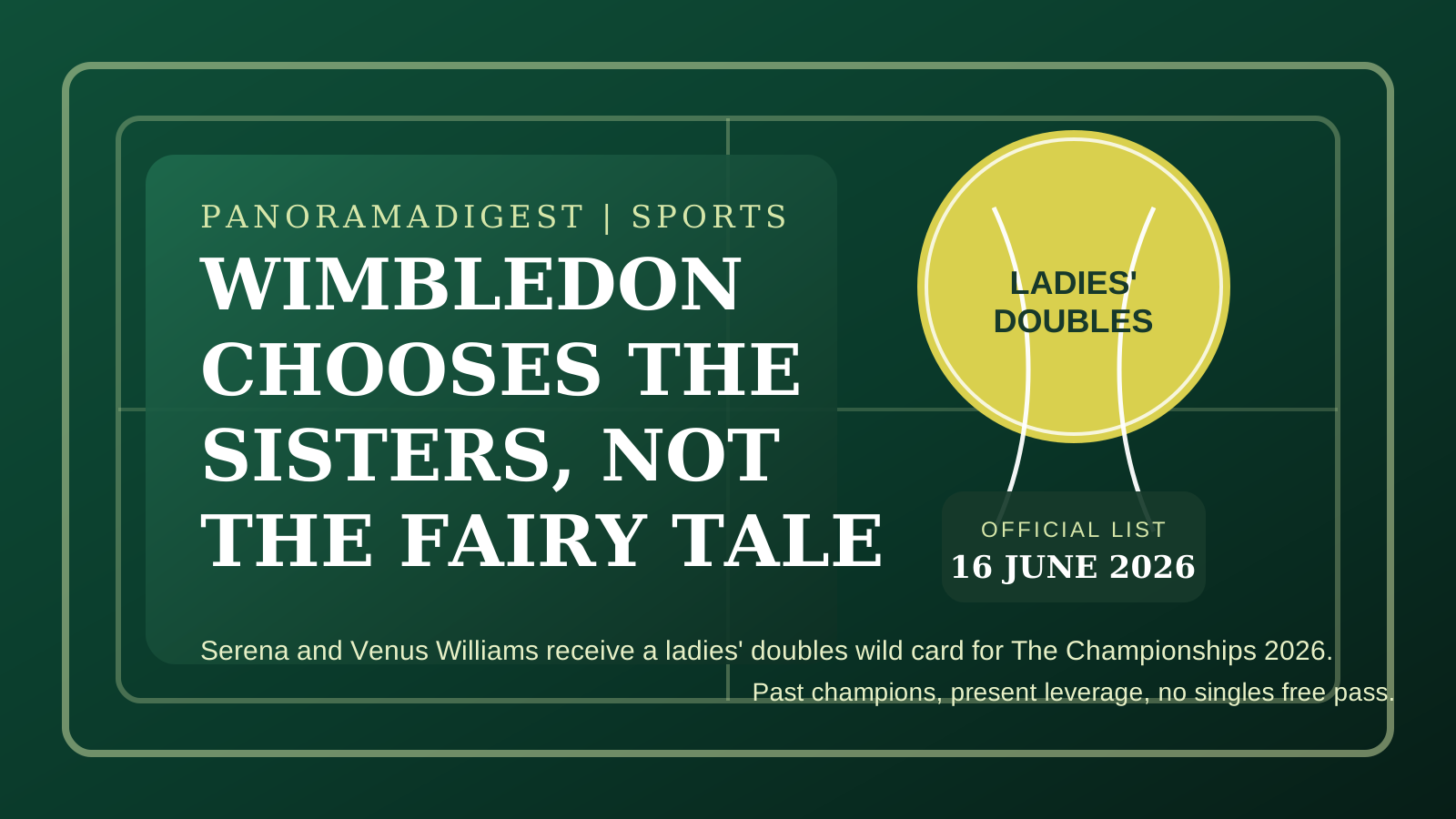
The official fact landed on Tuesday, June 16, 2026, in plain tournament language. Wimbledon's wild-card page and the initial wild-card announcement PDF put Serena Williams and Venus Williams into the ladies' doubles field for The Championships 2026. For readers searching the headline, that is the answer. For tennis, the more interesting answer is what the All England Club did not do. It did not hand either sister a singles invitation. It chose the partnership, not a blanket comeback story.
Wimbledon / Instagram — The initial wild cards for The Championships 2026 have been announced
Wimbledon's official Instagram post confirms the initial 2026 wild cards, including Serena and Venus Williams in ladies' doubles. Open the direct Instagram link in the story if the embed does not render.
That distinction matters because Wimbledon itself explains that wild cards are usually offered either for past performance at the tournament or to increase British interest. The Williams sisters obviously bring the first logic in overwhelming quantity and the second in a different modern form: global attention, live intrigue and a rare chance to turn doubles into appointment viewing. But the committee still showed discipline. The ladies' singles list published the same morning was built around active tour needs and British development. The sisters appeared only where their shared legacy is most specific and most defensible.
| What Wimbledon confirmed on June 16 | What it did not confirm | Why the difference matters |
|---|---|---|
| Serena and Venus Williams received a ladies' doubles wild card | No singles wild card for either sister in the initial announcement | The tournament is inviting a partnership, not staging a full ceremonial override of the singles field. |
| The invitation was published in the official 2026 wild-card list | No guaranteed seeding protection or special route through the draw | The sisters get entry, but not insulation from the normal hazards of a major bracket. |
| Wimbledon again leaned on past performance when it used discretion | No public claim that nostalgia alone drove the decision | The All England Club can defend the move on sporting history, not just promotional appetite. |
| The decision arrived less than two weeks before the main draw | No assurance yet about how deep the comeback run can go physically | The story is now about match fitness and pairing rhythm, not just announcement theater. |
Why the doubles lane is the smart one
The sisters are not being invited into some abstract Hall of Fame exhibit. They are being placed in the event that best matches their shared authority at this venue. Serena and Venus won six Wimbledon doubles titles together, and Wimbledon's own history pages already treat them as part of the place's permanent architecture. A ladies' doubles wild card therefore looks less like indulgence than category precision. If the committee was going to make room anywhere, this was the cleanest and least arguable place to do it.
The timing also matters. AP's June 16 report noted that the All England Club announced the invitation with the tournament starting in less than two weeks. That compresses the romance. There is no long runway here for myth-building. The decision asks a more practical question: if Serena's return to competitive tennis is real, and if Venus can still compete in high-value bursts, where does the pairing make the most immediate sense? Wimbledon answered by choosing the one format where the sisters' old chemistry is not merely historical trivia. It is still a plausible competitive asset.
- June 5-9, 2026: Serena Williams' return moved from rumor to grass-court reality when she entered doubles at Queen's Club with Victoria Mboko.
- June 11, 2026: that comeback pairing stopped early when Mboko withdrew because of a knee injury, shrinking the short-term route back into competition.
- June 16, 2026, 10:41 a.m. local time: Wimbledon's official wild-card document listed Serena and Venus together in ladies' doubles.
- What comes next: the real story shifts from nostalgia to draw position, physical readiness and whether one of sport's most famous partnerships can still solve modern match problems.
Serena's comeback needed a shape. Venus gave it one.
That is the broader strategic value of this announcement. Serena's recent return had already made tennis feel suddenly porous again, as if a chapter many people assumed was closed had been left on the desk half-open. But the comeback still needed a form readers could understand. A one-off appearance with a younger partner at Queen's was intriguing, yet provisional. The Wimbledon invitation with Venus gives the return a cleaner narrative and a more coherent sporting frame. It reconnects Serena not only to elite tennis, but to the specific partnership that made doubles feel, for years, like an annex of Williams family power.
Fans tend to talk about reunion stories as emotion first and mechanics second. Elite tournaments do the opposite. They ask what kind of entry produces real stakes without distorting the entire event. Serena with Venus in doubles satisfies both sides. It gives the sport its biggest family memory lane without forcing officials to explain a singles shortcut that would have looked much harder to defend on current form alone.
Wimbledon is betting on memory, but only where memory still has teeth
That is why the announcement reads as sharper than a publicity stunt. Memory is part of the value, obviously. A sisters pairing with a combined age of 90 guarantees attention. It also guarantees the sport a short burst of old-language electricity: Centre Court, white clothing, the Williams surname, and the feeling that an era can briefly be restarted. But the committee confined that nostalgia to a draw where experience, positioning, communication and reflex trust can still matter as much as week-to-week ranking logic.
In other words, Wimbledon used discretion without abandoning standards. That is harder than it looks. Major tournaments constantly have to decide whether their invitations honor competition or merely flatter attention. This one mostly clears the test because the sisters' doubles history is specific, measurable and directly relevant to the format they were chosen for. The move may be glamorous, but it is not random.
What to watch now
Three questions matter from here. First, how much real grass-court sharpness does Serena have after the stop-start shape of her return? Second, how much match rhythm can Venus supply if the pair gets a difficult opener? Third, can the sisters turn a ceremonial entry into a dangerous short-format team before the bracket's younger full-time pairs stretch the match into repetition and recovery?
The June 16 decision does not answer any of that. It does something subtler. It tells readers that Wimbledon wanted the Williams sisters back, but only on terms the tournament could justify with a straight face. That is why this wild card is interesting. It is generous without being lawless. It gives tennis one of its richest old partnerships another stage, while quietly insisting that the stage is doubles and not everything else.
If the official Wimbledon post below does not render in your browser, use the direct Instagram link at instagram.com/p/DZpJMreFRK1 or the official Wimbledon wild-card page.
Read Next
Related Stories

FIFA Drops $20 Billion World Cup Equity Plan as UEFA Withdraws Confidence in Infantino
FIFA withdrew its $20 billion World Cup equity plan after opposition across three confederations. UEFA's no-confidence statement now shifts the dispute to Infantino's 2027 election.

Nirmal Purja Dies in Broad Peak Avalanche: His Verified Climbing Records
Elite Exped has confirmed that Nirmal Purja died after the Broad Peak avalanche. Here is the verified rescue timeline and the record evidence behind his climbing legacy.

FIFA Proposes $20 Billion Commercial Company to Raise $4.2 Billion for Member Funding
FIFA wants to place commercial rights and tournament operations in a new company valued initially at $20 billion, then sell minority stakes to finance expanded member-association funding.