Trump's Education Reshuffle Tests Whether Disability Rights Can Survive a Bureaucratic Split
The Trump administration says June 16's Education Department partnerships will preserve civil-rights and disability protections. The real question is whether families will still find the same expertise, speed and accountability when the work is scattered across agencies.
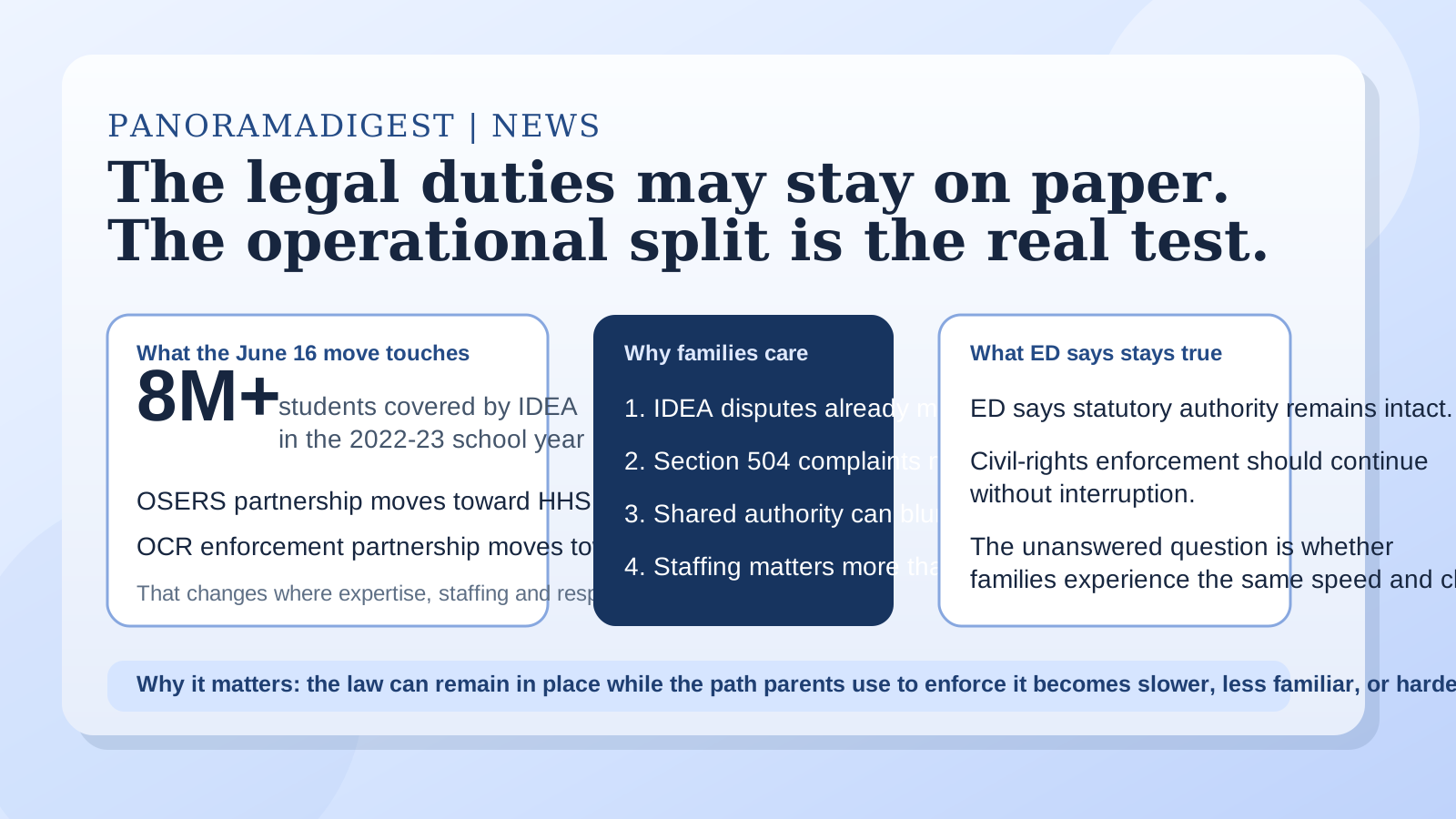
On Tuesday, June 16, 2026, the Trump administration announced a new shuffle inside the federal education apparatus that is easy to describe as bureaucratic and much harder to live with as a parent. The Education Department said it will partner with the Department of Health and Human Services on special education and rehabilitative services, while the Department of Justice will partner with Education on civil-rights enforcement, student privacy protection and training. In official language, the move is meant to reduce bureaucracy and improve delivery. In practical language, it asks families to trust that rights will feel just as real after the machinery behind them is spread across multiple agencies. The Education Department's own announcement frames the change as an efficiency play. AP's reporting and NPR's account make clear why critics see something more disruptive.
The cleanest way to understand this decision is to separate legal authority from lived enforcement. The administration insists the federal obligations remain. That may be true on paper. But families do not experience rights on paper. They experience them through response times, investigators, case handlers, guidance letters, technical expertise and the simple question of whether someone who understands school systems answers the phone when a district fails a child.
| Function | New partner | Why it matters |
|---|---|---|
| Office of Special Education and Rehabilitative Services | Health and Human Services | IDEA programs govern services for more than 8 million children and students with disabilities, plus early-intervention supports for infants and toddlers. |
| Office for Civil Rights work on education complaints | Justice Department partnership | Students and families rely on these channels when disability, race, sex or national-origin discrimination affects access to school. |
| Student privacy guidance and enforcement support | Justice Department partnership | That pulls another education-facing function toward a law-enforcement agency whose daily work is broader than schools. |
The administration is betting that coordination can substitute for proximity
The official case rests on specialization. Education says HHS is better positioned to support disability-related programming and that DOJ can help strengthen civil-rights enforcement. There is a logic there. HHS is a health-and-services giant. DOJ is the federal government's most powerful legal enforcement arm. But specialization is not the same thing as educational proximity. School disputes are rarely abstract civil-rights puzzles. They are intensely procedural, local and time-sensitive. They involve school calendars, individualized education programs, district records, parent meetings, transportation arrangements, staffing shortages and the difference between what a district promised and what a child actually received on Monday morning.
The federal IDEA page says the law guarantees a free appropriate public education for eligible children with disabilities and that it governs services for more than 8 million young people. That same federal guidance also clarifies an important distinction: the Office for Civil Rights does not enforce IDEA itself, but it does enforce Section 504 and shares enforcement of Title II disability protections with DOJ. That means the June 16 announcement is not simply moving one neat box from one shelf to another. It is rearranging the relationship among overlapping disability-rights pathways that families already find difficult to navigate.
Why this matters beyond Washington language
If a school district delays services, mishandles accommodations or lets discrimination harden into routine, parents do not care which cabinet secretary won the org-chart fight. They care whether a complaint reaches people who understand schools and whether the federal answer arrives before another semester slips away. The administration says civil-rights enforcement will continue without interruption. That promise deserves to be measured less by the wording of a press release than by what happens next: staffing continuity, complaint timelines, public guidance and whether state and local educators receive clear instructions instead of institutional shrugging.
There is also a political tell here. The Trump administration continues to treat federal institutions as things that can be hollowed out, rebranded and partially outsourced while leaving supporters to argue that nothing essential changed because the legal text still exists. PanoramaDigest saw a version of that same governing style in another recent administration dispute over powers that seemed broader in public than they did under scrutiny. The pattern matters because families dealing with schools do not have the luxury of waiting for constitutional theory to settle. They need durable points of contact.
What to watch after June 16
- Whether Education, HHS and DOJ publish detailed operating rules rather than slogans about partnership.
- Whether current case handlers and disability-policy specialists actually move with the work or disappear into attrition and delay.
- Whether complaint backlogs grow for Section 504, ADA and related education cases.
- Whether Congress, states or litigation force a clearer boundary between what remains at Education and what is effectively being run elsewhere.
The fairest reading tonight is narrow but serious. The administration has not repealed IDEA. It has not announced the end of federal civil-rights enforcement in schools. What it has done is create a new test of whether those rights can survive an institutional split without becoming slower, blurrier and harder for families to use. That is not a secondary administrative question. It is the story.
Read Next
Related Stories

Old Trails Fire Damage Estimate Reaches 640 Structures in Spokane
Spokane County's preliminary estimate says the Old Trails fire destroyed 640 structures, while evacuation zones remain active across northwest Spokane.

USCIS Can Now Refer Asylum Cases to Immigration Court Without an Interview
A DHS rule effective July 28 lets USCIS send some affirmative asylum applications directly to immigration court. Referral is not a denial, but the interview is no longer guaranteed.

Seattle Center Shooting Kills Three and Injures Four at Bite of Seattle Festival
Seattle police say a shooting at the Bite of Seattle festival killed three people and injured four others, including a 2-year-old boy. One suspect was arrested and police continued searching for another.