The L.A. Zoo's Grand Jury Warning Is Really About Whether City Hall Can Run a Modern Zoo
A new Los Angeles civil grand jury report says the zoo's problem is no longer just aging exhibits or a donor dispute. It is whether a city department can still finance, repair and modernize a major zoo at all.
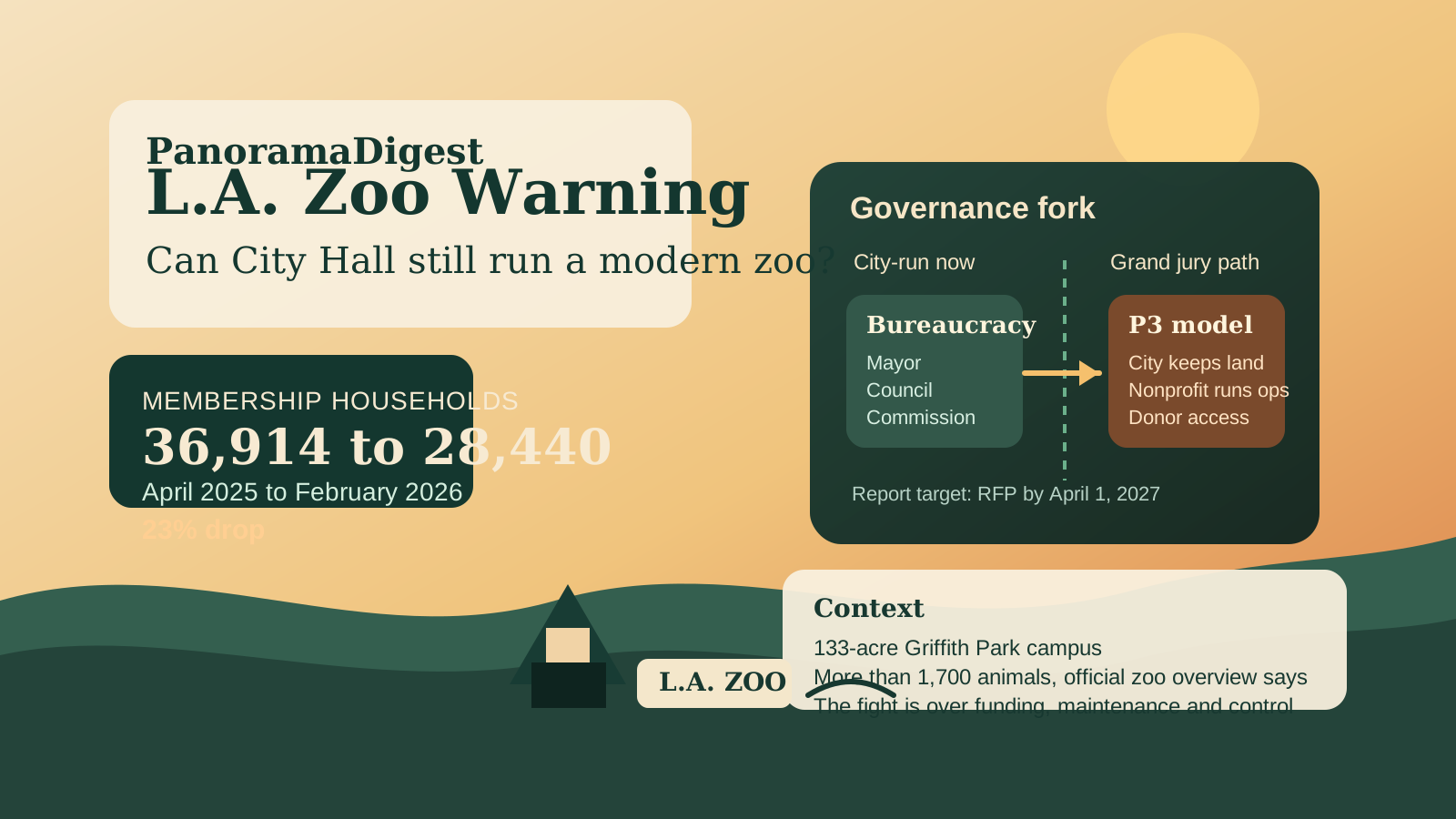
The new Los Angeles County civil grand jury report lands with a blunt premise: the L.A. Zoo is not failing because Angelenos suddenly stopped caring about it. It is failing because a 133-acre institution with aging exhibits, conservation obligations and expensive animal-care needs is being asked to behave like an ordinary city department at the exact moment City Hall is running out of fiscal slack. The Los Angeles Times' June 16 report distilled the immediate headline: the jury wants Los Angeles to move toward a public-private model. But the sharper signal is structural. The question is no longer whether the zoo needs a better fundraising year. The question is whether the city's current governance model can still support a modern zoo before decline becomes the story visitors feel in every closed exhibit and deferred repair.
That makes this more than a local culture item. The zoo's own official overview describes a site with more than 1,700 animals, more than 1.5 million annual visitors and a civic role that spans education, recreation and conservation. Those are big-system responsibilities. The grand jury argues that the city-run structure now moves too slowly, attracts too little philanthropic capital and carries too much bureaucratic drag to keep pace with those responsibilities. That is a governance warning disguised as an animal-park story.
The numbers in the report are less dramatic than the direction they point
The grand jury's most arresting statistic is not exotic or theatrical. It is membership. The report says membership households fell from 36,914 in April 2025 to 28,440 in February 2026, a 23% decline in less than a year. On its own, that does not prove institutional collapse. Zoos live with weather swings, tourism swings and post-pandemic attendance distortion. But in a budget environment where the city is already squeezing multiple services, a membership slide matters because it narrows the pool of flexible revenue precisely when deferred maintenance and exhibit modernization need more, not less, money.
The report also argues the zoo's campus looks tired in ways visitors can detect long before accountants finish a spreadsheet: old signs, worn hardscape, exhibits showing long service, and repairs that happen on a triage basis rather than on a reliable schedule. That matches the broader continuity here. The 2018 review by then-City Controller Ron Galperin had already warned that the zoo's shared governance arrangement with the Greater Los Angeles Zoo Association had grown cumbersome and that Los Angeles should explore a new organizational model. Eight years later, the grand jury is not inventing a crisis from scratch. It is effectively saying the older warning was never resolved.
| Pressure point | What the sources show | Why it matters now |
|---|---|---|
| Membership revenue | Grand jury report says households fell from 36,914 to 28,440 in under a year. | Less flexible revenue means less room to absorb repairs, programming and capital needs. |
| Governance | Grand jury and 2018 controller review both say the structure is too cumbersome. | Slow decision-making becomes more dangerous when the city is also short on money. |
| Infrastructure | Report describes worn exhibits, obsolete signage and no dependable repair schedule. | Visitors experience decline physically, not just in budget documents. |
| Fundraising | The report says government ownership makes major-donor cultivation harder. | A zoo needing long-term capital cannot rely on municipal improvisation forever. |
The real conflict is not public versus private. It is mission versus machinery.
That distinction matters. A lot of public institutions get trapped in lazy arguments about privatization that skip over the harder administrative question: what arrangement actually protects the mission? The grand jury does not recommend selling Griffith Park land or abandoning public oversight. It proposes a public-private partnership in which the city keeps ownership while a nonprofit-backed operator helps run and fund the institution. The report points to other Southern California cultural organizations that already use versions of that model. Its logic is straightforward: if government cycles are too rigid to support a capital-hungry zoo, keep the public stake but change the operating shell.
That idea will make people nervous for understandable reasons. Zoos are not interchangeable entertainment venues. Animal care, labor, procurement, accreditation and exhibit planning all carry real risk if a transition is rushed or politically staged. The report acknowledges that, which is why its timeline starts with an expert-led request-for-proposals process and a transition team rather than a flashy overnight handoff. Even the June 16 Zoo Commission agenda shows how embedded the institution already is inside city oversight layers. A governance change would not be simple. But complexity is not an argument for preserving a structure that multiple public reviews keep describing as misaligned with the job.
- April 25, 2018: the city controller's review said the zoo's governance arrangement had become cumbersome and recommended exploring a different organizational model.
- 2023: city officials advanced long-term renovation planning, but the larger operating question remained unresolved.
- 2025 to early 2026: membership slid sharply while litigation with GLAZA and city budget strain narrowed the room for easy fixes.
- June 2026: the civil grand jury concluded that a city-department structure no longer offers the flexibility or donor path the zoo needs.
What readers should watch next
The most important date in the report is not about an exhibit opening. It is April 1, 2027, when the jury says the mayor's office and zoo director should have an RFP ready for a governance-transition expert. If City Hall treats that like another memo-writing exercise, the recommendation will fade into the long archive of Los Angeles reports that identified a problem but never changed the operating habit behind it. If officials move, the next fight will center on labor protections, nonprofit accountability, donor influence and who gets to define success beyond attendance.
Readers should also be careful about one common misunderstanding. This is not a story about whether Los Angeles deserves a zoo. It plainly does. The official zoo site still presents a mission that is civic, educational and conservation-focused, and the grand jury explicitly says closing the institution is not a realistic solution. The argument is narrower and more consequential than that: can Los Angeles preserve public purpose while abandoning a city-run format that now appears too brittle for the mission it is supposed to protect?
That is why the report deserves more than a one-day burst of local indignation. The most serious public warnings are often the ones that sound administrative instead of dramatic. This one is telling Angelenos that the risk is not merely embarrassment. It is drift: a respected institution kept alive, but not renewed, until visitors and donors alike start behaving as if its best version belongs to the past.
Reader note: The primary documents worth reading are the 2025-26 civil grand jury report, the zoo's official overview, the Zoo Commission page, and the 2018 controller review.
Reader Sentiment & Impact Pulse
How do you evaluate the primary outcome of this development?
Select an option to cast your perspective. Responses are anonymous and aggregated in real time.
Key Context & Frequently Asked Questions
A new Los Angeles civil grand jury report says the zoo's problem is no longer just aging exhibits or a donor dispute. It is whether a city department can still finance, repair and modernize a major zoo at all. This analysis from PanoramaDigest examines primary documentation, operational implications, and broader institutional impacts across news.
Read Next
Related Stories

Jensen Huang Reframed AI Doom Debate as National Opportunity in Discourse With Donald Trump
Nvidia CEO Jensen Huang addressed existential AI fears during conversations with Donald Trump, advocating for American leadership and innovation over restrictive regulatory caution.
Old Trails Fire Damage Estimate Reaches 640 Structures in Spokane
Spokane County's preliminary estimate says the Old Trails fire destroyed 640 structures, while evacuation zones remain active across northwest Spokane.

USCIS Can Now Refer Asylum Cases to Immigration Court Without an Interview
A DHS rule effective July 28 lets USCIS send some affirmative asylum applications directly to immigration court. Referral is not a denial, but the interview is no longer guaranteed.