21st Century ROAD to Housing Act Is Now Law. What Changes for Buyers, Renters and Builders.
The 21st Century ROAD to Housing Act became law on July 11, 2026, after President Donald Trump declined to sign it. The package is broad and consequential, but it is designed to speed supply, expand financing and limit some investor competition, not to cut monthly housing costs overnight.
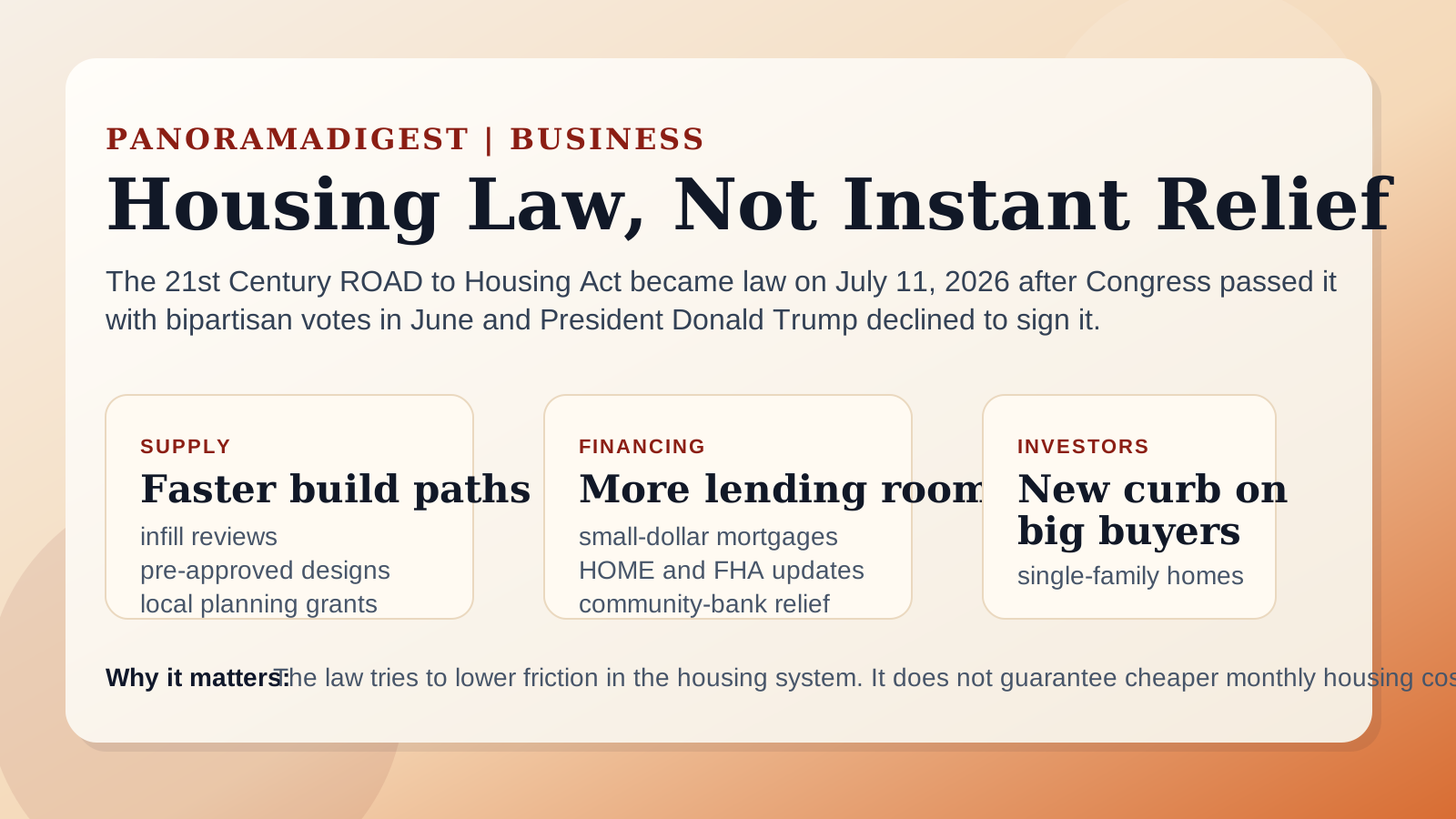
The 21st Century ROAD to Housing Act became law just after midnight on July 11, 2026, after President Donald Trump chose not to sign it. For buyers, renters and builders, the short version is simple: this is a supply-and-rules law, not an instant-price-cut law. It gives HUD, FHA, local governments and community lenders new tools to speed construction, widen financing and curb some large-investor competition, but it will not make a mortgage cheaper next week or an apartment cheaper next month.
CBS News — Bipartisan housing bill set to take effect despite Trump's refusal to sign
CBS News' same-day explainer on the 21st Century ROAD to Housing Act taking effect after President Donald Trump declined to sign it.
That distinction matters because the housing debate has been collapsing two different questions into one. One question is whether Washington can help more homes get built and financed. The other is whether a federal statute can reverse years of high borrowing costs and local shortage politics on command. The votes on June 22 in the Senate, 85-5, and June 23 in the House, 358-32, answered the first question. The market will answer the second much more slowly.
That is also why this new law fits better as a follow-up to PanoramaDigest's June 23 analysis of the Senate package than as a victory-lap headline. The legislative core did not suddenly change at midnight. What changed is status. The bill is now enacted, which means agencies, lenders and local governments can move from lobbying and messaging into rule-writing, guidance and implementation.
What the law changes now
The House Financial Services Committee's section-by-section summary and one-page overview make clear that the package is trying to attack housing friction from several angles at once.
| Area | What the law does | Why it matters |
|---|---|---|
| Construction speed | Creates or expands faster paths for infill reviews, pre-approved home designs, local planning help and housing-oriented grant incentives. | Projects that stall in paperwork or local process may have a clearer path to construction. |
| Affordable financing | Adds a small-dollar mortgage pilot, updates appraisal and loan-disclosure rules, and gives community banks more flexibility to keep local housing lending moving. | Lower-priced homes and smaller lenders have often been the weak spots in the financing chain. |
| Rental and preservation programs | Reworks the HOME program, expands the Rental Assistance Demonstration cap, and preserves key rural-housing support. | The law is not only about ownership. It also tries to keep existing affordable stock from shrinking further. |
| Investor limits | Section 1001 bars large institutional investors from buying certain single-family homes. | That responds directly to the political argument that Wall Street competition has boxed families out of entry-level ownership. |
One number worth keeping in view is the supply gap that lawmakers kept returning to. The committee's own summary says the United States is short by as many as 5.5 million housing units. That is why so much of the law is aimed at permitting, construction methods, federal review timelines and lender capacity rather than at one-time buyer subsidies alone.
What this law does not do
It does not wave away mortgage-rate math. That is the key point people searching this story should not miss. A family squeezed by payments is still living in the world PanoramaDigest mapped in June, when homeownership was costing roughly $3,120 a month. The new law can make it easier to add housing supply and open more financing channels over time. It cannot by itself force bond markets lower, cut land costs in expensive metros, or make every zoning fight disappear.
The law also is not a simple anti-investor purge. The House committee said the final text retained the House change that removed a forced seven-year divestiture requirement and protected build-to-rent activity even while keeping the headline restriction on large institutional investors buying certain single-family homes. In other words, Congress tried to draw a narrower line than the campaign rhetoric suggested: less competition against household buyers at the single-family level, but not a total federal war on every form of scaled housing capital.
Why the no-signature ending matters politically
According to AP's July 10 report, Trump said he was withholding his signature in protest over the Senate's failure to pass the SAVE America Act. That move matters because it turned what had been a bipartisan affordability message into a test of whether the White House was willing to subordinate housing politics to a separate voting-law fight. The law still took effect, but the ending changed the story around it: Republicans cannot campaign on a clean Rose Garden signing, and Democrats can argue that even a major affordability package was treated as leverage.
For readers trying to map real-world consequences, though, the political theater matters less than the implementation queue. HUD, FHA, community lenders, local housing departments and builders now have a large, technical law to interpret. That is where the next real test sits.
What to watch next
Three pressure points matter most. First, watch how quickly agencies publish implementation guidance for the construction, appraisal and program-reform sections. Second, watch whether smaller lenders actually expand small-balance and local construction lending, or merely welcome the flexibility without materially changing risk appetite. Third, watch whether local governments use the planning, design and review provisions to build more housing in practice. Federal law can cut friction, but local politics still decides plenty. New York's recent rent-freeze fight is a reminder that city and state choices still shape the lived cost of housing even when Washington rewrites the rules above them.
The cleanest way to understand the new law is this: it is a national housing-production bill with financing and oversight extras attached. It is significant because it is now law, because the vote margins were unusually broad, and because it tries to tackle several bottlenecks at once. It is limited because affordability is still a monthly-payment problem as much as a paperwork problem. July 11 changed the statute book. It did not, by itself, change the housing math for every family already struggling with rent or mortgage bills.
Read Next
Related Stories

China Q3 GDP Growth Rebounds to 4.5%: Retail and Investment Still Lag
China's Q3 GDP rose 4.5%, but September retail sales and nine-month investment show an uneven recovery. A guide to the figures, periods and price bases.

2027 Social Security COLA: The 3.6% Increase in Dollars and Payment Dates
The 2027 Social Security COLA is 3.6%. Our worked examples separate the gross increase from the bank deposit, with the official calculation and payment timing.

EU Greenwashing Rules Start September 27: How to Check Labels and Guarantees
A practical guide to the EU rules applying from September 27: environmental claims, certification labels, GARAN guarantees and the limits of old-stock flexibility.