The Russian Frigate's Warning Shots in the Channel Made Civilian Shipping Part of the Message
The encounter between the Russian frigate Admiral Grigorovich and the British yacht Bright Future mattered not only because shots were fired, but because it showed how quickly sanctions pressure and civilian movement can collide in the Channel.
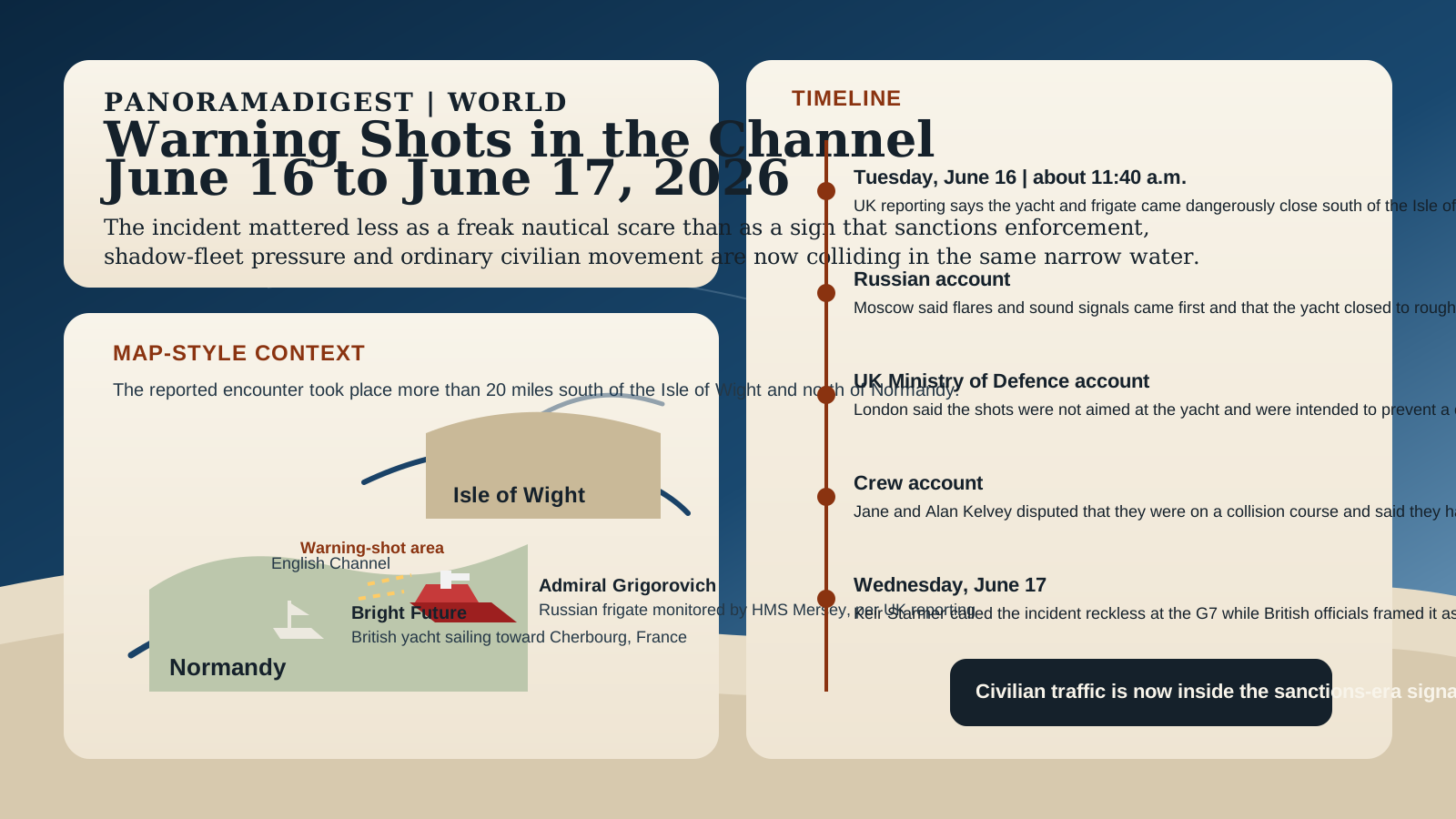
By Wednesday morning, June 17, the easiest version of the English Channel warning-shot story was the dramatic one: a Russian warship, a retired British couple and a burst of gunfire near a small yacht. The more useful version is strategic. According to ITV News' reporting and a subsequent Guardian account from the G7 summit, the incident involved the Russian frigate Admiral Grigorovich, the British yacht Bright Future and a stretch of water more than 20 miles south of the Isle of Wight. British officials said the warning shots were fired to prevent a possible collision. Russia said the yacht ignored signals and came too close. The couple aboard the yacht said they were not on a collision course. That disagreement is the story's center, not a side detail.
BBC News — British couple describe moment Russian warship fired warning shots
BBC's report centers the yacht crew's account of the Channel encounter. If the embedded player is blocked in your browser, use the direct YouTube link in the article body.
Once three versions of the same encounter enter the record that quickly, the question stops being whether the scene was alarming. Of course it was. The harder question is what readers should learn from the fact that an armed Russian frigate, a British civilian vessel and a sanctions-charged shipping lane are now sharing the same margin for error. That is why this does not read like a one-off maritime oddity. It reads like the civilian edge of a broader pressure campaign.
Why this happened in a politically hotter Channel than the one tourists imagine
The UK Ministry of Defence told British outlets that the shots were not aimed at the yacht and were meant to avert a collision after attempts to contact the crew. ITV reported that the frigate was believed to be drifting rather than maneuvering under power, a detail that makes the official British explanation more specific but not automatically complete. Russia's defence ministry, cited by ITV and summarized in ABC News' coverage, said the yacht was on a dangerous approach, that warning signals came first and that the vessel closed to about 150 metres. Jane and Alan Kelvey, the couple aboard Bright Future, disputed that account and said they had no radio contact from the frigate.
That clash of narratives would matter in any body of water. It matters more in this one because the Channel is already carrying the spillover from Europe's sanctions fight with Moscow. PanoramaDigest wrote just days ago about Britain's public interception of the shadow-fleet tanker Smyrtos, a move that made the Channel look less like neutral transit space and more like an enforcement corridor. ITV reported that British officials do not assess the yacht incident as directly linked to the Smyrtos boarding. That is a reasonable official line. It is also narrower than the strategic picture. The point is not that one event necessarily caused the other. The point is that they now belong to the same atmosphere of friction.
- Tuesday, June 16, around 11:40 a.m.: The British yacht Bright Future and the Russian frigate Admiral Grigorovich came into close proximity south of the Isle of Wight, according to UK and Russian accounts.
- Immediate dispute: Russia said the yacht ignored flares, sound signals and radio attempts before closing to roughly 150 metres; the yacht's crew said they were not on a collision course and did not receive radio contact.
- UK official framing: The Ministry of Defence said warning shots were not aimed at the yacht and were intended to prevent a possible collision.
- Wednesday, June 17: Prime Minister Keir Starmer called the incident reckless from the G7 summit while British officials continued to describe it as isolated rather than a formally escalatory act.
What the public record actually supports
The safest way to read the event is neither to dismiss it as accidental noise nor to inflate it into a naval crisis. The public record supports four narrower conclusions. First, warning shots were fired. Second, no one was injured and the yacht was not hit. Third, British and Russian officials both describe a close-approach problem, even though they disagree sharply about responsibility and sequence. Fourth, the incident took place in a corridor that has become politically more sensitive because of shadow-fleet enforcement and the wider war over Ukraine.
| Claim | What reporting supports | What remains contested |
|---|---|---|
| Were shots fired? | Yes. British and Russian accounts both acknowledge warning shots. | The exact number of shots and their precise distance from the yacht remain unclear. |
| Was the yacht targeted? | The UK says the shots were not aimed at the vessel but were intended to prevent a collision. | The crew's description underscores how threatening the moment felt even without a direct hit. |
| Did the yacht ignore warnings? | Russia says signal flares and sound warnings came first. | The couple aboard Bright Future dispute the Russian version and deny meaningful radio contact. |
| Was this linked to the Smyrtos boarding? | British officials say no direct link has been established. | The broader context still makes the incident impossible to separate from sanctions-era tension in the Channel. |
Why the story is bigger than one frightened couple
Keir Starmer called the incident reckless on Wednesday, and that is the right word because recklessness is what closes the distance between state confrontation and civilian exposure. The problem here is not only that a British couple had an alarming encounter at sea. It is that the geography of European pressure on Russia is no longer confined to abstract policy documents, far-off battle maps or tanker registries. It is increasingly visible in the everyday waterways where ordinary crews, commercial operators and patrol vessels all have to interpret one another in real time.
That does not mean every close encounter is a covert act of retaliation. It means the Channel has become a place where ambiguity itself is useful. Moscow can insist the frigate acted according to navigation rules. London can say the event was isolated. Both things can exist inside a larger truth: a heavily armed Russian vessel firing warning shots near a British civilian yacht in June 2026 is no longer shocking because it is unimaginable. It is shocking because it now feels imaginable enough to fit the times.
Readers should watch what happens next in two places. The first is the factual record: whether the UK releases more detail from its investigation and whether additional technical evidence clarifies the distance, warnings and vessel movements. The second is the political language around future Channel encounters. If similar episodes keep being framed as isolated, the important signal may be that this level of danger is quietly becoming normalized. A BBC video report is available via this direct YouTube link if the embedded player below does not load in your browser.
The British couple on Bright Future had one terrifying afternoon. Europe should treat it as something else as well: a preview of how thin the line has become between maritime routine and geopolitical signaling.
Read Next
Related Stories

Denmark's 11-Month Military Service Starts With 1,600 Volunteers Across 14 Bases
Denmark's first full 11-month military-service cohort includes about 1,600 volunteers at 14 sites. Equal conscription applies if volunteers fall short.

Lula Wins PT Nomination for Brazil's 2026 Election With Alckmin as Running Mate
Brazil's Workers' Party formally selected Lula and Geraldo Alckmin for the 2026 presidential election. Candidate registration is due August 15.

Ceuta Migrant Crossing Death Toll Reaches 67 as Spain Adds a 500-Meter Barrier
Spain says 67 people died during the mass crossing into Ceuta and is adding a 500-meter sea-border barrier after most entrants returned to Morocco.