Ukraine Opened the EU Talks That Matter Most. The Harder Test Starts Now.
The EU's June 15 decision to open Ukraine's first accession-negotiation cluster was a real milestone, but not a finish line. Brussels chose the chapters that measure institutions, rights, procurement, and corruption first because they will decide whether every later promise actually holds.
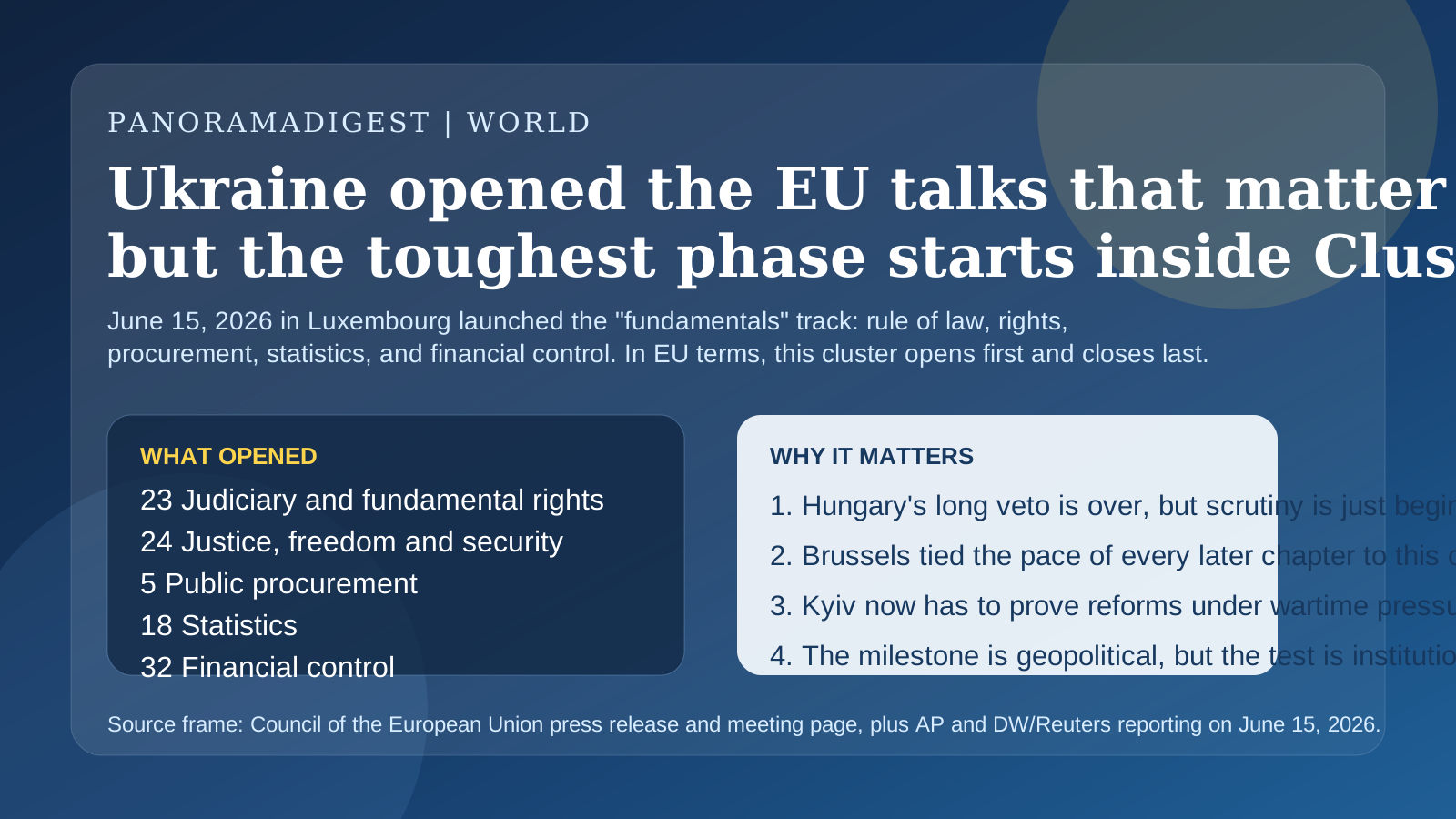
Ukraine got the headline it has been chasing for more than two years on Monday, June 15, 2026: the European Union formally opened the first negotiation cluster in Kyiv's membership talks. The more important detail sits underneath the ceremony language. Brussels did not start with symbolic chapters that let everyone celebrate momentum cheaply. It started with the "fundamentals" cluster, the rule-of-law and governance file that opens first and closes last because it determines whether the rest of an accession bid can be trusted.
YouTube / European Commission — Ukraine and Moldova begin EU accession negotiations
The European Commission's official clip gives readers a direct visual reference for the accession milestone. If the player does not render, use the fallback link in the article body.
The Council of the European Union's June 15 press release set out the formal move: Ukraine opened negotiations on five chapters inside Cluster 1, covering judiciary and fundamental rights, justice and security, public procurement, statistics, and financial control. The official meeting page from Luxembourg added the broader institutional frame, including the EU's interim benchmarks and the rule that progress under this cluster will determine the overall pace of negotiations. AP's same-day report captured why Kyiv wanted the milestone now, during an active war: Ukrainian officials still treat EU membership as a long-term security anchor at a moment when NATO entry remains politically blocked. DW's report, drawing on Reuters and other wire coverage added the clearest explanation of what changed procedurally: Hungary's long obstruction ended after Viktor Orban's defeat and a new deal over minority-rights concerns.
That combination is what makes the story more serious than another Europe summit photo. Ukraine won a geopolitical opening. It now enters the part of the process designed to disappoint anyone who mistakes symbolism for compliance.
If the video card below does not load in your browser, use the direct European Commission video on Ukraine and Moldova beginning EU accession negotiations.
The EU chose the chapters that decide whether every later promise means anything
The cleanest way to read Monday's move is to ignore the phrase talks have opened for a moment and ask which talks opened. The answer matters. The EU did not start with an easy economic package or a technocratic side chapter that gives both sides room to declare progress. It opened the chapters tied most directly to democratic institutions, corruption controls, border justice, procurement rules, and the reliability of state administration. Brussels does that on purpose. A candidate country that cannot convince the bloc on those foundations cannot expect smoother treatment later on agriculture, trade, energy, or the internal market.
That is why the Council's own wording matters. The June 15 release says the fundamentals cluster is the first to open and the last to close, and that progress there will set the overall speed of negotiations. In other words, the EU is telling Kyiv that membership remains politically imaginable, but only through a method built to slow enthusiasm down into measurable administrative proof.
| What opened on June 15 | What it covers | Why readers should care |
|---|---|---|
| Chapter 23 | Judiciary and fundamental rights | The EU wants proof that courts, rights protections, and legal safeguards work under pressure. |
| Chapter 24 | Justice, freedom and security | This is where border policy, law enforcement cooperation, and internal-security standards get tested. |
| Chapter 5 | Public procurement | War spending and reconstruction money make procurement credibility politically explosive. |
| Chapter 18 | Statistics | Brussels cannot evaluate reforms if it does not trust the state's numbers. |
| Chapter 32 | Financial control | Future aid, oversight, and anti-fraud confidence all depend on this chapter landing cleanly. |
Ukraine got past Hungary's veto. It did not get past European skepticism.
One major obstacle did move. For months, the accession track was stuck behind Hungary's veto politics. DW reported that the blockage eased after Hungary's change of government and a renewed accommodation over the rights of the Hungarian minority in Ukraine. That procedural shift is real and important. But it would be a mistake to confuse the end of one government's obstruction with the end of wider European concern.
AP's reporting made the next part plain enough: EU officials and member states still insist the process must stay merit-based, and several capitals remain wary of importing another long-term rule-of-law headache into the bloc. That skepticism is not necessarily anti-Ukraine. It is anti-shortcut. The EU has enough internal memory of democratic backsliding, procurement disputes, and enforcement gaps to know that a wartime solidarity narrative cannot do the auditing by itself.
This is where geopolitics collides with state capacity
Kyiv has a persuasive geopolitical case. Many European governments now see Ukraine not only as a neighbor under attack, but as a future security pillar whose fate will shape the continent's border logic for years. That argument has strengthened every time Russia reminded Europe that the war is still not background noise, including in PanoramaDigest's June 15 analysis of the strike on Kyiv Pechersk Lavra. The trouble is that geopolitics can get a candidate country into the room; it cannot by itself clear procurement, courts, and anti-corruption reviews.
That is the real tension inside this accession phase. Ukraine has to prove institutional durability while fighting a war, rebuilding damaged systems, and managing the political temptations that large flows of military and reconstruction money inevitably create. Brussels knows that. Kyiv knows that Brussels knows it. So the next stretch of the accession story will be less about rhetorical belonging and more about whether Ukraine can keep producing rule-of-law and governance evidence under extraordinary stress.
The contrast is visible elsewhere in the region too. PanoramaDigest argued in its June 14 piece on Romania's government test that European stability often rises or falls on administrative credibility rather than speechmaking. Ukraine's accession track is now that problem at continental scale.
Why the procurement and statistics chapters may matter more than the emotional headlines
Readers naturally gravitate to the language of democracy, rights, and strategic belonging. Brussels does too, in public. But the quiet chapters in this first cluster may end up deciding more than the soaring ones. Procurement and financial control are where wartime solidarity becomes an accountability system. Statistics are where political claims have to survive contact with shared methods and outside scrutiny. Those are not glamorous files. They are the files that let the EU decide whether future support, reconstruction flows, and eventual market integration can happen without importing opaque risks.
That is why the fundamentals cluster is so often misunderstood. People hear values language and imagine a moral exam. It is partly that. It is also a brutally practical test of whether the state can document what it is doing, spend money cleanly, and maintain legal standards when pressure is highest.
What to watch next
Three follow-ups matter now. First, how quickly Ukraine can meet the interim benchmarks Brussels attached to the cluster, especially on the rule-of-law chapters. Second, whether European leaders keep speaking as if enlargement is strategically urgent while still enforcing the method strictly enough to preserve credibility. Third, whether the wider war changes the political appetite for patience. If the conflict drags on and reform fatigue deepens, the temptation to either over-politicize or over-romanticize the accession track will grow.
For now, the right conclusion is narrower than the celebration suggests but more useful than cynicism. Ukraine did not merely win another gesture on June 15, 2026. It won entry into the hardest conversation Europe can offer: prove that wartime resilience can be translated into institutions the bloc is willing to trust for the long haul.
Read Next
Related Stories

Denmark's 11-Month Military Service Starts With 1,600 Volunteers Across 14 Bases
Denmark's first full 11-month military-service cohort includes about 1,600 volunteers at 14 sites. Equal conscription applies if volunteers fall short.

Lula Wins PT Nomination for Brazil's 2026 Election With Alckmin as Running Mate
Brazil's Workers' Party formally selected Lula and Geraldo Alckmin for the 2026 presidential election. Candidate registration is due August 15.

Ceuta Migrant Crossing Death Toll Reaches 67 as Spain Adds a 500-Meter Barrier
Spain says 67 people died during the mass crossing into Ceuta and is adding a 500-meter sea-border barrier after most entrants returned to Morocco.