Australia's Radar Sale to Canada Turns Arctic Defense Into an Allied Industrial Test
Australia and Canada signed a A$2.5 billion over-the-horizon radar agreement on Monday, June 22, 2026. The deeper world story is that Arctic defense is starting to look less like a U.S.-only shield and more like a middle-power industrial partnership.
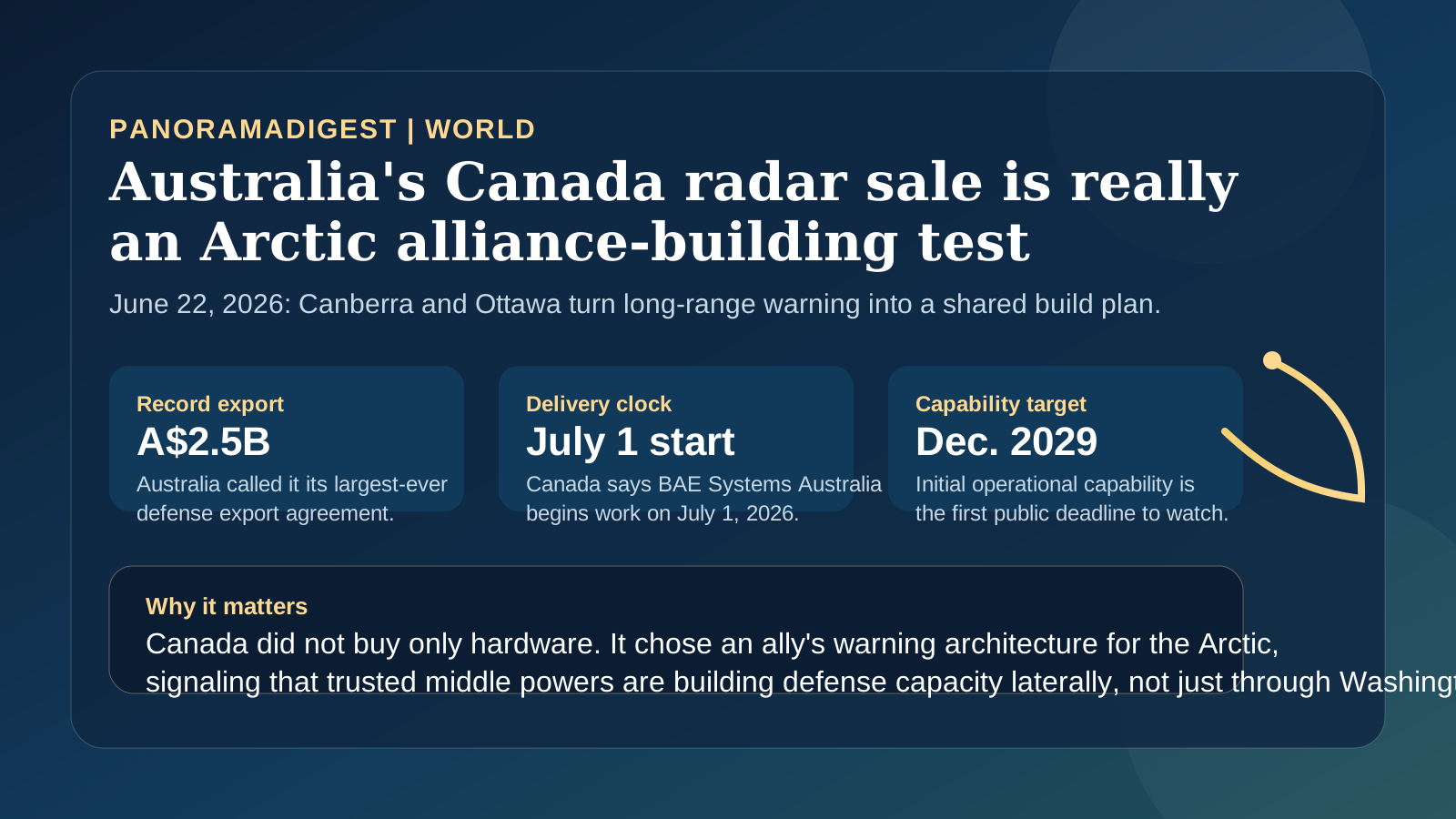
The easy headline on Monday, June 22, 2026, is that Australia just booked the largest defense export in its history. The more interesting headline is that Canada did not buy only a radar. It bought a relationship, a research path and a piece of Arctic warning infrastructure from a close ally rather than waiting for Washington to define every layer of continental defense. In the official Australian defense release, Canberra described the A$2.5 billion agreement as the first international sale of its Over the Horizon Radar technology. In the matching Canadian announcement, Ottawa framed the same deal as a step deeper into Arctic sovereignty and NORAD modernization. Put those two statements together and the strategic meaning becomes clearer. This is not only an export success. It is an alliance structure story.
That is why the deal matters beyond defense procurement jargon. According to Canada's June 22 release, the formal arrangements move the Arctic Over-the-Horizon Radar program into delivery, with BAE Systems Australia due to begin work on July 1, 2026, and an initial operational capability target of December 2029. Australia's release adds that the agreement supports about 300 high-value technical jobs there and establishes a framework for joint research and development. AP's report from Canberra adds the geopolitical wrinkle that makes the story bigger than a contract note: Canadian Prime Minister Mark Carney had chosen Australia's system over comparable U.S. technology, then used his March visit to Australia to expand cooperation on defense technology, artificial intelligence and critical minerals.
Why this is bigger than one export win
Australia's official line emphasized national innovation and industrial pride, and fairly so. The June 22 release says the system builds on the Jindalee Operational Radar Network, or JORN, and calls it the first overseas sale of Australia's world-leading over-the-horizon radar capability. At the joint Canberra press conference, Deputy Prime Minister Richard Marles said the project would support 1,000 direct and indirect jobs and argued that the real significance was that Australia and Canada were becoming partners in the future development of the technology. Canada used a different emphasis. Its release stressed Arctic threat detection, domain awareness and the need to protect northern approaches in a more complex security environment. Those are not conflicting messages. They are the two halves of the same one: industrial policy and military posture are now being sold together.
| Signal | What the official record says | Why the wider strategic meaning matters |
|---|---|---|
| Australia's largest-ever defense export | Australia said the A$2.5 billion agreement is the biggest defense export arrangement in its history. | Canberra is no longer presenting defense technology only as self-protection. It is selling it as alliance infrastructure. |
| Canada's Arctic radar move enters delivery | Canada said the deal moves its Arctic Over-the-Horizon Radar program into delivery, with work starting July 1, 2026 and initial operational capability targeted for December 2029. | The Arctic file is shifting from speeches about sovereignty to a dated build schedule with real capability milestones. |
| Joint research and industrial-benefits framework | Both governments tied the agreement to broader cooperation, while Canada also signed industrial and technological benefits arrangements with BAE Systems Australia. | The partnership is meant to create a longer runway than a one-off purchase and to shape domestic defense capacity on both sides. |
| Australia chosen over comparable U.S. technology | AP reported that Canada selected the Australian system over a comparable American option. | That suggests close allies are willing to diversify defense dependence even inside a U.S.-anchored security system. |
The Arctic angle matters because warning time has become political time
Over-the-horizon radar is not glamorous in the way missile-defense slogans are glamorous. That is exactly why it matters. The point is to see farther, sooner and more reliably over huge distances than conventional radar can manage. Australia has used the technology for long-range northern surveillance for decades. Canada wants that same logic pointed toward Arctic approaches, where distance, weather and thinning ice are turning geography into a harder security problem rather than a softer one. Ottawa's June 22 release says the capability will strengthen early warning and informed decision-making while supporting continental security through NORAD. That phrase is doing important work. It means the radar is not being pitched as an isolated Canadian gadget. It is being framed as part of a wider command-and-warning system for North America.
This is where the deal starts to connect with PanoramaDigest's recent analysis of how strategic supply chains are moving from rhetoric into named-company risk and its earlier look at why allies are increasingly being judged by wartime usability, not just by spending promises. The common thread is that security policy is becoming less theoretical. Governments are being forced to show which systems they can actually build, share and sustain when deterrence depends on capability more than communiques.
The most revealing part may be what this says about trust inside the alliance
Five Eyes cooperation is usually discussed as an intelligence habit, almost a background condition. Monday's agreement made it look more like an industrial strategy. AP reported that Marles called the partnership strategic, and the Canadian side described Australia as a trusted partner for a capability central to continental defense. That matters because allied trust is easiest to praise in speeches and hardest to prove in procurement. Choosing another country's technology for a sensitive early-warning role is one of the more practical ways to prove it. Canada is effectively saying that Australian expertise is mature enough, politically safe enough and strategically durable enough to sit inside a system tied to sovereignty and North American defense.
That does not mean the United States is suddenly absent from the picture. NORAD, Five Eyes and Arctic security are still full of American weight. But the cleaner reading of June 22 is that close allies are trying to reduce the number of problems that must be solved only through Washington. In a period shaped by defense-industrial bottlenecks, political volatility and a widening Arctic competition map, that is not a minor adjustment. It is a practical hedge.
What to watch next
- Delivery discipline: July 1, 2026 is the first concrete operational date in the public record, and December 2029 is the first real capability deadline that outsiders can measure.
- Industrial follow-through: Canada's release says at least 14 Canadian companies are expected to support the effort, while Australia's side says local jobs and research gains will follow. Those claims will need visible evidence.
- Alliance spillover: if this project stays on time, other allied procurement decisions may start to look less automatically U.S.-centric in sectors where trusted partners have an edge.
- Arctic strategy beyond hardware: radar range matters, but so do staffing, maintenance, data integration and the political will to act on early warning once it arrives.
The strongest way to read Monday's agreement is not as proof that Canada or Australia is breaking from the American security orbit. It is proof that both governments think the orbit needs reinforcement from the sides. When allies start sharing not only intelligence but also the expensive machinery of early warning, the strategic map changes a little. The Arctic is one place where that change is now written into a contract, a timetable and a procurement choice that looks far more consequential than a headline about export records suggests.
Primary sources and reporting used here: Australia's June 22 defense export media release, Canada's June 22 Arctic defense announcement, the joint press conference transcript, and AP's June 22 report from Canberra.
Reader Sentiment & Impact Pulse
How do you evaluate the primary outcome of this development?
Select an option to cast your perspective. Responses are anonymous and aggregated in real time.
Key Context & Frequently Asked Questions
Australia and Canada signed a A$2.5 billion over-the-horizon radar agreement on Monday, June 22, 2026. The deeper world story is that Arctic defense is starting to look less like a U.S.-only shield and more like a middle-power industrial partnership. This analysis from PanoramaDigest examines primary documentation, operational implications, and broader institutional impacts across world.
Read Next
Related Stories

Saudi Arabia Intercepts Targeted Houthi Attack on Riyadh Amid Escalating Regional Tensions
Saudi air defense forces neutralized an attempted strike targeting the capital city of Riyadh by Yemen's Houthi rebels, threatening fragile regional peace initiatives and raising security concerns for Gulf energy infrastructure.

Two Killed in Ukrainian Drone Strike on Moscow, Russian Officials Report
A rare and lethal drone attack on the Russian capital leaves two dead, escalating the cross-border aerial conflict and intensifying security concerns across the region.

Israeli President Pardons Combat Medic Convicted in High-Profile Shooting
Israeli President Isaac Herzog has granted an executive pardon to a combat medic convicted after shooting an incapacitated Palestinian attacker. The decision reopens deep national debates over military legal accountability and international human rights standards.