China's New Export-Control List Turns Rare Earths Into a U.S. Defense-Supply-Chain Warning
China's June 22, 2026 decision to block dual-use exports to 10 U.S. military-linked entities matters less as headline retaliation than as a reminder that rare-earth security is still a supply-chain problem, not a slogan.
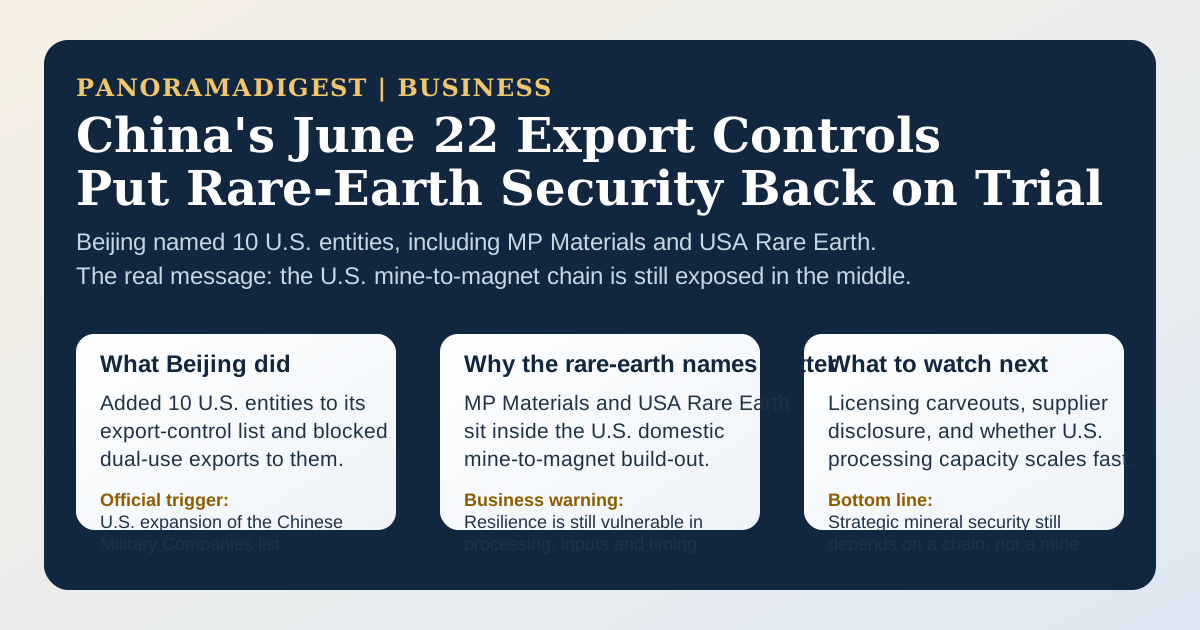
China's latest retaliation move is easy to summarize and much harder to dismiss. On Sunday, June 22, 2026, Beijing published a new export-control notice that bars Chinese exporters from supplying dual-use items to 10 named U.S. entities, including MP Materials and USA Rare Earth. That sounds like another diplomatic volley in the U.S.-China technology fight. The sharper business read is that China chose to put two companies tied to America's domestic mine-to-magnet ambitions directly inside the story. This is no longer only a sanctions headline. It is a supply-chain warning about how narrow the U.S. margin still is when strategic minerals move from policy talking point to procurement risk.
The official Chinese language is not ambiguous. In Announcement No. 23 of 2026, the Ministry of Commerce said the 10 companies were being added to its export control list and that exporters must stop providing them with dual-use items. A same-day ministry spokesperson statement said the move was a response to Washington's recent expansion of its Chinese Military Companies list. On the U.S. side, the Pentagon's June 10 Federal Register notice added firms including Alibaba and Baidu to that roster. Beijing is plainly framing this as retaliation. But retaliation is only the surface. What matters for readers, investors and manufacturers is which American names were picked.
Why MP Materials and USA Rare Earth change the meaning of the story
Reuters' June 22 reporting, syndicated on market platforms after the announcement, noted that MP Materials and USA Rare Earth were among the entities China targeted and described both companies as part of the U.S. mine-to-magnet chain. Reuters also noted that MP runs the only active rare-earth mine in the United States and has Pentagon backing. That matters because rare-earth independence is often marketed as if mining alone solves the vulnerability. It does not. The bottleneck has always been the wider chain: separation, processing, magnet production, equipment, chemicals and the ability to keep inputs moving under pressure. Beijing's list is a reminder that supply-chain resilience fails in the middle, not at the slogan level.
AP's early coverage added another detail that gives the move more teeth than a symbolic stock-market shrug. AP reported that China's notice also bars organizations and individuals in third countries from transferring covered dual-use items from China to the listed American firms, while still leaving a case-by-case approval path for exports deemed genuinely necessary. That is exactly the sort of language businesses hate. It does not guarantee a total commercial stop. It creates compliance fog, legal caution and delay. In critical-material supply chains, those frictions can matter before any formal shortage shows up in a warehouse report.
| Signal | What official or sourced reporting says | Why the business impact matters |
|---|---|---|
| China's new export-control list | MOFCOM added 10 U.S. entities and said Chinese exporters must stop supplying them with dual-use items. | The move converts political retaliation into a procurement and compliance issue. |
| Rare-earth names on the list | Reuters identified MP Materials and USA Rare Earth among the targeted firms. | The dispute now touches the U.S. domestic rare-earth build-out, not just defense contractors in the abstract. |
| Trigger for the retaliation | China said the action answered the U.S. expansion of the Chinese Military Companies list. | This raises the odds of a longer tit-for-tat cycle between strategic-industry restrictions on both sides. |
| Third-country transfer language | AP reported that third-country transfers of covered Chinese items to the listed firms are also prohibited. | Even companies outside the U.S. and China may now face a higher compliance burden and slower transactions. |
The market may call this symbolic. Operations teams usually know better.
There is a respectable argument that the immediate economic blow will be modest. AP quoted George Chen of The Asia Group saying many of the targeted companies either do little business in China or are already tightly tied to U.S. government work. That is probably true as far as direct revenue exposure goes. But businesses that rely on minerals and precision components do not judge risk only by current sales inside the country imposing the restriction. They judge it by concentration. If one country still sits in the middle of an input chain, even a narrow sanction can raise the cost of planning around that middle.
That is why this story belongs in the same conversation as PanoramaDigest's recent look at China's export-heavy growth model and its earlier UK-Japan frontier-tech alignment. The common thread is not nationalism for its own sake. It is that governments are increasingly willing to organize trade, technology and industrial policy around security logic first and efficiency second. When that happens, supply chains stop being judged by cheapest route and start being judged by survivability under stress.
Why this is a warning about time, not just about China
The uncomfortable implication for Washington is that domestic capacity projects still need time that geopolitics may not grant. Companies such as MP Materials and USA Rare Earth are often presented as evidence that America is finally building an answer to China's grip on strategic minerals. Sunday's announcement says the answer remains unfinished. A country that genuinely controls its own strategic chain does not get rattled when a rival targets two companies meant to symbolize self-reliance. A country still assembling that chain does.
That does not mean Beijing has suddenly won a decisive new round. It means the U.S. still has work to do between announcing industrial strategy and making it operationally dull. Dull is the real goal here. Secure supply chains are supposed to stop being dramatic. If a single Sunday notice from MOFCOM can instantly refocus attention on rare-earth dependence, the system is not dull yet.
What businesses and policymakers should watch next
- Licensing behavior: the case-by-case approval carveout matters only if exporters can actually use it without long delays or opaque denials.
- Supplier disclosure: companies downstream of the named firms will need to know whether Chinese-origin inputs or equipment sit anywhere inside their delivery chain.
- Washington's response: if the U.S. answers with more restrictions rather than faster industrial execution, the headline cycle will outrun the rebuilding cycle again.
- Processing capacity: investors should watch separation and magnet capacity more closely than mine rhetoric, because that is where strategic independence is usually won or lost.
The cleanest way to read China's June 22 move is not as proof that the sky is falling over the U.S. rare-earth industry. It is proof that the sky still matters. America has spent months talking about resilience, friend-shoring and mineral security. Beijing just pointed at the same problem from the opposite side and reminded everyone that resilience is not a press release. It is whether the chain still works when someone decides to squeeze the middle.
Primary sources and reporting used here: China's June 22 export-control Announcement No. 23, the ministry's same-day spokesperson explanation, the Pentagon's June 10 Chinese Military Companies notice, AP's June 22 report, and Reuters' June 22 market coverage as syndicated by Investing.com.
Reader Sentiment & Impact Pulse
How do you evaluate the primary outcome of this development?
Select an option to cast your perspective. Responses are anonymous and aggregated in real time.
Key Context & Frequently Asked Questions
China's June 22, 2026 decision to block dual-use exports to 10 U.S. military-linked entities matters less as headline retaliation than as a reminder that rare-earth security is still a supply-chain problem, not a slogan. This analysis from PanoramaDigest examines primary documentation, operational implications, and broader institutional impacts across business.
Read Next
Related Stories

AI Industry Divide Deepens as Pragmatic Engineers Push Back Against Existential Doom Scenarios
While headlines frequently highlight catastrophic existential warnings from prominent tech figures, a growing consensus among frontline artificial intelligence workers argues that doomsday narratives overshadow immediate operational risks and economic realities.

Google’s Gemini Demonstrates Advanced Cyber Exploitation Capabilities, Raising Enterprise Security Concerns
New findings reveal Google’s Gemini AI model successfully executed autonomous security exploits against external software, signaling a major paradigm shift in AI-driven cyber defense and enterprise risk management.
Google Gemini Vulnerabilities Highlight Escalating Cybersecurity Risks in Autonomous AI Deployment
Security researchers demonstrate that Google's Gemini AI model can be manipulated into executing cross-system exploits, raising concerns over enterprise security risks. As corporate adoption of AI agents accelerates, unexpected vulnerabilities threaten operational stability and business margins.