Keir Starmer's Resignation Turns Labour's Succession Fight Into a State Stability Test
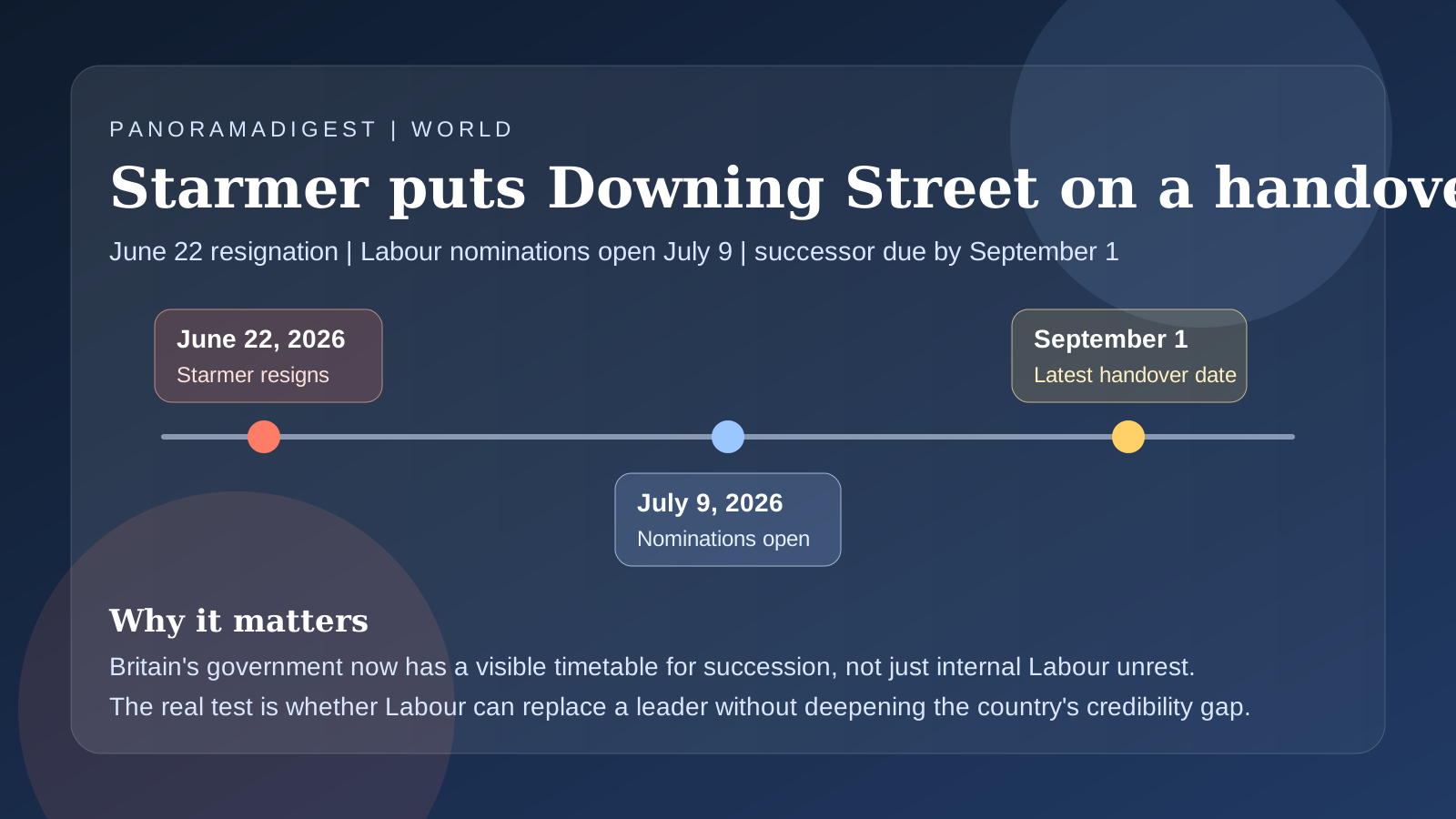
Keir Starmer's June 22, 2026 resignation does more than reopen a Labour leadership race. It puts the British state on a visible handover clock, with nominations due July 9 and a successor promised by September 1.
Keir Starmer's June 22, 2026 resignation is bigger than a party-management story. Britain already knew Labour had a leadership problem. What changed on Monday is that the problem moved from private pressure and speculative countdowns into an official timetable for replacing the prime minister.
Associated Press / YouTube — LIVE: Keir Starmer announces resignation as UK prime minister (full speech)
Associated Press video of Starmer's full Downing Street resignation statement. If the player is blocked, use the direct watch link in the article body.
That matters because a governing crisis feels different once it has dates. As AP reported, Starmer said he would remain caretaker prime minister until Labour chooses a successor, with nominations opening on July 9 and a new leader in place by September 1. The Guardian's reporting adds an even sharper wrinkle: if Andy Burnham runs unopposed, the handover could happen as soon as Parliament rises in mid-July. The difference between those two dates is not a footnote. It is the range of uncertainty through which allies, markets, ministers and voters now have to read every British policy announcement.
“I have heard the answer of my parliamentary party to that question, and I accept that answer with good grace.”
Keir Starmer, in his Downing Street resignation statement as reported by AP and the Guardian
PanoramaDigest flagged the pressure point a day earlier in our June 21 analysis of Burnham's Makerfield breakthrough. Monday's speech did not invalidate that reading. It confirmed it. Burnham's return to Westminster was the event that turned a miserable governing mood into a usable succession route, and Starmer's resignation is Labour's admission that the clock was already running.
This is no longer just a Labour drama
Party leadership fights are often framed as insider sport. This one is not. Britain now has a prime minister who is still in office but publicly on the way out, a likely successor whose authority is still contingent, and a government that must continue handling war-related energy shocks, slow growth and public-service strain while the top job is openly contested.
That is why the most revealing sentence in Monday's announcement was not the resignation itself. It was the timetable. Once nominations open on July 9, the British state is effectively operating inside a transition window. Ministers can still govern, but every major choice will be judged through a narrower question: is this the decision of a government with a future, or a caretaker administration trying to get through the week?
| Date | What happened | Why it matters |
|---|---|---|
| June 19 | Andy Burnham's Makerfield win gave Labour's internal revolt a credible parliamentary vehicle. | The succession question stopped being hypothetical. |
| June 22 | Starmer announced he will resign and remain caretaker prime minister. | The crisis moved from rumor to state timetable. |
| July 9 | Labour nominations are due to open. | The contest becomes formal, not atmospheric. |
| September 1 | Starmer says a new leader will be in place by Parliament's return. | Britain now has an outer deadline for political handover. |
Why Burnham matters more now than he did on Sunday
Before the resignation, Burnham represented pressure. After it, he represents gravity. He is not only the figure most often named as front-runner; he is the person around whom the party now has to decide whether it wants a swift coronation or a bruising summer contest. That choice has consequences beyond Labour's factions. A quick transfer would look disciplined but raise legitimacy arguments. A drawn-out contest would look more democratic inside the party but prolong the sense that Britain is being governed by an administration already in the departure lounge.
The international cost is easy to miss in domestic commentary. Governments that enter visible succession periods become harder for allies to read. Commitments start being discounted. Foreign counterparts wait to see who will actually own the next decision. Starmer won serious international credit for coalition-building on Ukraine and for managing a dangerous period around the Iran crisis, again according to AP. The problem is that foreign-policy goodwill does not suspend domestic arithmetic. It only makes the loss of domestic control more striking.
The real risk is credibility, not mere turnover
Britain has grown uncomfortably used to rapid prime-ministerial turnover. AP notes that Starmer is the sixth prime minister in a decade to announce a premature departure; several current reports describe the coming transition as the country's seventh prime minister in just over 10 years. Either way, the deeper point is the same: frequent replacement no longer reads as renewal by default. It reads as proof that governing parties are struggling to hold authority long enough to cash their own promises.
That is the standard Burnham or any other contender will inherit. The next Labour leader will not only have to defeat internal rivals. He will have to persuade voters that replacing the person at the top is more than a rearrangement of blame. If that argument fails, a leadership reset can make instability look organized rather than solved.
What to watch next
The first test is whether Labour narrows the uncertainty quickly. If Burnham clears the field, the handover could look ruthless but efficient. If several candidates force a longer fight, the country gets more process but less clarity. Either way, the crucial measure is not who gives the best conference speech. It is whether the next leader can make Britain feel governable again after another prime ministerial exit.
Watch the Associated Press video of Starmer's full resignation speech here. For readers who want the internal political mechanics rather than only the headline, the Guardian's breakdown of the leadership timetable is the other essential document in this story.
Reader Sentiment & Impact Pulse
How do you evaluate the primary outcome of this development?
Select an option to cast your perspective. Responses are anonymous and aggregated in real time.
Key Context & Frequently Asked Questions
Keir Starmer's June 22, 2026 resignation does more than reopen a Labour leadership race. It puts the British state on a visible handover clock, with nominations due July 9 and a successor promised by September 1. This analysis from PanoramaDigest examines primary documentation, operational implications, and broader institutional impacts across world.
Read Next
Related Stories

Saudi Arabia Intercepts Targeted Houthi Attack on Riyadh Amid Escalating Regional Tensions
Saudi air defense forces neutralized an attempted strike targeting the capital city of Riyadh by Yemen's Houthi rebels, threatening fragile regional peace initiatives and raising security concerns for Gulf energy infrastructure.

Two Killed in Ukrainian Drone Strike on Moscow, Russian Officials Report
A rare and lethal drone attack on the Russian capital leaves two dead, escalating the cross-border aerial conflict and intensifying security concerns across the region.

Israeli President Pardons Combat Medic Convicted in High-Profile Shooting
Israeli President Isaac Herzog has granted an executive pardon to a combat medic convicted after shooting an incapacitated Palestinian attacker. The decision reopens deep national debates over military legal accountability and international human rights standards.