Bayahibe's Resort Fire Evacuated 1,690 Guests. The Harder Test Is Caribbean Response Capacity.
The June 19, 2026 fire at Viva Wyndham Dominicus Beach killed one tourist and emptied a major Dominican Republic resort. The larger story is how Bayahibe's tourism system handled a stress test it can no longer treat as rare.
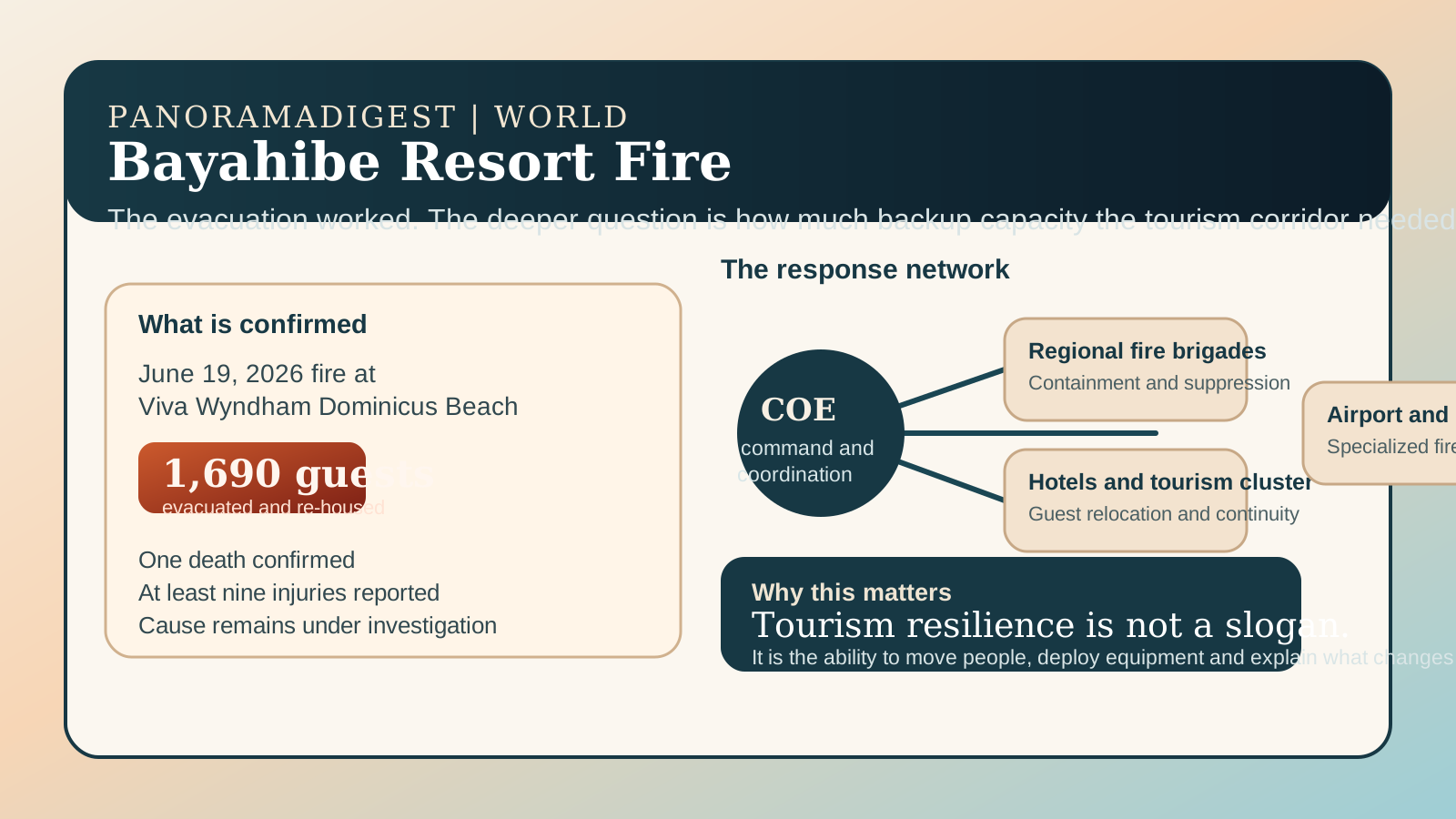
On Friday, June 19, 2026, a fire tore through the Viva Wyndham Dominicus Beach resort in Bayahibe, on the Dominican Republic's southeastern coast, killing one tourist and forcing the evacuation of about 1,690 guests. The Associated Press reported the scale of the evacuation and the broad damage to the property. The Dominican Republic's Emergency Operations Center said it took over response coordination with regional fire brigades and other agencies. CBS News reported that at least nine other people were injured, with three taken to hospitals and six treated on site.
ABC News / YouTube — Deadly fire at popular resort in Dominican Republic
ABC News shows the scale of the Bayahibe resort fire and evacuation. The article body includes a direct-watch fallback link if the player is blocked.
The raw facts matter on their own. So does the part that usually gets buried once the flames are out: modern resort economies are built on a promise of frictionless safety, but they depend on layered backup systems that only become visible when one property suddenly fails. Bayahibe's fire is therefore not just a hotel disaster story. It is a live test of whether a tourism corridor that sells reliability can still prove it under pressure.
| What officials have confirmed | Why it matters |
|---|---|
| The fire broke out at the Viva Wyndham Dominicus Beach resort in Bayahibe on June 19, 2026. | This was not an isolated inland property. It hit a dense, internationally marketed coastal tourism zone. |
| About 1,690 guests were evacuated and re-housed. | The response depended on neighboring hotels and destination-wide contingency planning, not just one hotel's staff. |
| One tourist died and at least nine others were injured. | The story is no longer only about property damage. It now carries accountability, medical-response and disclosure questions. |
| Authorities say wind and combustible roofing helped the fire spread quickly. | That points attention toward materials, design choices and code enforcement, not just bad luck. |
| The cause remains under investigation. | The next public test is whether investigators produce a credible explanation and whether the tourism sector acts on it. |
What looked orderly from the outside was really a networked rescue
The COE's official statement is revealing because it describes a response much bigger than one hotel or one local fire unit. The agency said the evacuation effort involved regional fire departments, the La Romana-Bayahibe tourism cluster, the Ministry of Tourism, Central Romana Corporation and support from Punta Cana International Airport's specialized firefighting resources. Guests from the damaged property were redistributed not only to the neighboring Dominicus Palace resort but also to other local properties and facilities prepared to absorb them.
That operational detail changes the meaning of the story. The Dominican Republic did not just rely on a single resort to save itself. It relied on a destination-wide mutual-aid web: public emergency management, tourism operators, transport infrastructure and corporate backup capacity. That is what mature tourism systems are supposed to do. The reason this episode deserves closer attention is that the system appears to have worked, but only by showing how many moving parts had to be available at once.
In other words, Bayahibe passed a short-term relocation test. It has not yet answered the longer-term resilience question. If a coastal destination needs airport firefighting assets, regional hotel re-housing and multi-agency coordination to keep one resort fire from cascading, then investors, regulators and travelers should all care about whether that redundancy is robust or merely improvised.
Why this is bigger than one thatched roof
Officials told AP and CBS that wind conditions and combustible roofing materials helped the blaze spread. That is an immediate fire-behavior fact, but it is also a design and policy story. Tropical resort architecture often sells atmosphere through open-air layouts, natural textures and low-rise structures that feel relaxed and local. Those choices can be commercially powerful. They can also create exactly the kind of vulnerability that only looks charming until a fire moves faster than the first crews can contain it.
That does not mean Bayahibe is uniquely unsafe, and it would be irresponsible to imply that before investigators finish their work. It does mean the tourism industry keeps running into a harder truth: the aesthetics of paradise do not exempt destinations from industrial-grade risk management. A hotel zone built around romance, weather and visual softness still needs brutal competence underneath it, from materials decisions to evacuation routes to inter-property coordination.
- Friday morning, June 19: The fire breaks out at Viva Wyndham Dominicus Beach, according to Dominican and U.S. reporting.
- As the blaze spreads: Guests move toward beaches and safe areas while local and regional responders work to contain the fire.
- By Friday evening: COE says roughly 1,690 guests have been evacuated and re-housed through a broader destination response.
- Friday night: CBS reports one death and at least nine injuries, including three patients transferred to hospitals.
- Next phase: Investigators determine cause, while the tourism sector faces pressure to explain what structural lessons will actually change.
The accountability phase starts after the evacuation ends
Tourism officials understandably want to emphasize continuity. The COE said tourism activity in Bayahibe and surrounding areas continues normally, and that the nearby Dominicus Palace resort was not damaged. That message matters economically. The Dominican Republic has a strong interest in showing that one fire did not cripple a major destination. But continuity messaging is only half the job after an event like this.
The other half is credibility. Travelers, insurers and local workers will want direct answers on three fronts: what ignited the fire, whether the property's materials or layout worsened it, and what destination operators will change before the next peak travel stretch. If those answers turn vague, the evacuation success story will start to look more like a narrowly avoided systems failure.
This is where Bayahibe's local stakes become clearer. Resort belts often concentrate jobs, logistics and reputation in a small geographic footprint. A fire that destroys one major property does not only wound one balance sheet. It tests worker routines, transport planning, local firefighting depth and the willingness of tourism authorities to treat resilience as a public obligation rather than a marketing line.
What to watch now
The next important developments are not dramatic video clips. They are slower and more consequential. Watch for the technical findings on the cause of the blaze. Watch for whether Dominican officials or hotel operators address roofing materials, fire-break design and suppression capacity in plain language. Watch for whether the destination's mutual-aid response is formalized and stress-tested, not just praised after the fact.
If the ABC News video below does not render in your browser, the direct report is available at youtube.com/watch?v=RLDc75oagoM.
Bayahibe's fire should not be flattened into a single lurid image of a beachside inferno. The more useful reading is tougher and more practical. A destination built to feel effortless had to reveal its emergency machinery in public. The evacuation suggests that machinery exists. The investigation will show whether it is strong enough to deserve the confidence the region sells every day.
Reader Sentiment & Impact Pulse
How do you evaluate the primary outcome of this development?
Select an option to cast your perspective. Responses are anonymous and aggregated in real time.
Key Context & Frequently Asked Questions
The June 19, 2026 fire at Viva Wyndham Dominicus Beach killed one tourist and emptied a major Dominican Republic resort. The larger story is how Bayahibe's tourism system handled a stress test it can no longer treat as rare. This analysis from PanoramaDigest examines primary documentation, operational implications, and broader institutional impacts across world.
Read Next
Related Stories

Russia Extends Parliamentary Elections to Occupied Ukrainian Territories in Defiance of International Law
Moscow's decision to conduct parliamentary voting inside illegally occupied regions of Ukraine has drawn sharp international condemnation, underscoring ongoing sovereignty disputes and challenges to the rule of law.
Philippines School Shooting Leaves Three Dead, Sparking Urgent Security Review
A tragic shooting at a Philippine educational institution has left three people dead, including the gunman, prompting immediate calls for national campus safety reforms.

Scientists Warn of Escalating Glacial Flood Risks Across Eight Himalayan Nations Following Nepal Disaster
Following catastrophic inundations in Nepal, climate scientists warn that over 240 million people across eight South and Central Asian countries face heightened risks from glacial lake outburst floods and extreme weather events.