The Bedford Train Collision Is Now a Trust Test for Britain's Rail Safety Story
A fatal collision between two East Midlands Railway trains near Bedford left one driver dead and 89 others injured on Friday, June 19, 2026. The hardest question for Britain's rail system now is not only what failed near Elstow, but how quickly the network can explain the failure without letting public confidence fracture first.
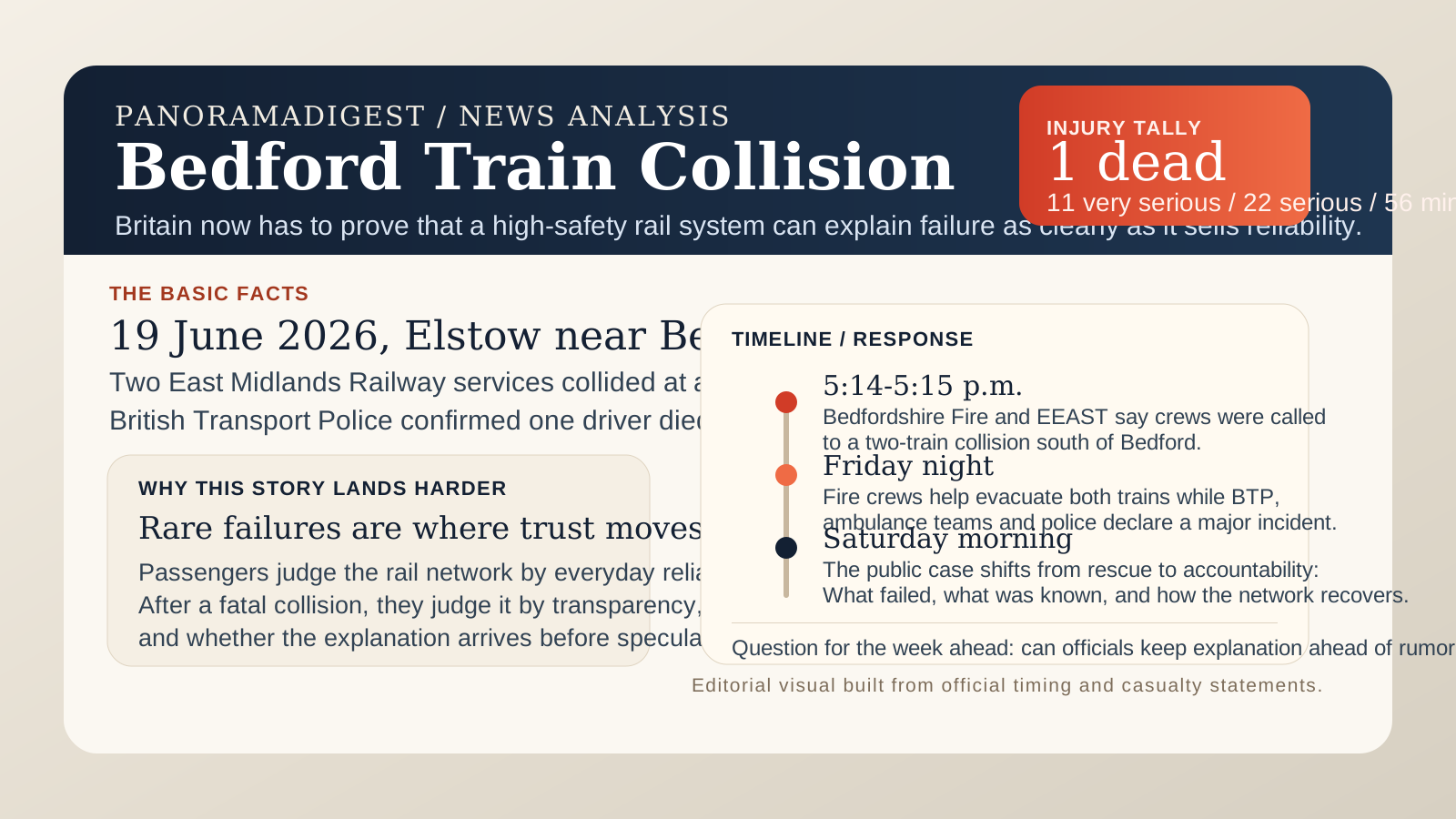
Britain's railways spend most days selling a simple bargain: the system is busy, imperfect and occasionally delayed, but fundamentally safe. That is why the collision between two East Midlands Railway trains near Elstow, south of Bedford, on Friday, June 19, 2026, lands as more than a local transport emergency. British Transport Police said officers were called at about 5:15 p.m., and the East of England Ambulance Service said one person died at the scene, 11 people suffered very serious injuries, 22 were seriously injured and 56 had minor injuries. ITV News Anglia reported that the person who died was the driver of one of the trains. The public shock is understandable. In a country where rail safety is often treated as an institutional given, a crash like this does not merely interrupt travel. It interrupts assumption.
BBC News — One dead and 11 very seriously injured in Bedford train crash
BBC News' video report summarizes the confirmed casualty picture and the scene near Bedford. Use the direct YouTube link in the article if the embedded player does not load.
Why a single crash can change the mood around an entire network
Rare transport disasters carry a peculiar force because they collide with a public promise people barely notice until it breaks. Most passengers do not board trains thinking about signaling discipline, braking systems or dispatcher routines. They board because they assume those things are working somewhere beyond view. When two passenger services collide anyway, trust does not erode one missed connection at a time. It drops all at once, because the failure feels systemic even before the cause is known.
That is why Friday night's official details matter. British Transport Police placed the collision on the line in Elstow. EEAST documented the scale of the emergency response, including more than 20 ambulances, specialist hazardous-area teams and six air ambulances. Bedfordshire Fire and Rescue said seven fire engines and specialist vehicles were deployed and that crews helped evacuate passengers from both trains. Those are rescue facts, but they also become trust facts. They show a system trying to prove it can still operate under extreme stress, even after one part of it has already failed.
| Time | What officials said | Why it matters |
|---|---|---|
| About 5:14-5:15 p.m., Friday, June 19 | EEAST and Bedfordshire Fire said they were called to a collision near Elstow/Kempston Hardwick south of Bedford. | The early timeline anchors the public record and limits room for mythmaking. |
| Friday night | Fire crews evacuated passengers while BTP, ambulance and police teams treated the crash as a major incident. | The response showed how quickly a rail failure becomes a multi-agency stress test. |
| By Saturday, June 20 | BTP confirmed one driver had died; EEAST put the injury count at 89 in total. | The story shifted from rescue alone to accountability, disruption and explanation. |
The response was large. The explanation now has to be larger.
The rescue effort appears to have been fast and heavily staffed. That matters, and it deserves to be said plainly. But public confidence is rarely restored by logistics alone. It returns when officials can explain, in language ordinary passengers can follow, what sequence turned routine rail movement into a fatal collision. If one train struck a stationary service, as witness accounts cited by ITV suggested, then the eventual public conversation will move quickly toward layered safeguards: why the stopped train was where it was, what warning or signaling chain existed behind it, and whether every procedural barrier that should have separated the two services actually held.
No responsible report should pretend to answer those questions before investigators do. Still, it is possible to say what readers should expect next. A credible inquiry does not end with a technical cause buried in specialist language. It has to show where the system was resilient, where it was brittle and what changes will follow for drivers, operators, maintainers, dispatchers and passengers. In a crash this visible, opacity becomes its own secondary injury.
Weekend disruption is only the visible cost
Travel disruption is the part passengers feel first. ITV reported severe effects on services running in and out of London St Pancras, including routes toward Leicester, Nottingham and Sheffield, while Thameslink services between Luton and Bedford were halted. That is the obvious cost. The less visible cost is institutional: every cancellation, every vague service advisory and every incomplete update encourages people to see the network less as a system with one acute failure and more as a system that no longer fully understands itself.
That distinction matters for rail operators because the modern bargain with passengers is built on managed complexity. Travelers will forgive inconvenience longer than they will forgive uncertainty. Once people suspect that the investigation will be slow, defensive or too technical to trust, they stop hearing ordinary operational messages as routine. They start hearing them as excuses. A weekend timetable problem can therefore become a credibility problem if the communication line never catches up with the forensic one.
- Cause discipline: officials should resist speculation and explain clearly what is known, unknown and under investigation.
- Passenger communication: travelers need plain-language updates on service disruption, not only rail-industry shorthand.
- System accountability: the inquiry has to show whether human, technical or procedural safeguards failed in sequence or all at once.
- Visible follow-through: any promised safety changes will matter only if passengers can see how the lessons alter operations.
What readers should watch next
The Bedford collision is already a human tragedy for the driver who died, for the injured passengers and for the families now living inside the event rather than reading about it. That fact should stay central. But the broader national meaning of this story is about trust under strain. Britain's rail system does not need to prove it can run on ordinary days. It needs to prove that when something extraordinary goes wrong, the institutions around it can be as honest, legible and accountable as the safety culture they claim to represent.
Source card: If the video player below does not load in your browser, use the direct BBC News video report. Readers who want the clearest official summaries should keep the British Transport Police update, the EEAST statement and Bedfordshire Fire and Rescue's incident note close at hand.
Reader Sentiment & Impact Pulse
How do you evaluate the primary outcome of this development?
Select an option to cast your perspective. Responses are anonymous and aggregated in real time.
Key Context & Frequently Asked Questions
A fatal collision between two East Midlands Railway trains near Bedford left one driver dead and 89 others injured on Friday, June 19, 2026. The hardest question for Britain's rail system now is not only what failed near Elstow, but how quickly the network can explain the failure without letting public confidence fracture first. This analysis from PanoramaDigest examines primary documentation, operational implications, and broader institutional impacts across news.
Read Next
Related Stories

Jensen Huang Reframed AI Doom Debate as National Opportunity in Discourse With Donald Trump
Nvidia CEO Jensen Huang addressed existential AI fears during conversations with Donald Trump, advocating for American leadership and innovation over restrictive regulatory caution.

Old Trails Fire Damage Estimate Reaches 640 Structures in Spokane
Spokane County's preliminary estimate says the Old Trails fire destroyed 640 structures, while evacuation zones remain active across northwest Spokane.

USCIS Can Now Refer Asylum Cases to Immigration Court Without an Interview
A DHS rule effective July 28 lets USCIS send some affirmative asylum applications directly to immigration court. Referral is not a denial, but the interview is no longer guaranteed.