NASA Handed Relativity a Mars Mission. The Real Bet Is on Pace, Not Hype.
NASA's new Aeolus partnership with Relativity Space sounds like a flashy Mars headline, but the harder question is whether the agency can buy faster mission cadence from a rocket company that still has to prove its schedule in orbit first.
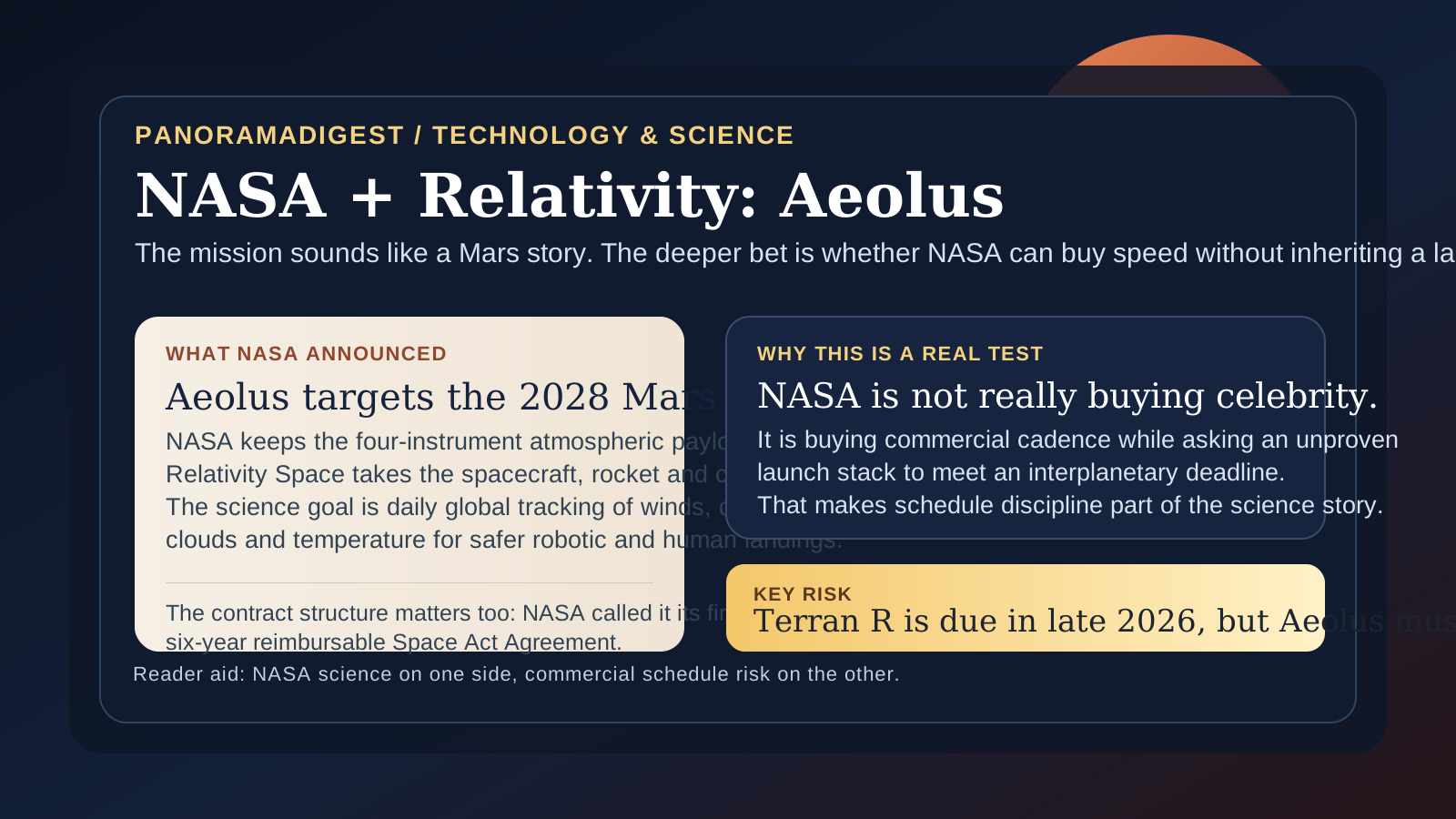
NASA's June 17 announcement was easy to oversimplify as a celebrity-space headline: Eric Schmidt's rocket company gets a Mars mission. The more consequential reading is narrower and more interesting. In its official June 17 release, NASA said it will supply the Aeolus atmospheric-science payload while Relativity Space provides the spacecraft, rocket and cruise operations needed to deliver that payload to Mars in 2028. That is not a decorative partnership. It is a statement about what the agency now wants to buy from the private sector: not just launch capacity, but mission pace.
Aeolus itself is a serious science job. NASA says the four-instrument package is designed to produce the first integrated, daily, global view of Martian winds, temperatures, dust and clouds, giving future robotic and human missions better data for entry, descent and landing. Those are practical measurements, not prestige extras. But the public-private structure matters just as much as the payload. NASA said this is its first six-year reimbursable Space Act Agreement, a detail that signals how far the agency is willing to lean into commercial development when it thinks the science benefit is faster cadence rather than strict institutional control.
Why Aeolus matters beyond one orbiter
NASA's release makes clear that the science case is unusually concrete. Aeolus is supposed to improve models of seasonal atmospheric behavior and reduce risk for future landings by giving planners a better daily picture of how dust, wind and temperature move through the Martian atmosphere. That sounds technical, but the implication is plain: Mars missions fail or succeed on environmental predictability long before a crewed landing becomes a headline. Better weather intelligence is not glamorous. It is infrastructure for ambition.
That is also why this agreement fits a larger pattern in modern space policy. Agencies increasingly want to keep the highest-value science instruments and data pipelines in house while letting commercial partners carry more of the transportation and systems burden. PanoramaDigest made a similar point in its recent look at Europe's Ariane 6 scale test: launch systems are no longer judged only by whether they fly, but by whether they can fly on time often enough to support a real mission rhythm. Aeolus brings that same cadence question to Mars.
| Piece of the mission | Who handles it | Why that split matters |
|---|---|---|
| Aeolus science instruments | NASA | The agency keeps the part most tied to long-term scientific credibility and data quality. |
| Spacecraft, rocket and cruise operations | Relativity Space | The company is being asked to turn commercial speed into a complete interplanetary delivery service. |
| Science data processing pipeline | NASA | The public value of the mission still depends on NASA controlling how raw measurements become usable research products. |
| Schedule pressure | Both, but mostly Relativity's side of the contract | A Mars launch window does not care about startup narratives, management charisma or investor patience. |
The risk is not Mars. It is timing.
This is where the feel-good version of the story breaks down. Relativity Space may be ambitious, but it is not yet operating from a long record of orbital reliability. Its Terran 1 page now describes that rocket as a retired pathfinder vehicle, and earlier reporting from TechCrunch's June 17 coverage notes that the company is being elevated to a Mars assignment after stumbling on the path to orbit. Relativity's bigger bet is Terran R, which the company says on its current product page is targeted for launch starting in late 2026. That leaves very little room for romantic storytelling. If Terran R slips badly, Aeolus does not simply move from one quarter to another. It risks missing the 2028 interplanetary window that gives the whole arrangement its urgency.
That makes this less a story about Schmidt and more a story about NASA's tolerance for managed risk. The agency is effectively saying that a newer commercial player is worth the exposure if the upside is a faster, potentially more repeatable Mars-science pipeline. That logic is not irrational. It is how NASA helped create entire commercial markets in low-Earth orbit. But Mars is a harsher proving ground because planetary windows are discrete, science goals are tightly coupled to launch timing, and the cost of being merely a little late is strategic rather than cosmetic.
- June 17, 2026: NASA announces the public-private Aeolus partnership and locks in the broad role split.
- Late 2026: Relativity says Terran R is supposed to begin launching, giving the company its first real schedule proof point.
- 2027: spacecraft integration and mission operations planning have to mature without forcing NASA to narrow the science ambition.
- 2028: the mission has to hit the Mars window, or the argument for commercial speed starts looking much weaker than the sales pitch.
What readers should watch next
The next honest indicator is not another executive quote about Mars. It is Terran R's actual schedule discipline. If Relativity reaches orbit on something close to the timeline it is now advertising, NASA's Aeolus decision will look less like a daring outlier and more like a preview of how interplanetary science gets bought in the 2030s. If the rocket slips repeatedly, the agency will have learned a harsher lesson: that buying speed from a younger company can quietly become buying delay at a more complicated level.
Source card: NASA's June 17 Aeolus partnership release is the core primary document for the mission split, science purpose and agreement structure. Readers who want the hardware-side context should also check Relativity Space's Terran R page and Terran 1 background page for the company's current launch roadmap and pathfinder history.
Reader Sentiment & Impact Pulse
How do you evaluate the primary outcome of this development?
Select an option to cast your perspective. Responses are anonymous and aggregated in real time.
Key Context & Frequently Asked Questions
NASA's new Aeolus partnership with Relativity Space sounds like a flashy Mars headline, but the harder question is whether the agency can buy faster mission cadence from a rocket company that still has to prove its schedule in orbit first. This analysis from PanoramaDigest examines primary documentation, operational implications, and broader institutional impacts across technology & science.
Read Next
Related Stories

Romania Funds 7 Million Lei Danube Barge Plan to Keep Cernavoda Unit 2 Online
Romania approved a 7 million lei temporary barge intervention at the Bala-Dunarea Veche split to preserve the Danube flow needed by Cernavoda Unit 2.

Zoox Wins Federal Approval for Paid Robotaxis, but State Permits Still Control Launches
NHTSA cleared Zoox's steering-wheel-free robotaxi for a limited paid-service path, but state and local permits still determine where fares can begin.

Kenya Footprints Show Eight Large Hominins Moving Together 1.43 Million Years Ago
A PNAS study describes tracks from eight large hominins at Kenya's Koobi Fora, while leaving open whether they were Paranthropus boisei or Homo erectus.