Keir Starmer Hasn't Quit. But Makerfield Turned Labour's Waiting Game Into a Deadline.
Keir Starmer was still the U.K.'s prime minister on June 21, 2026. But Andy Burnham's Makerfield win changed the question from whether Labour had a problem to how long the party can afford to stall.
Keir Starmer was still listed by GOV.UK as the United Kingdom's prime minister on Sunday, June 21, 2026. That matters, because this is not yet a resignation story. It is something more revealing: a story about how quickly authority can drain from an office before the office itself changes hands.
BBC News / YouTube — Andy Burnham wins Makerfield by-election
BBC News video provides direct context on Burnham's Makerfield victory, the electoral trigger behind Labour's new leadership deadline.
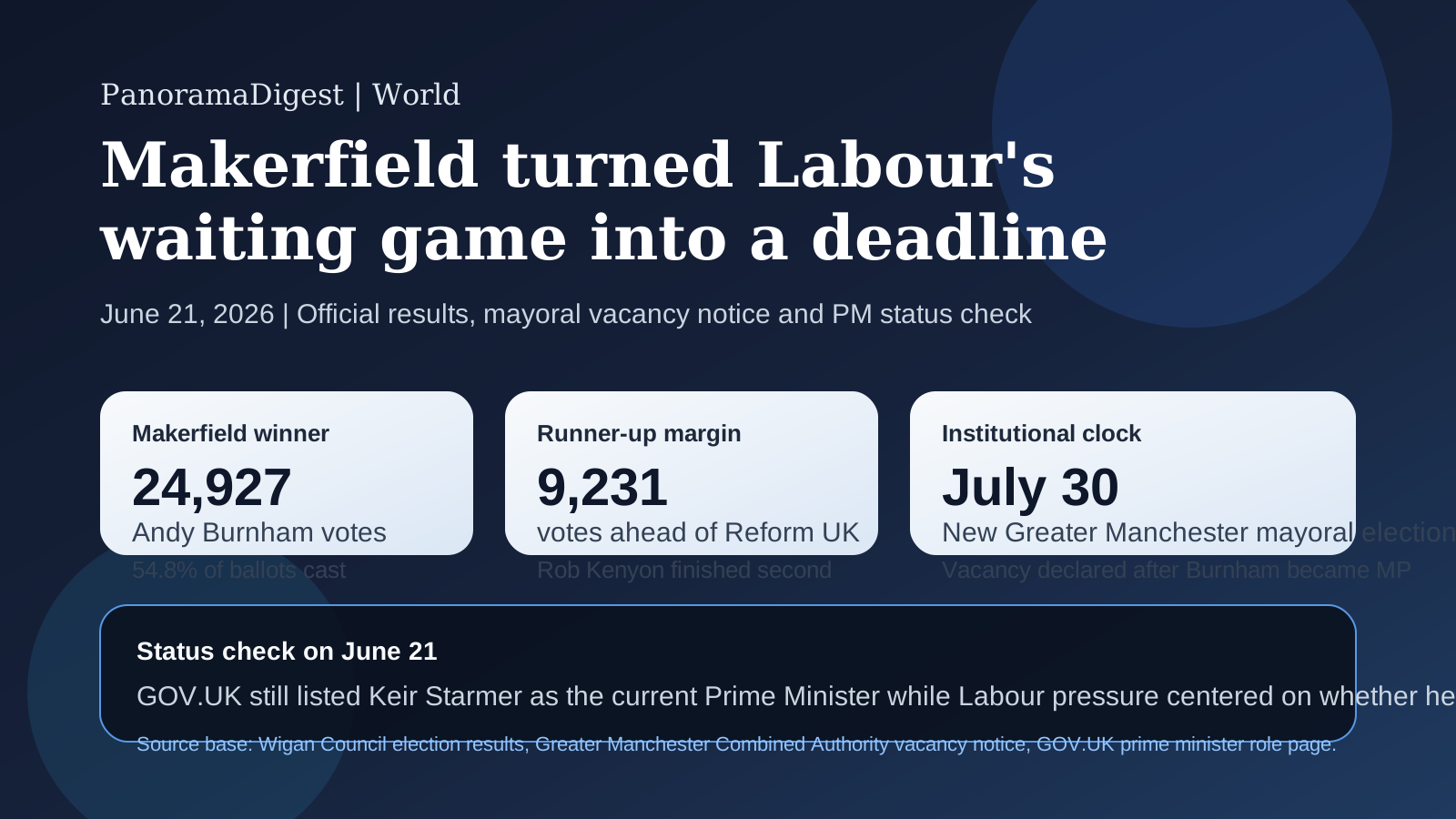
The immediate trigger is now official record, not Westminster gossip. Andy Burnham won the June 18 parliamentary by-election in Makerfield with 24,927 votes, according to Wigan Council's certified result page, taking nearly 55% of the vote and finishing 9,231 ballots ahead of Reform UK's Rob Kenyon. A day later, the Greater Manchester Combined Authority announced a vacancy in the mayoralty because Burnham's return to Parliament disqualified him from continuing in that office and set a new mayoral election for July 30. In other words, Burnham did not just win a seat. He reopened a route back to national power.
That is why Labour's problem has become more dangerous than a bad week. Burnham's win did not remove Starmer from office, and it did not automatically begin a leadership contest. What it did was strip away the most comfortable defense available to an embattled prime minister: that there was no plausible successor with fresh democratic momentum. Now there is one.
Everyone knows that politics isn't working.
Andy Burnham, after the Makerfield by-election, as reported by CBS/AP
This is a deadline story, not a coup story
British politics has become too accustomed to reading leadership turmoil as instant regime change. This moment is sharper than that and slower than that. CBS/AP reported Sunday that Business Secretary Peter Kyle said Starmer was taking time to reflect on the political realities around him while dismissing immediate resignation reports as speculation. That wording is important. It suggests a government trying to keep institutional control while privately admitting that the old argument for patience is gone.
The harder political truth is that Labour no longer has the luxury of pretending its internal question is merely atmospheric. When a governing party starts discussing whether its leader should leave before the leader has accepted the premise, every public appearance turns into a countdown. Cabinet discipline weakens. Ambition stops hiding. Markets, diplomats and civil servants all begin reading policy through the lens of succession.
| Signal | What changed | Why it matters now |
|---|---|---|
| Makerfield result | Burnham won with 24,927 votes and 58.77% turnout in a real electoral test. | Labour's strongest internal alternative now has a fresh parliamentary mandate, not just media intrigue. |
| Greater Manchester vacancy | The mayoralty was formally declared vacant on June 19, with a replacement vote set for July 30. | Burnham's move back to Westminster is no longer symbolic; it has immediate institutional consequences. |
| Starmer's official status | GOV.UK still listed Starmer as prime minister on June 21. | The crisis is about authority draining before office changes hands. |
| Cabinet language | Peter Kyle publicly acknowledged the prime minister was reflecting on political realities. | That is softer than open revolt, but harder than a routine denial. |
Why Burnham changes the geometry
Burnham matters because he offers Labour something Westminster factions rarely trust at the same time: electoral proof, public familiarity and a governing record outside Parliament. His Makerfield win came after years as mayor of Greater Manchester, which lets allies present him as more than a protest candidate. He can argue that he has run something, won something and can now challenge from inside the Commons rather than from the political outskirts.
That does not make him inevitable. A leadership race would still split Labour over ideology, timing and legitimacy. Some MPs will fear replacing one unpopular leader with another short-term fix. Others will worry that a handover without a general election looks procedurally legal but politically thin. Yet those are problems of method. Starmer's problem is more basic: the party now has a real vehicle for impatience.
Watch BBC News' report on Burnham's Makerfield by-election win here.
The risk for Labour is not only who leads next
If Starmer goes, Britain would be looking at its sixth prime ministerial exit in a decade. That statistic is not just constitutional trivia. It is a governing cost. Allies begin discounting long-term promises. Voters stop hearing reset language as renewal and start hearing it as another elite workaround. Every transition makes the next one easier to imagine.
That is why this story should not be flattened into palace drama. Labour's decline has been fueled by unmet promises on growth, public-service repair and cost-of-living relief, while pressure has also come from both flanks: liberal voters drifting toward the Greens and anti-immigration voters feeding Reform UK. Burnham's parliamentary return sharpens the leadership question, but it does not answer the governing question that created the opening.
What to watch on Monday, June 22
The first test is not whether Starmer vanishes overnight. It is whether he can reappear with enough authority to turn Monday into a reset instead of a suspense cycle. If he sets a timetable, Labour moves into managed succession. If he refuses and the party keeps leaking doubt, the government enters a weaker and more punishing phase: one where every policy announcement is judged mainly by whether it looks like a leader buying time.
Burnham's victory in Makerfield did not end Keir Starmer's premiership on June 21. It did something more consequential in the short term. It made waiting look like a political decision in its own right, and in Westminster that is usually when the clock starts being heard by everyone.
Reader Sentiment & Impact Pulse
How do you evaluate the primary outcome of this development?
Select an option to cast your perspective. Responses are anonymous and aggregated in real time.
Key Context & Frequently Asked Questions
Keir Starmer was still the U.K.'s prime minister on June 21, 2026. But Andy Burnham's Makerfield win changed the question from whether Labour had a problem to how long the party can afford to stall. This analysis from PanoramaDigest examines primary documentation, operational implications, and broader institutional impacts across world.
Read Next
Related Stories

Israeli President Pardons Combat Medic Convicted in High-Profile Shooting
Israeli President Isaac Herzog has granted an executive pardon to a combat medic convicted after shooting an incapacitated Palestinian attacker. The decision reopens deep national debates over military legal accountability and international human rights standards.
Houthi Ballistic Missile Attack Targeting Riyadh Heightens Regional Security Risks
Yemen’s Houthi movement has claimed a ballistic missile attack on the Saudi capital, threatening regional economic stability and signaling a renewed wave of escalation across Middle Eastern energy corridors.

Putin Accuses Ukraine of Interfering in Russian Parliamentary Elections
Russian President Vladimir Putin alleged Ukrainian intelligence services are actively attempting to sabotage Russia's parliamentary elections, signaling potential cyber escalations and tightened domestic security control.