Vance Is in Switzerland. The Real Test Is Whether the U.S.-Iran Deal Can Survive Two Negotiations at Once.
JD Vance's June 21 arrival in Switzerland turned the U.S.-Iran file from a ceasefire announcement into a harder question: can Washington and Tehran build a nuclear roadmap while Lebanon and Hormuz keep rewriting the terms in real time?
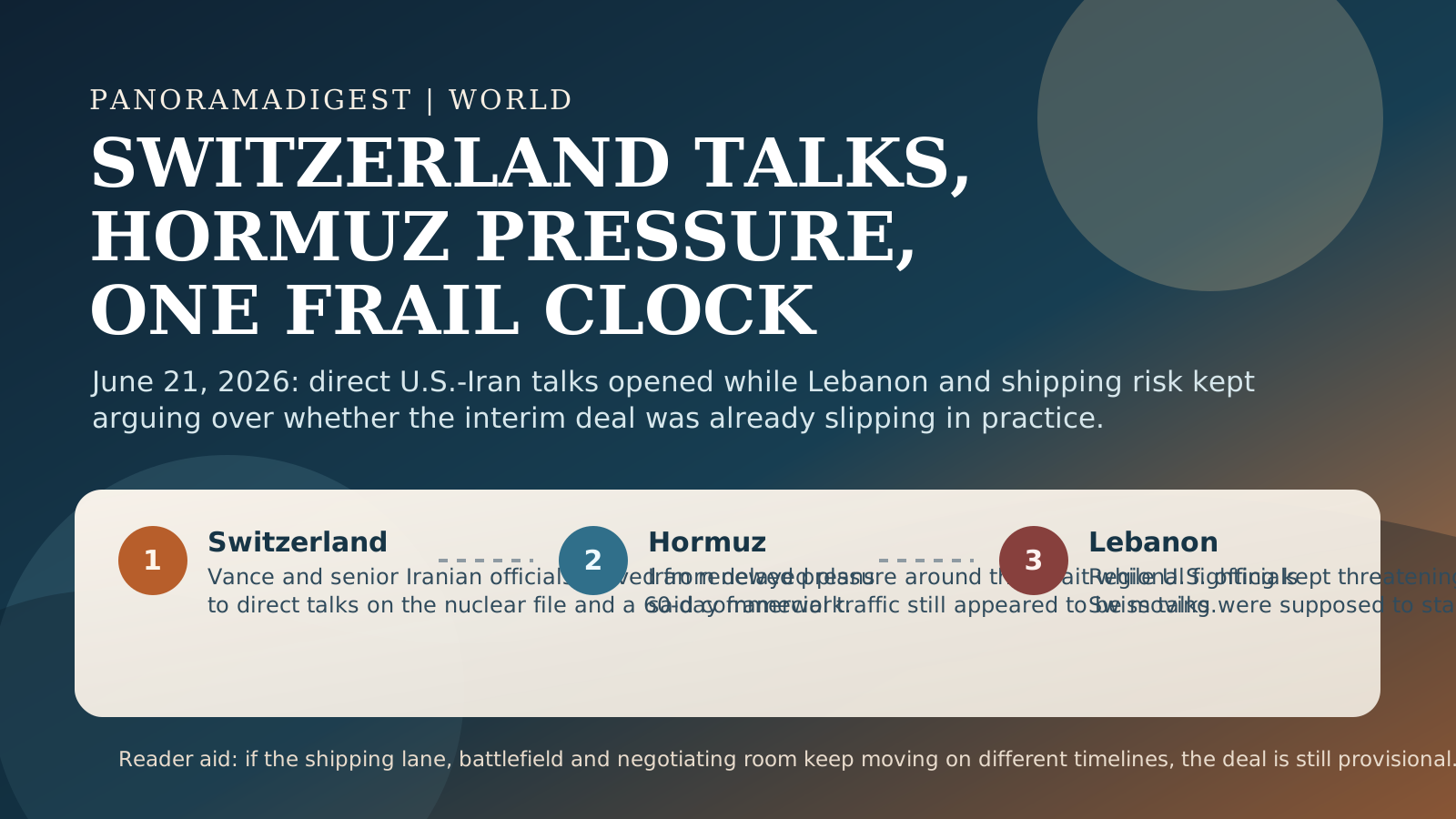
Vice President JD Vance's arrival in Switzerland on Sunday, June 21, 2026 did not open a clean diplomatic chapter. It opened two negotiations at once. The Associated Press reported that Vance met senior Iranian officials as the White House tried to put last week's interim war-ending deal back on a workable track. CBS News described the session as a rare face-to-face launch of a 60-day sprint over the future of Iran's nuclear program. But Al Jazeera, citing AFP and Reuters, noted that the talks began only after Iran's Revolutionary Guard announced another closure of the Strait of Hormuz in response to Israeli attacks in Lebanon, even as the U.S. military said commercial vessels were still operating. That is the real shape of Sunday's story. The nuclear track is not negotiating in a quiet room. It is negotiating while the regional enforcement problem keeps barging through the door.
CBS News / YouTube — JD Vance joins talks with Iran in Switzerland
CBS News' June 21 video is the cleanest current visual summary of Vance's Switzerland meeting with Iranian officials. If the player does not render, use the direct YouTube link in the story.
That matters because the June 21 meeting is the first truly practical test of whether this deal has moved beyond emergency messaging. A ceasefire extension is one thing. A durable sequence of obligations is another. Washington wants to move toward a broader settlement that restrains Iran's nuclear program, stabilizes shipping, and lowers the odds of the war reigniting. Tehran wants sanctions relief, economic breathing room, and proof that the United States can constrain the wider battlefield that surrounds the deal. Those aims can coexist on paper. They are much harder to hold together when one side says it is negotiating in good faith while the other says Lebanon and Hormuz already prove the interim terms are being violated in spirit, if not yet in formal text.
The room in Switzerland is trying to solve a sequencing problem
AP's dispatch is useful because it resists the temptation to oversell the handshake. The report frames Vance's meeting with Iranian officials as an effort to get negotiations back on track, not as evidence that a durable settlement is already near. CBS adds the key institutional point: the talks mark the start of a 60-day window to work out what happens next on Iran's nuclear program. That is a concrete clock. The trouble is that the region is running on different clocks at the same time. Iran is signaling urgency around sanctions, oil flows and regional pressure. The Trump administration is signaling urgency around Hezbollah and broader deterrence. Markets and shipping insurers are signaling urgency around Hormuz. None of those timelines line up neatly.
That is why the Swiss venue matters less as symbolism than as a sorting mechanism. The negotiators do not simply have to produce language. They have to decide what counts as compliance while the ground beneath the agreement is still moving. Does Iran's renewed Hormuz announcement function as leverage, a warning, or a partial breach? Do continued strikes linked to Lebanon count as outside noise or as proof that the political assumptions behind the deal are too weak? Those are not side arguments. They are the architecture of whether a 60-day sprint can produce anything more than a better-organized pause.
Why this is a real follow-up, not a duplicate of PanoramaDigest's earlier Iran coverage
PanoramaDigest has already tracked the earlier parts of this file. On June 19, our analysis of Lebanon's fragile ceasefire and the U.S.-Iran talks argued that the regional side of the agreement was always the part most likely to wobble first. On June 20, our piece on Iran's renewed Hormuz warning argued that the real danger was not only physical closure but the collapse of a shared diplomatic timeline. June 21 is a genuine next step because the talks have now formally begun under those exact stresses. This is no longer a debate over whether diplomats might meet. It is the first day on which they are trying to negotiate while the ceasefire's supporting assumptions are already being contested in public.
| Pressure point | What changed by June 21 | Why it matters now |
|---|---|---|
| Switzerland talks | Vance and senior Iranian officials moved from planned contact to actual face-to-face talks. | The deal now has to produce working details, not only intentions. |
| Hormuz risk | Iran renewed pressure around the strait while the U.S. position remained that commercial traffic was still functioning. | The gap between political warning and operating reality keeps oil, shipping and diplomacy tied together. |
| Lebanon fighting | Regional violence remained the easiest way for either side to argue that broader commitments were being undercut. | If the battlefield keeps moving, every technical negotiation becomes harder to trust. |
| Deal credibility | Washington wants to build out a nuclear framework; Tehran wants proof that the surrounding bargain is enforceable. | The talks can fail without a dramatic walkout if both sides keep reading the same agreement through different priorities. |
Vance's language matters because the administration is trying to widen the frame
Al Jazeera's account, drawing on AFP and Reuters, highlighted Vance's claim that Washington wants to "turn over a new leaf" in the Middle East. That is not just rhetorical garnish. It suggests the administration wants these talks to be read as something larger than crisis management. A nuclear framework, in that reading, could become the entry point to a broader rearrangement of U.S.-Iran relations. But the same report also notes that President Donald Trump continued warning that the United States could strike Iran again if Hezbollah's actions escalated. That tension matters. One side of the message invites strategic reset. The other side reminds Tehran that the reset is being offered under pressure, with military leverage still very much in view.
Iran, for its part, has every reason to use that contrast. A government that wants sanctions relief can still argue to domestic audiences that it is negotiating from resistance rather than concession. That is why Sunday should be read as a test of political elasticity, not merely diplomatic endurance. Can both governments keep telling their own publics that they are holding firm while still making enough technical progress to justify the next meeting? The answer will probably matter more than whether the first session produces a headline breakthrough.
- Earlier this week: Washington and Tehran extended the ceasefire framework and set up a 60-day negotiation window over Iran's nuclear future.
- Saturday, June 20: Iran renewed Hormuz pressure and linked regional instability to Israeli attacks in Lebanon, while U.S. officials said commercial traffic still appeared to move.
- Sunday, June 21: Vance and senior Iranian officials met in Switzerland for direct talks on how to turn the interim arrangement into a more durable structure.
- Next phase: The talks must prove they can survive competing public threats, battlefield slippage and the unresolved order of who owes what first.
What readers should watch over the next 48 hours
The first signal is not whether negotiators smile for cameras. It is whether they leave Switzerland with a usable sequence. Watch for any common language on inspections, sanctions timing, or interim enforcement steps. The second signal is whether the Hormuz file calms in practice. If commercial transit remains steady and no new operational interference appears, that lowers the pressure even if the rhetoric stays sharp. The third signal is Lebanon. If the regional fire keeps flaring, Tehran can keep insisting that Washington is asking for nuclear patience while failing to stabilize the environment around it.
That is why June 21 deserves more than a simple "talks began" treatment. The diplomatic story is not that the two sides found a room. It is that the room now has to compete with every force outside it that profits from delay, ambiguity or renewed escalation. The real test is whether the U.S.-Iran deal can survive two negotiations at once: the formal one in Switzerland and the informal one being waged across Hormuz, Lebanon and the politics of deterrence.
Watch the source card: the clearest current video summary is CBS News' JD Vance joins talks with Iran in Switzerland. If the embedded player does not render in your browser or region, the direct YouTube link carries the same report. For text verification, keep the AP main dispatch, the AP live update, the CBS live file, and Al Jazeera's Sunday report open alongside PanoramaDigest's own recent follow-ups.
Reader Sentiment & Impact Pulse
How do you evaluate the primary outcome of this development?
Select an option to cast your perspective. Responses are anonymous and aggregated in real time.
Key Context & Frequently Asked Questions
JD Vance's June 21 arrival in Switzerland turned the U.S.-Iran file from a ceasefire announcement into a harder question: can Washington and Tehran build a nuclear roadmap while Lebanon and Hormuz keep rewriting the terms in real time? This analysis from PanoramaDigest examines primary documentation, operational implications, and broader institutional impacts across world.
Read Next
Related Stories

Israeli President Pardons Combat Medic Convicted in High-Profile Shooting
Israeli President Isaac Herzog has granted an executive pardon to a combat medic convicted after shooting an incapacitated Palestinian attacker. The decision reopens deep national debates over military legal accountability and international human rights standards.
Houthi Ballistic Missile Attack Targeting Riyadh Heightens Regional Security Risks
Yemen’s Houthi movement has claimed a ballistic missile attack on the Saudi capital, threatening regional economic stability and signaling a renewed wave of escalation across Middle Eastern energy corridors.

Putin Accuses Ukraine of Interfering in Russian Parliamentary Elections
Russian President Vladimir Putin alleged Ukrainian intelligence services are actively attempting to sabotage Russia's parliamentary elections, signaling potential cyber escalations and tightened domestic security control.