More Than 5,300 People Are Still Trapped Near Thailand. The Scam-Centre Crackdown Never Built the Exit.
A year after a celebrated border crackdown, a Thai-based trafficking-victim network says more than 5,300 people are still stuck inside scam compounds in Myanmar. The hard truth is that raids are not the same thing as an exit system.
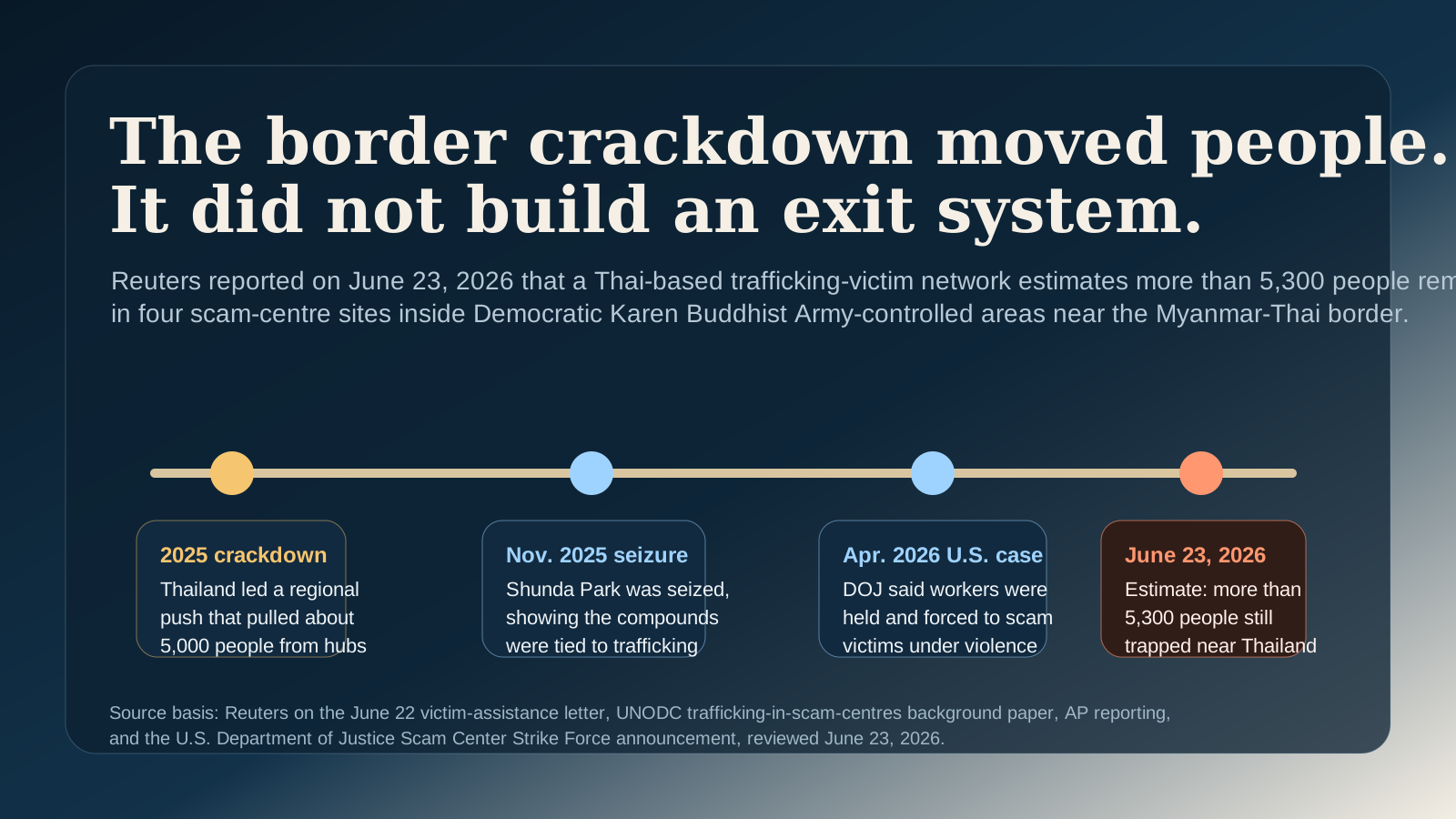
The new number matters because it exposes the weakness in one of the region's most publicized anti-scam campaigns. Reuters reported on June 23, 2026, that a Thailand-based victim-assistance network estimates more than 5,300 people are still trapped in online scam compounds near Myanmar's border with Thailand, more than a year after thousands were removed during a multinational crackdown. If that estimate is even close to accurate, the story is no longer that Southeast Asia found a working model. It is that the region proved it could stage rescues without building a reliable way to finish them.
According to the Reuters report, the Civil Society Network for Human Trafficking Victim Assistance said in a June 22 letter to Thai police that victims remain confined at four sites inside areas controlled by the Democratic Karen Buddhist Army, or DKBA. The group said the trapped population includes large numbers of foreign nationals, among them Chinese, Burmese, Thai and citizens of countries stretching from the Philippines and Malaysia to Brazil, Kenya and Zimbabwe. Reuters also reported that Thai authorities helped pull roughly 5,000 people out of scam hubs in Myanmar's Myawaddy area last year, but that large-scale illegal operations continued.
That is the key distinction readers should hold onto. A crackdown can be real in the narrow sense that it disrupts compounds, seizes devices or moves victims across a river. It can still fail in the larger sense if the same geography, militia protection, trafficking routes and profit incentives remain intact. Border scam economies do not collapse just because one operation becomes politically expensive. They collapse only when the route from rescue to repatriation to prosecution becomes sturdier than the route from recruitment to confinement to fraud.
| Moment | What happened | What it actually proved |
|---|---|---|
| 2025 regional push | Thailand led a widely watched effort that removed thousands of people from scam hubs near Myawaddy. | States could force movement at the border, but not necessarily close the ecosystem behind it. |
| November 2025 | The Shunda Park compound in Myanmar was seized. | Investigators gained evidence that scam compounds were tied to trafficking, coercion and transnational fraud. |
| April 2026 | The U.S. charged two Chinese nationals accused of managing the Shunda operation. | The business model was international enough to trigger federal action far beyond the border region. |
| June 23, 2026 | A Thai-based victim network said more than 5,300 people remain trapped at four sites. | The rescue architecture is still too partial to convert pressure into durable shutdowns. |
A rescue headline is not the same thing as a shutdown
The easiest mistake in stories like this is to confuse extraction with resolution. Reuters said the June 22 letter identified compounds in militia-controlled territory and warned that many sites had not been dismantled or subjected to full rescue operations. That matters because scam-centre networks thrive in zones where sovereignty is layered, bargaining is informal and enforcement can be selective. When that environment survives, operators do not need perfect impunity. They only need enough time, enough access and enough human inventory to restart.
The broader institutional record points the same way. A 2026 UN Office on Drugs and Crime background paper on trafficking linked to scam centres treats these compounds not as isolated fraud dens but as a trafficking system built around forced criminality. That language matters. It means the workers inside are not simply operators in a gray market. Many are people recruited under false job offers, stripped of documents, intimidated, beaten or sold between compounds, then ordered to cheat strangers abroad as the price of survival.
The U.S. Department of Justice offered a particularly concrete example in April. In its Scam Center Strike Force announcement, the department said workers in the Shunda compound were trafficked, held against their will and forced to defraud victims under threat of violence and torture. The department said FBI agents reviewed thousands of devices recovered after the compound's seizure and traced schemes that targeted Americans. AP's subsequent report on the case added that the defendants were accused of managing that operation before later turning up in Thailand on immigration charges. In other words, the fraud was not local, the victims were not local and the profits were not staying local either.
The real bottleneck is not discovery. It is controlled exit.
By now, the scam-centre model is not mysterious. Investigators, aid groups and police know the recruitment patterns. They know the border routes. They know the compounds rely on a mix of militia protection, criminal management, digital infrastructure and cross-border logistics. The harder part is what comes after identification. A functioning exit system has to do four things at once: remove victims safely, hold them somewhere more secure than the compound network, identify nationality and trafficking status quickly, and build cases that survive political delay. Miss any one of those steps and the operation drifts back toward the criminals.
That is why the June 23 figure is so politically uncomfortable. It suggests the region has become better at dramatic intervention than at administrative follow-through. Rescue capacity made headlines. Durable custody, repatriation pipelines and prosecution coordination did not keep pace. The result is a system that can produce impressive visuals and deeply incomplete outcomes at the same time.
What a serious response would look like
If governments in the region want this story to look different by late 2026, they need something more boring and more important than a fresh show of force. They need a repeatable handoff system.
- First, Thailand, Myanmar-border authorities and partner governments need a standing triage mechanism for victims pulled from compounds, including translation, document recovery and immediate trafficking screening.
- Second, investigators need shared case-building around the compounds themselves, not just individual workers, so prosecutions move up the chain toward operators, transporters, recruiters and militia-linked protection networks.
- Third, the region needs public accounting of which compounds were actually dismantled, which were only disrupted and which simply shifted control or geography.
Without that kind of bookkeeping, every new raid invites the same illusion: that motion equals progress. Sometimes it does. Sometimes it only changes where the locked door is.
Readers can review the freshest public reporting in the Reuters report carried by WHTC, the April AP account of the U.S. charges tied to Shunda Park, and the Justice Department's official strike-force announcement. The number to watch next is not only how many people are rescued. It is how many compounds can no longer refill, rename themselves or reopen under another patron. That is the difference between a border operation and a real exit.
Reader Sentiment & Impact Pulse
How do you evaluate the primary outcome of this development?
Select an option to cast your perspective. Responses are anonymous and aggregated in real time.
Key Context & Frequently Asked Questions
A year after a celebrated border crackdown, a Thai-based trafficking-victim network says more than 5,300 people are still stuck inside scam compounds in Myanmar. The hard truth is that raids are not the same thing as an exit system. This analysis from PanoramaDigest examines primary documentation, operational implications, and broader institutional impacts across world.
Read Next
Related Stories

World Leaders Convene at UN Amid Compounding Crises of War, Climate, and AI
Global heads of state gather at United Nations headquarters as intersecting geopolitical conflicts, accelerating climate disasters, and unregulated artificial intelligence challenge multilateral governance.

German Chancellor Merz Slams State Election Outcome as Party 'Disaster' but Defies Calls to Step Down
German Chancellor Friedrich Merz has bluntly labeled a crucial regional election a disaster for his conservative party, yet firmly rejected mounting pressure for his resignation as political instability rattles Berlin.
Russia's Ruling United Russia Party Extends Dominance in Wartime Parliamentary Vote
Early election results in Russia show the ruling United Russia party consolidating its grip on legislative power amid tight state control and ongoing military operations in Ukraine. The wartime vote reinforces Moscow's centralized political trajectory while further insulating its wartime economy from domestic legislative challenge.