New York's Primary Day Is Really a Test of Whether Democratic Energy Can Scale
On Tuesday, June 23, 2026, New York's primary election is doing more than naming nominees. It is measuring whether the city's progressive energy, the party establishment's defensive muscle and a closed-primary turnout model can scale into candidates strong enough for a narrowly divided House map in November.
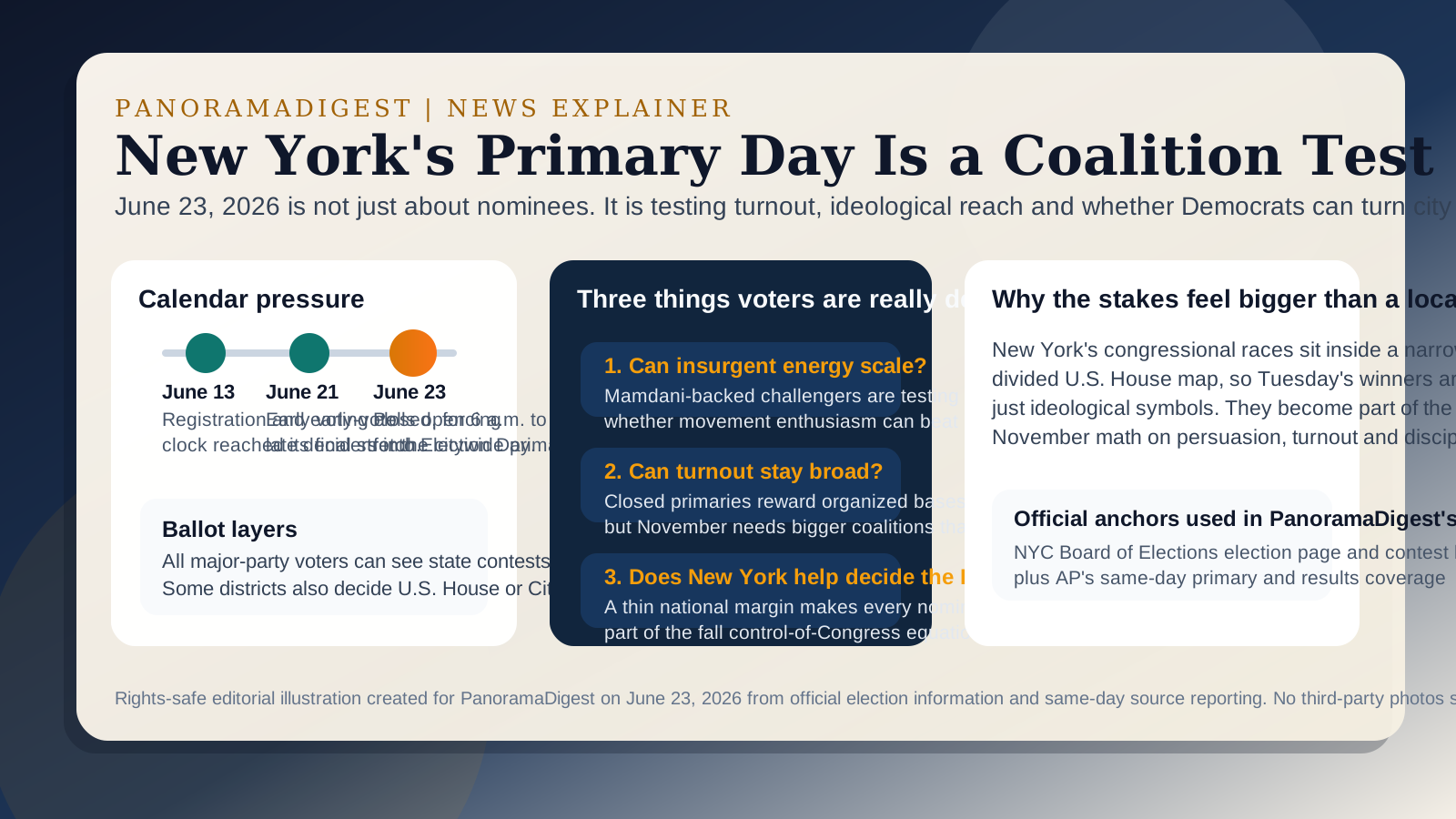
The cleanest way to read New York's primary election on Tuesday, June 23, 2026, is not as a collection of isolated district dramas. It is as a coalition exam happening under deadline. The New York City Board of Elections says polls are open from 6 a.m. to 9 p.m. on June 23, after an early-voting period that ran from June 13 through June 21. That calendar sounds procedural. Politically, it is doing harder work. It is forcing the Democratic Party's New York factions to show whether intensity can become turnout, whether turnout can become persuasion, and whether either of those things can survive the jump from city-primary theater to a general-election map where control of the U.S. House is still close enough for every nominee to matter.
CBS New York — Voting beings for the 2026 primary election in NYC
CBS New York's same-day report shows polls opening for the June 23 primary; the article body includes a direct YouTube fallback link if the player is blocked.
That is why the city's biggest congressional contests deserve to be read less as personality feuds and more as stress tests. The Associated Press reported that Democratic incumbents Dan Goldman and Adriano Espaillat are facing challengers backed by Mayor Zohran Mamdani, while a crowded open-seat contest is unfolding in the district being vacated by Jerry Nadler. AP's primary-results page adds the national frame directly: New York's seats in the closely divided U.S. House are a central story in Tuesday's election. That sentence is the article. Everything else is detail.
Watch the local video brief: if the player below does not load in your browser, use the direct link to CBS New York's same-day report from the opening of primary voting.
What is actually on the ballot, and why that matters
NYC Votes says the June primary can include city, state and federal offices depending on where a voter lives. All major-party voters in the city can vote for state comptroller, state Senate and state Assembly contests, while some districts also have U.S. House and City Council races on the ballot. That mix matters because it means many voters are not simply picking between personalities. They are getting a compressed test of what kind of party they want at several levels of government at once. Closed primaries reward intensity and organization; general elections reward breadth. Tuesday's winners will need both, even if only one is enough to get through the day.
It is also why the city cannot afford to confuse activist heat with durable coalition strength. In a low-trust political climate, primaries often flatter the best-organized faction rather than the most transferable one. That tension is familiar in national politics, but it is especially sharp in New York because the state has become one of the places where Democrats must defend existing ground and build new November leverage at the same time. PanoramaDigest's earlier look at how voter-system credibility depends on cleaner process, not louder rhetoric sits in the background here too: winning an argument inside a party is not the same thing as widening trust outside it.
| Test | What Tuesday measures | Why it matters after Tuesday |
|---|---|---|
| Mamdani's reach | Whether mayoral momentum can move congressional races, not just citywide enthusiasm. | If the endorsements land, progressives gain leverage. If they stall, establishment Democrats can argue that base excitement still has limits. |
| Closed-primary turnout | Whether organized voters can dominate the field without producing a nominee too narrow for November. | Primary winners who cannot expand their coalition become liabilities in a thin House map. |
| Open-seat discipline | How the party handles crowded races where no incumbent can hold the center together. | Messy victories can leave ideological residue that Republicans exploit later, even in blue terrain. |
The city races are really arguing about scale
AP's same-day race framing gives the clearest evidence of what the party is testing. Goldman and Espaillat are not facing generic challengers. They are facing candidates attached to a larger argument about what Democratic ambition should look like in 2026: more insurgent, more ideological, more willing to use city-level momentum to rearrange congressional power. At the same time, the open seat vacated by Nadler shows the opposite pressure. Crowded fields can invite novelty, celebrity and sharper factional appeals, but they also expose how quickly a party can mistake buzz for structure.
That is where Tuesday's primary becomes less romantic than some of its slogans. Political movements love proof-of-life moments. They are worse at admitting that nomination fights are only half the job. A candidate who can electrify the most committed slice of the electorate is useful. A candidate who can survive attack advertising, lower-information fall voting and the national drag of a hostile cycle is more useful. New York Democrats are not deciding between purity and compromise. They are deciding, district by district, what kind of political product can actually travel.
What to watch after the polls close
The first thing to watch is not merely who wins. It is how they win. If insurgent candidates break through with broad-enough geographic and demographic support, progressives will have a stronger claim that their politics can scale beyond movement spaces. If incumbents or establishment-backed figures hold on with room to spare, they will argue that primary intensity remains louder online than in the actual electorate. If the open-seat races splinter badly, the warning sign is not chaos for its own sake. It is the possibility that the party spends the rest of the summer explaining its own internal divisions instead of widening its fall message.
The second thing to watch is whether turnout tells a narrow story or a healthy one. New York's closed-primary structure means high-information and highly motivated voters tend to have outsized power. That can be a feature when parties need clarity. It can also be a problem when November will require candidates to sound less like factional avatars and more like coalition managers. Tuesday's winners should be judged not only by the voters they thrilled, but by the voters they still need.
The city will get names by the end of the night. The harder answer will take longer. New York's June 23 primary is not just deciding who carries a party label into November. It is deciding whether the party has learned how to translate internal energy into something steadier, broader and more durable than a one-day show of force.
Reader Sentiment & Impact Pulse
How do you evaluate the primary outcome of this development?
Select an option to cast your perspective. Responses are anonymous and aggregated in real time.
Key Context & Frequently Asked Questions
On Tuesday, June 23, 2026, New York's primary election is doing more than naming nominees. It is measuring whether the city's progressive energy, the party establishment's defensive muscle and a closed-primary turnout model can scale into candidates strong enough for a narrowly divided House map in November. This analysis from PanoramaDigest examines primary documentation, operational implications, and broader institutional impacts across news.
Read Next
Related Stories
Old Trails Fire Damage Estimate Reaches 640 Structures in Spokane
Spokane County's preliminary estimate says the Old Trails fire destroyed 640 structures, while evacuation zones remain active across northwest Spokane.

USCIS Can Now Refer Asylum Cases to Immigration Court Without an Interview
A DHS rule effective July 28 lets USCIS send some affirmative asylum applications directly to immigration court. Referral is not a denial, but the interview is no longer guaranteed.

Seattle Center Shooting Kills Three and Injures Four at Bite of Seattle Festival
Seattle police say a shooting at the Bite of Seattle festival killed three people and injured four others, including a 2-year-old boy. One suspect was arrested and police continued searching for another.