SpaceX's Starfall Debut Is Really a Bet on Return Cargo, Not Launch Theater
SpaceX launched its first Starfall demo mission on June 23, 2026. The sharper story is not the sunrise liftoff itself, but whether a much larger return capsule can make orbital manufacturing, research retrieval and reentry logistics feel routine instead of exotic.
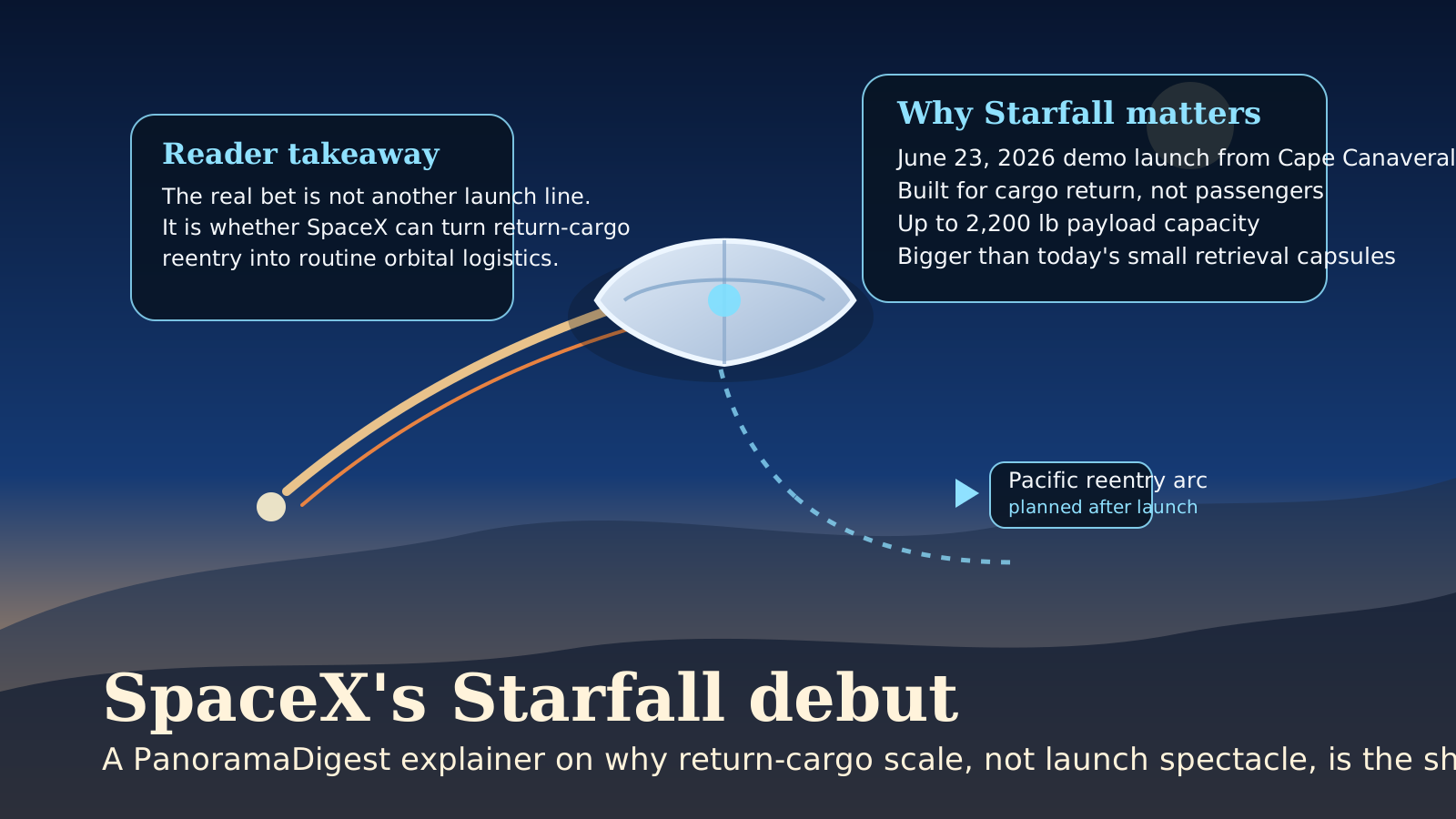
SpaceX's first Starfall Demo Mission lifted off from Cape Canaveral on Tuesday, June 23, 2026, and the easiest way to read it is as another efficient Falcon 9 morning. That misses the more interesting point. Starfall is not mainly a launch story. It is a logistics story about whether SpaceX can make return cargo from orbit feel less like a boutique stunt and more like a dependable service layer.
Space.com reported that the mission lifted off at 6:52 a.m. EDT from Space Launch Complex-40 and described Starfall as a cargo transportation vehicle built to take payloads to low Earth orbit and bring materials safely back to Earth. That matters because the return leg is where orbital commerce still feels thin. Launch has become cheaper and more frequent. Retrieval remains harder, scarcer and strategically more valuable than the public often notices.
Why the capsule matters more than the rocket
SpaceX's launch page frames Starfall as a dedicated mission to low Earth orbit, but the real novelty sits in the vehicle profile rather than the Falcon 9 underneath it. Space.com's launch-day reporting says Starfall is designed for payloads that need retrieval after time in orbit, including pharmaceutical and manufacturing work that cannot be monetized fully if the return path stays narrow or expensive. The same report says Starfall can carry up to 2,200 pounds, making it materially larger than the small reentry capsules that have defined the current commercial-return niche.
That size difference changes the argument. A return capsule that is meaningfully bigger is not just offering more room. It is testing whether the economics of orbital experimentation can shift from one-off demonstrations toward something closer to scheduled logistics. PanoramaDigest readers saw a version of this timing-and-scale question in our June 17 analysis of Europe's Ariane 6 scale challenge and again in our June 20 look at NASA's pace bet on commercial Mars delivery. Space is increasingly less about whether one mission flies and more about whether an operational lane can be repeated often enough to support real planning.
The harder comparison is with today's smaller retrieval market
That is where the story gets sharper. Space.com notes that Varda Space has already landed five smaller capsules, proving there is real demand for bringing specialized payloads back from orbit. But Starfall appears to be chasing a different level of throughput. A bigger vehicle can widen the range of experiments, hardware and manufacturing output worth sending up in the first place. The question is whether that extra scale comes with a dependable recovery rhythm or merely a larger headline.
| Return-cargo question | What Starfall suggests | Why readers should care |
|---|---|---|
| Payload scale | A larger retrieval platform than the current small-capsule niche | Bigger return volume can make orbital experiments easier to justify commercially. |
| Mission purpose | Built for cargo and materials, not crew transport | This is infrastructure for research and production, not a tourism side show. |
| Operational value | Success depends on repeatable reentry and recovery, not just launch | Without cadence, orbital manufacturing remains more aspirational than industrial. |
| Competitive signal | SpaceX is moving into a market Varda helped legitimize | The retrieval economy may be shifting from niche proof points toward platform competition. |
Why FAA airspace language is part of the story
The launch also came with an unusual reminder that Starfall is a reentry operation as much as an ascent. The FAA's June 23 operations advisory said the Starfall launch was successful out of the Cape and that reentry was anticipated later that morning in western U.S. airspace. That bureaucratic detail matters because it underscores what SpaceX is really testing: a full outbound-and-back transportation loop, not just a payload drop-off. Once airspace planning, recovery windows and return trajectories become routine, the category starts to look less experimental and more infrastructural.
There is still a serious caveat here. Space.com notes that Starfall lacks its own propulsion system and likely depends on the launch stack and mission design to manage the return profile. That means the service is only as credible as the entire chain around it: launch schedule discipline, orbital operations, heat-shield performance, recovery execution and customer confidence that the returned cargo will arrive when it matters. A bigger capsule without predictable timing is just a bigger promise.
- Before June 23: commercial return cargo had proof points, but mostly through smaller, niche capsule missions.
- June 23, 2026: SpaceX launches the first Starfall demo mission from Florida, pushing a larger-scale return concept into live operations.
- Same-day FAA tracking: the advisory language highlights that reentry planning, not just liftoff, defines the mission.
- Next test: whether Starfall can build a repeatable retrieval cadence that makes orbital manufacturing and research planning less fragile.
What to watch after the debut
The cleanest next indicator is not applause around the first launch. It is whether SpaceX can show that Starfall will support a believable schedule for recovered payloads and a customer base that needs more than symbolic access to microgravity. If the system matures, the winners are not only launch-watchers. They are the companies and labs that can finally plan around return capacity instead of treating it as a rare opportunity.
That is also why Starfall deserves a more sober reading than the usual rocket highlight reel. Space launch is already crowded with competent providers and increasingly familiar milestones. The thinner lane is what happens after orbit, when physical goods, research samples and manufacturing output need a reliable way home. If Starfall can widen that lane, Tuesday's mission will look less like a spectacle and more like the quiet start of a new logistics layer.
Source card: The cleanest public primary reference is SpaceX's mission page. Readers who want launch-day operational detail should pair it with Space.com's launch report and the FAA advisory trail that flagged the mission's reentry profile.
Reader Sentiment & Impact Pulse
How do you evaluate the primary outcome of this development?
Select an option to cast your perspective. Responses are anonymous and aggregated in real time.
Key Context & Frequently Asked Questions
SpaceX launched its first Starfall demo mission on June 23, 2026. The sharper story is not the sunrise liftoff itself, but whether a much larger return capsule can make orbital manufacturing, research retrieval and reentry logistics feel routine instead of exotic. This analysis from PanoramaDigest examines primary documentation, operational implications, and broader institutional impacts across technology & science.
Read Next
Related Stories

Leaked Apple Silicon Benchmarks Point to Massive Graphics Performance Gains in M5 Ultra and M6 Chips
Leaked benchmark testing reported by MacRumors highlights significant graphics and computational advancements for Apple's upcoming M5 Ultra and M6 silicon, signaling a major leap for on-device AI and workstation performance.
Smart TV Data Tracking Prompts Heightened Privacy Concerns as Consumers Seek Mitigation Strategies
Modern smart televisions routinely monitor viewing habits and collect consumer data through Automatic Content Recognition technology. However, targeted network adjustments and privacy settings offer users practical avenues to limit telemetry and reclaim control over their living room data.

Apple Hardware Executive Details Engineering Strategy for Foldable iPhone Durability and Crease Elimination
In an interview highlighting material science breakthroughs, Apple's hardware leadership discussed the hinge design, display elasticity, and structural longevity engineered for foldable form factors.