UK Boards Shadow-Fleet Tanker: Sanctions Enforcement in the English Channel
Britain's interception of the tanker SMYRTOS in the English Channel was more than a maritime enforcement action. It was a deliberate attempt to make sanctions look operational, visible and harder for Moscow's oil network to shrug off.
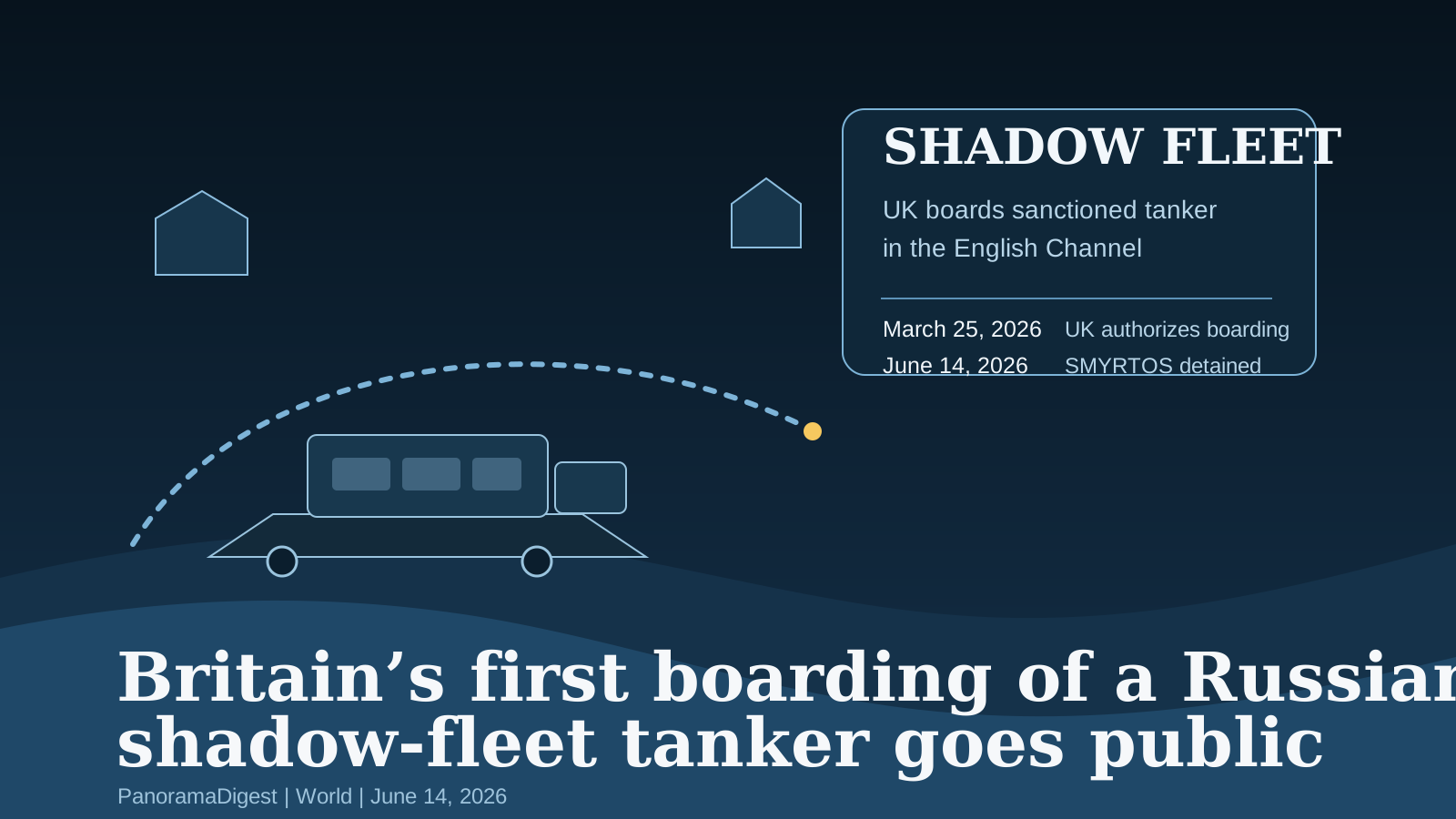
Britain's interception of the tanker SMYRTOS on Sunday, June 14, 2026, matters for a reason larger than one ship. The operation in the English Channel was not simply about stopping a sanctioned cargo carrier. It was about proving that the United Kingdom's March decision to let its forces board shadow-fleet vessels was not rhetorical theater. Once Royal Marines and National Crime Agency officers climbed aboard, sanctions stopped being a communiqué and started looking like an instrument with teeth.
The official British account was unusually blunt. In the Ministry of Defence press release published on June 14, ministers said the tanker was boarded in a six-hour operation supported by helicopters, an RAF P-8 aircraft, HMS Sutherland and HMS Ledbury, then moved toward an anchorage off England's south coast for further investigation. Associated Press separately reported that British officials described the detention as the first UK-led operation of its kind, carried out in close coordination with France. Reuters' June 14 report, which surfaced through Google News discovery and matched the government's timing and vessel identification, placed the action in the same frame: a direct attempt to disrupt oil flows that help finance Russia's war in Ukraine.
The March permission only mattered if Britain used it
That is the real hinge in this story. When Downing Street said on March 25, 2026 that British forces could board sanctioned shadow-fleet vessels in UK waters, the move looked important but still hypothetical. Governments make symbolic legal escalations all the time. What separates a policy warning from a strategic signal is whether it is applied in public, under scrutiny and with enough confidence that allies and adversaries have to update their assumptions.
Sunday's boarding did exactly that. It told Moscow that London is willing to tie legal authority, military capability and sanctions enforcement together in one visible action. It also told European partners that Britain wants the shadow-fleet fight to be measured in operational disruptions, not only in sanctions lists that can be evaded through shell ownership, reflagging and insurance games. PanoramaDigest saw part of that wider British defense-pressure debate earlier this week in its coverage of John Healey's resignation and the timing pressure around UK defence policy. The SMYRTOS operation gives ministers a much cleaner exhibit than another speech would have.
| Question | What changed by June 14 | Why it matters |
|---|---|---|
| Could Britain board a sanctioned shadow-fleet vessel? | Yes, after the March 25 authorization announced by Downing Street and the Ministry of Defence. | Legal permission created the option, but not the proof that Britain would use it. |
| What happened on June 14? | British forces and law-enforcement officers boarded and detained the tanker SMYRTOS in the Channel. | The UK converted a sanctions threat into a visible enforcement action. |
| Why was France mentioned so often? | British and AP accounts both said the mission was closely coordinated with French authorities. | The operation was national in execution but European in signaling. |
| What is the larger target? | The network of aging, opaque vessels moving sanctioned Russian oil outside normal compliance channels. | The point is not one ship alone. It is raising cost and uncertainty across the fleet. |
One tanker does not close Russia's shipping workaround
That is the caution worth keeping. The British press release said the broader shadow fleet still numbers in the hundreds and carries most of Russia's sanctioned oil trade. Governments can seize one vessel, even several, without collapsing the system. The fleet exists precisely because sanctions enforcement is fragmented, documentation can be falsified, and the commercial incentives remain large enough for intermediaries to keep improvising.
But that does not make the boarding symbolic in the dismissive sense. Visibility matters in maritime sanctions because uncertainty is part of the enforcement mechanism. If owners, crews, insurers, brokers and ports begin to price in a higher chance that transits through European waters will end with boarding teams, delay, detention or legal exposure, then one operation can travel further than one hull. That is especially true in the Channel, a passage too public and too commercially central to pretend that enforcement risk belongs only to distant waters.
The operation was also a message to allies
London has another audience besides Moscow. European governments have spent months talking about shadow-fleet risk as a mix of sanctions evasion, insurance fraud, maritime safety danger and strategic vulnerability. The trouble is that those concerns can sound diffuse until one government acts decisively enough to show the model. Sunday's operation offers that model: identify a vessel already under sanction, use the authority announced in March, coordinate with France, and keep the public explanation tightly tied to war-financing pressure rather than grandstanding about direct military confrontation.
The political utility of that framing is obvious. It gives Britain a way to look forward-leaning on Ukraine pressure without pretending that a tanker detention changes the battlefield overnight. It also lands before the next round of European summit diplomacy, where leaders will keep arguing about how much risk they are willing to absorb to squeeze Russian revenue. In that sense, the SMYRTOS boarding was less a climax than a reference point. Other capitals can now either match the approach, support it quietly or explain why they will not.
What to watch next
Three follow-on questions matter more than the celebratory language. First, how much evidence Britain releases about the vessel's sanction status, routing and ownership structure. Second, whether Russia or its commercial intermediaries alter Channel traffic patterns in response. Third, whether allied governments treat this as a one-off headline or as the beginning of a more regular interdiction pattern.
If the answer to the third question is yes, June 14 may end up looking like the day Britain's anti-shadow-fleet policy stopped being theoretical. If the answer is no, the operation will still matter, but more as a warning shot than a durable shift. Either way, London has now made one thing harder for everyone involved in Russia's maritime workaround: the claim that Europe's sanctions campaign still lives mostly on paper.
Read Next
Related Stories
John Healey's Resignation Turns Britain's Defence Debate Into a Timing Problem
John Healey's resignation on June 11, 2026 did more than embarrass Keir Starmer. It exposed a harder question for Britain and its allies: whether promises of higher defence spending later are enough when ministers think the dangerous years are now.
French Senate Election 2026: RN's Group Breakthrough and the 10-Member Rule
RN officials announced enough senators for a group after the September 27 election. Here is why 178 seats, a 10-member threshold and a 14-member claim mean different things.
Swiss Neutrality Vote: 70.15% Reject Stricter Rules on Sanctions and Military Cooperation
Switzerland remains neutral after voters rejected a stricter constitutional definition. The official result and the sanctions exceptions explain what stays unchanged.