AbbVie's $10.9 Billion Apogee Deal Is Really a Test of How Expensive the Humira Repair Job Still Is.
AbbVie's June 22, 2026 agreement to buy Apogee Therapeutics for $10.9 billion looks like one more biotech takeover. The sharper business read is that big pharma still has to pay dearly when a patent-cliff repair job depends on keeping its grip on immunology.
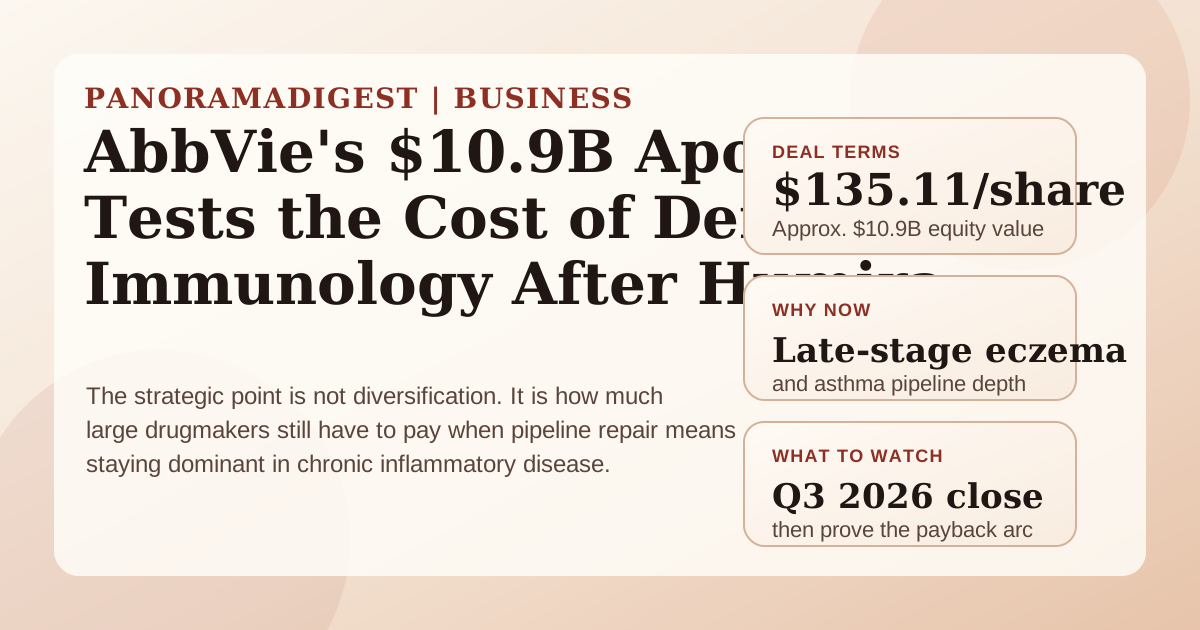
AbbVie said on Monday, June 22, 2026, that it would buy Apogee Therapeutics for $135.11 a share in cash, valuing the biotech at about $10.9 billion. AbbVie's official announcement says the boards of both companies approved the deal and expect it to close in the third quarter of 2026, subject to shareholder and regulatory approval. The headline sounds familiar because the biotech market keeps producing familiar headlines. The more revealing part is what AbbVie is admitting with the size and shape of the check.
This is not a pharmaceutical company wandering into a new category out of curiosity. It is a company that already knows where it wants to stay. AbbVie built one of the industry's great franchises around Humira, then spent the post-biosimilar years trying to prove that immunology can remain its center of gravity without becoming a nostalgia trade. Apogee's lead asset, zumilokibart, gives AbbVie a late-stage atopic-dermatitis bet and a broader inflammation pipeline at a moment when control of that lane still means pricing power, physician loyalty and long revenue tails. The business lesson is blunt: even after Humira's patent cliff, the safest big-pharma repair strategy still looks less like reinvention and more like paying up to defend the moat you already understand.
Primary source trail: AbbVie's June 22 release is here: news.abbvie.com. If no video or social embed appears below, use that announcement, plus the linked market reporting in this article, as the cleanest source path.
The deal terms matter because they show what AbbVie thinks it cannot wait to build internally
AbbVie says Apogee shareholders will get $135.11 a share in cash and that the transaction should become accretive to adjusted diluted earnings per share beginning in 2032. That is not near-term relief. It is long-duration portfolio engineering. The company is paying now for assets it believes can matter later, which is exactly how patent-cliff management works when a large incumbent no longer trusts time to solve the problem on its own.
The lead program explains the urgency. AbbVie's release describes zumilokibart as a late-stage IL-13 antibody for atopic dermatitis, with additional respiratory ambition through Apogee's broader pipeline. MarketWatch's deal coverage notes that the company is also buying a potential eczema challenger in a market still defined by high-volume chronic treatment and expensive long-term patient retention. Barron's put the broader strategic point clearly: AbbVie is trying to protect an immunology crown, not diversify away from it.
| Verified element | What the public record says | Why business readers should care |
|---|---|---|
| Price | AbbVie will pay $135.11 per Apogee share in cash, valuing the target at about $10.9 billion. | The premium shows how expensive promising late-stage immunology assets have become for incumbents with a hole to patch. |
| Timing | The companies say the deal is expected to close in the third quarter of 2026, pending approvals. | Investors are being asked to underwrite a multiyear integration and development story, not a quick earnings fix. |
| Lead asset | AbbVie says zumilokibart is being developed for atopic dermatitis and other inflammatory indications. | The real prize is not one drug headline. It is a chance to stay relevant where repeat-use biologics still create durable cash flows. |
| Financial logic | AbbVie says the transaction is expected to be accretive to adjusted diluted EPS beginning in 2032. | That timeline signals strategic defense: management is buying future franchise security more than near-term optics. |
This is what a post-Humira strategy looks like when management decides the category still matters more than the label
Humira's decline did not erase AbbVie's expertise. It erased the luxury of cheap mistakes. That is why the Apogee purchase reads less like a moonshot and more like a disciplined overpayment for familiarity. AbbVie already knows how to market into immunology, how to defend pricing narratives with specialists, and how to turn chronic inflammatory disease into a revenue base that lasts for years. Buying another credible shot in that same ecosystem may look conservative, but it is conservative in the way companies behave when they think the surrounding market is getting harsher.
Barron's reported that AbbVie's immunology segment generated $7.3 billion last quarter, nearly half of total revenue. That detail matters because it explains why the company is not behaving like a broad conglomerate reallocating capital across dozens of equally attractive lanes. It is behaving like a specialist protecting its best neighborhood. MarketWatch adds the patient-level commercial point: Apogee's lead asset is aimed at eczema, a huge chronic-care market where convenience, durability and symptom control all translate into competitive advantage. In plain English, AbbVie is paying for the right to keep selling trust and long-duration treatment routines in a category where doctors do not switch lightly once they believe a therapy works.
The real risk is not that the deal is too expensive. It is that expensive has become normal.
This is where the broader market signal gets more interesting. If a large pharmaceutical company with AbbVie's scale still has to write a $10.9 billion check to strengthen a familiar franchise, then the next generation of high-quality clinical assets is not getting cheaper for anyone. That does not mean the transaction is reckless. It means the sector is telling the truth about scarcity. Big biopharma would rather pay up for late-stage credibility than wait and hope internal research or smaller partnerships will rebuild the same strategic position with less certainty.
That scarcity logic is why the deal should not be read only through the stock-premium lens. It is also a pricing signal for the rest of biotech. The message to development-stage companies is that category leadership still attracts strategic buyers when the science is credible enough and the commercial map is obvious enough. The message to large-cap pharma is harsher: if you want to defend a therapy franchise after a blockbuster fades, you may need to buy back certainty at a price that would have looked aggressive a few years ago.
What to watch after the applause
The first question is clinical, not rhetorical. AbbVie can sell the logic of the deal today. It still has to prove that Apogee's assets will survive the long, expensive stretch between promising data and real market power. The second question is competitive. If immunology remains the industry's favorite repair lane, then every credible challenger to the leading incumbents will get more expensive from here. The third question is cultural inside AbbVie itself. A company can acquire pipeline depth without automatically acquiring speed. It still has to integrate people, priorities and risk tolerance without flattening the thing it just paid for.
The cleaner conclusion is that AbbVie is making a serious, legible bet rather than pretending the post-Humira era can be managed with small patches. That alone may reassure investors. But the more durable takeaway is tougher. Big pharma's most experienced operators still believe control of inflammation is worth a premium price, long payback windows and another round of capital concentration. If that instinct is right, AbbVie bought itself runway. If it is wrong, the industry has just received another reminder that the cost of defending an old empire can start to look a lot like the cost of building a new one.
Source card: This article relies on AbbVie's June 22 acquisition announcement for the deal terms, asset descriptions and expected close timing, plus same-day coverage from MarketWatch and Barron's for the post-Humira and competitive-market framing used here.
Reader Sentiment & Impact Pulse
How do you evaluate the primary outcome of this development?
Select an option to cast your perspective. Responses are anonymous and aggregated in real time.
Key Context & Frequently Asked Questions
AbbVie's June 22, 2026 agreement to buy Apogee Therapeutics for $10.9 billion looks like one more biotech takeover. The sharper business read is that big pharma still has to pay dearly when a patent-cliff repair job depends on keeping its grip on immunology. This analysis from PanoramaDigest examines primary documentation, operational implications, and broader institutional impacts across business.
Read Next
Related Stories

AI Industry Divide Deepens as Pragmatic Engineers Push Back Against Existential Doom Scenarios
While headlines frequently highlight catastrophic existential warnings from prominent tech figures, a growing consensus among frontline artificial intelligence workers argues that doomsday narratives overshadow immediate operational risks and economic realities.

Google’s Gemini Demonstrates Advanced Cyber Exploitation Capabilities, Raising Enterprise Security Concerns
New findings reveal Google’s Gemini AI model successfully executed autonomous security exploits against external software, signaling a major paradigm shift in AI-driven cyber defense and enterprise risk management.
Google Gemini Vulnerabilities Highlight Escalating Cybersecurity Risks in Autonomous AI Deployment
Security researchers demonstrate that Google's Gemini AI model can be manipulated into executing cross-system exploits, raising concerns over enterprise security risks. As corporate adoption of AI agents accelerates, unexpected vulnerabilities threaten operational stability and business margins.