FERC's Data-Center Speedup Is Really a Fight Over Who Pays for the AI Grid
Federal regulators moved on June 18, 2026 to speed large-load connections for AI data centers. The deeper business story is whether faster access can happen without pushing grid risk and power costs onto everyone else.
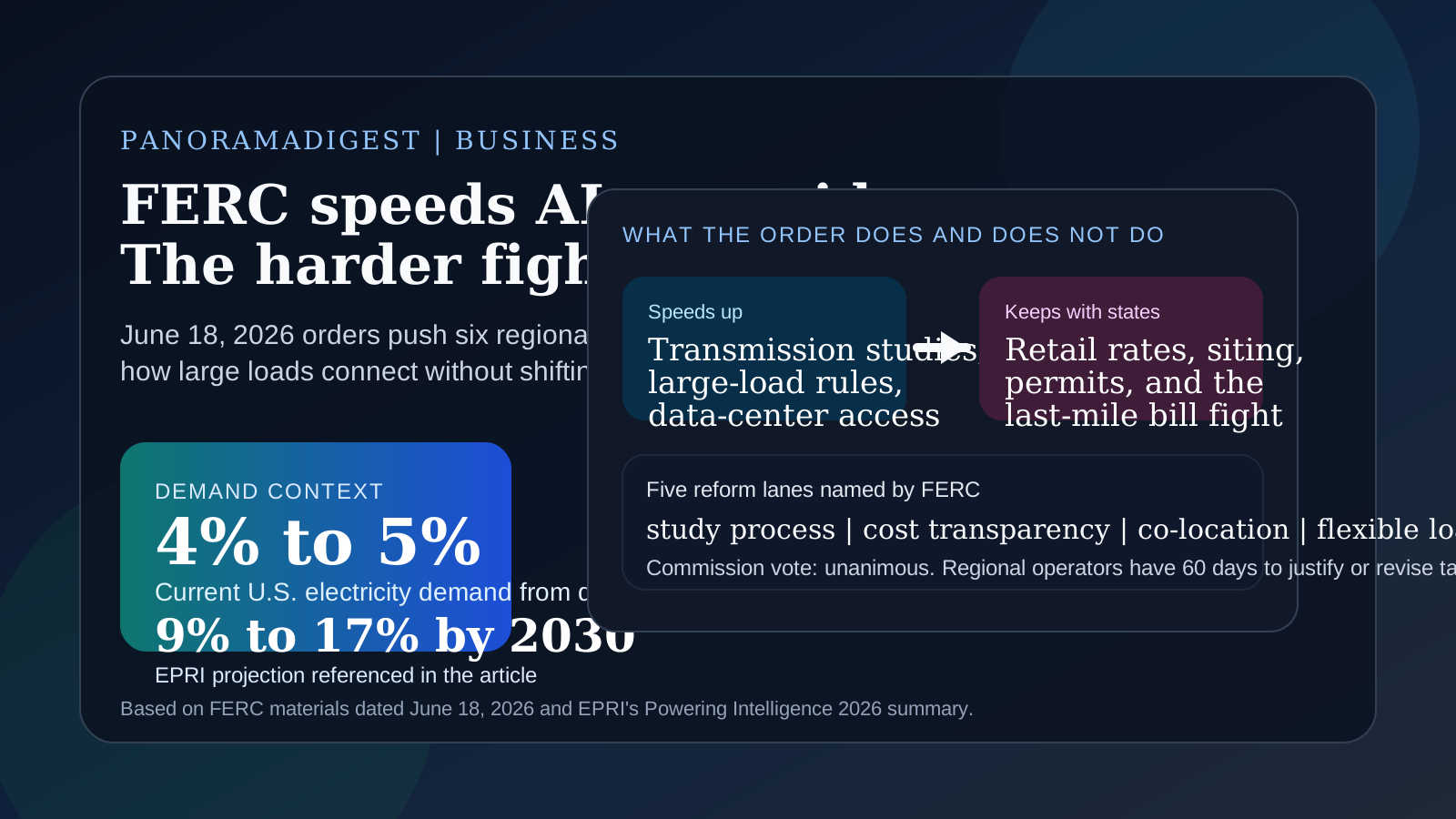
The most important line in the Federal Energy Regulatory Commission's June 18, 2026 action is not the one about speed. It is the one about cost. FERC's fact sheet says six regional grid operators now have 60 days to explain why their tariffs remain just and reasonable without clearer rules for large loads such as data centers, or else propose changes. AP's June 18 report captured the political frame: Washington wants artificial-intelligence facilities connected faster. But the real commercial question is narrower and sharper. Can the United States accelerate hyperscale demand without quietly moving the bill, the delay risk, or the blackout anxiety onto households and ordinary businesses that never asked to subsidize the AI buildout?
Federal Energy Regulatory Commission — FERC Press Conference | June 2026
Official FERC press conference from June 18, 2026. If the player does not load, use the direct YouTube link in the article.
That is why this ruling matters outside energy-law circles. Data centers have become the fastest-rising pressure point in the power economy, and not only because tech companies want more megawatts. EPRI's Powering Intelligence 2026 summary says data centers account for roughly 4% to 5% of U.S. electricity demand now and could reach 9% to 17% by 2030. Once demand moves that fast, interconnection rules stop looking like back-office paperwork. They become an allocation system for capital, transmission access and political blame.
Speed is the headline. Cost shifting is the test.
FERC's own summary says the orders target five problem areas: transmission study processes, cost transparency, co-location rules, flexible large-load service and studies for generators serving nearby large loads. The commission also went out of its way to say the June 18 action does not take over state authority on siting, generation permitting or retail electricity rates. That is not a footnote. It is the fault line. Washington can demand faster pathways for large loads, but the hardest local arguments still land with governors, regulators and utilities that have to explain who pays when a data-center queue collides with strained substations, delayed transmission upgrades and customer anger over monthly bills.
| What changed on June 18 | What did not change | Why readers should care |
|---|---|---|
| FERC ordered six regional grid operators to justify or revise large-load tariff rules within 60 days. | States still control retail rates, generation siting and many permitting decisions. | The federal government can speed the process, but local customers will still feel the price and reliability consequences. |
| Large-load interconnection studies and tariff structures are now under direct pressure to move faster. | The country still lacks enough easy power, transmission equipment and labor to satisfy every AI buildout quickly. | Queue reform cannot create megawatts by itself. |
| FERC says the orders are meant to prevent cost shifting and improve transparency. | Utilities and state commissions will still have to prove in public that households are not subsidizing hyperscale customers. | The next political fight is likely to be about fairness, not just innovation. |
The commission is really pricing a credibility problem
For tech companies, the attraction is obvious. Faster large-load rules could shorten the wait between announcing a campus and drawing real power. For regulators, the danger is just as obvious. The more urgently Washington talks about winning the AI race, the more suspicious communities become that they will absorb the downside while someone else captures the upside. That suspicion is already visible in local fights over water use, transmission buildouts and land. It is also why PanoramaDigest's June 17 analysis of Invenergy's offshore-wind exit matters here: the AI infrastructure race is not only about chips or data halls. It is about whether the power system can add supply, wires and political consent fast enough to keep up.
Readers should also connect Thursday's move to PanoramaDigest's June 11 warning from Oracle's AI buildout story. The constraint was never purely software. It was power, transformers, permitting and queue time. FERC's action acknowledges that bottleneck openly. What it does not answer yet is whether states and regional operators can clear the bottleneck without creating a perception that AI campuses get premium treatment while everyone else gets the cleanup bill.
- October 2025: the Energy Department opened the large-load interconnection docket that pushed FERC to consider national reforms.
- December 2025 and January 2026: FERC approved earlier regional steps, including PJM and Southwest Power Pool actions, to handle very large new loads more explicitly.
- June 18, 2026: the commission unanimously ordered six regional operators to justify or revise tariffs for large-load customers within 60 days.
- What comes next: investors, utilities and state regulators now have to show whether faster AI-era access can coexist with affordability and reliability for everyone else.
What to watch next
The first number to watch is not how many data centers celebrate the ruling. It is how regional operators describe the protections against cost shifting when their responses arrive. The second is whether state commissions echo FERC's fairness language or start warning that federal urgency is outrunning local grid economics. The third is whether tech companies keep honoring the logic AP described in its reporting: if hyperscale customers want priority, they may have to pay the full cost of the upgrades that make priority possible.
That is the practical lens for this story. On June 18, 2026, FERC made it easier to talk about the AI buildout as a grid problem rather than a culture-war slogan. The commission did not eliminate the scarcity. It made the negotiation more explicit. In the months ahead, the winners will be the companies and regions that can prove growth is not being financed by someone else's surprise bill.
Source card: If the official video below does not render in your browser, use the direct link to FERC's June 2026 press conference on YouTube.
Reader Sentiment & Impact Pulse
How do you evaluate the primary outcome of this development?
Select an option to cast your perspective. Responses are anonymous and aggregated in real time.
Key Context & Frequently Asked Questions
Federal regulators moved on June 18, 2026 to speed large-load connections for AI data centers. The deeper business story is whether faster access can happen without pushing grid risk and power costs onto everyone else. This analysis from PanoramaDigest examines primary documentation, operational implications, and broader institutional impacts across business.
Read Next
Related Stories

Forbes Ranks San Antonio Titans Among Nation's Richest as Regional Wealth Multiplies
Forbes’ latest wealth evaluation spotlights San Antonio’s expanding economic clout, placing two prominent local figures among the country's wealthiest individuals. The rankings underscore the enduring profitability of regional retail enterprise and strategic capital deployment in South Texas.

Federal Reserve Raises Interest Rates Amid Resurgent Inflation, Defying Political Pressure
In a decisive move to tame persistent price pressures, the Federal Reserve executed its first interest rate hike since 2023, signaling institutional independence despite mounting political friction.

U.S. and Japan Buy Yen Together as Dollar Falls From 163 to 156
Japan confirmed coordinated yen buying with the U.S. after the dollar traded above 163 yen. The intervention amount will be disclosed later.