Invenergy's $765 Million Offshore Wind Exit Shows How Washington Is Rewiring the Energy Map
On June 17, 2026, the Trump administration and Invenergy agreed to terminate four offshore wind leases in the New York Bight, Gulf of Maine and off California's central coast. The $765 million reimbursement is not just another energy headline. It is a vivid sign that federal policy is moving capital away from coastal clean-power plans and toward gas and geothermal projects that can be built on a faster commercial clock.
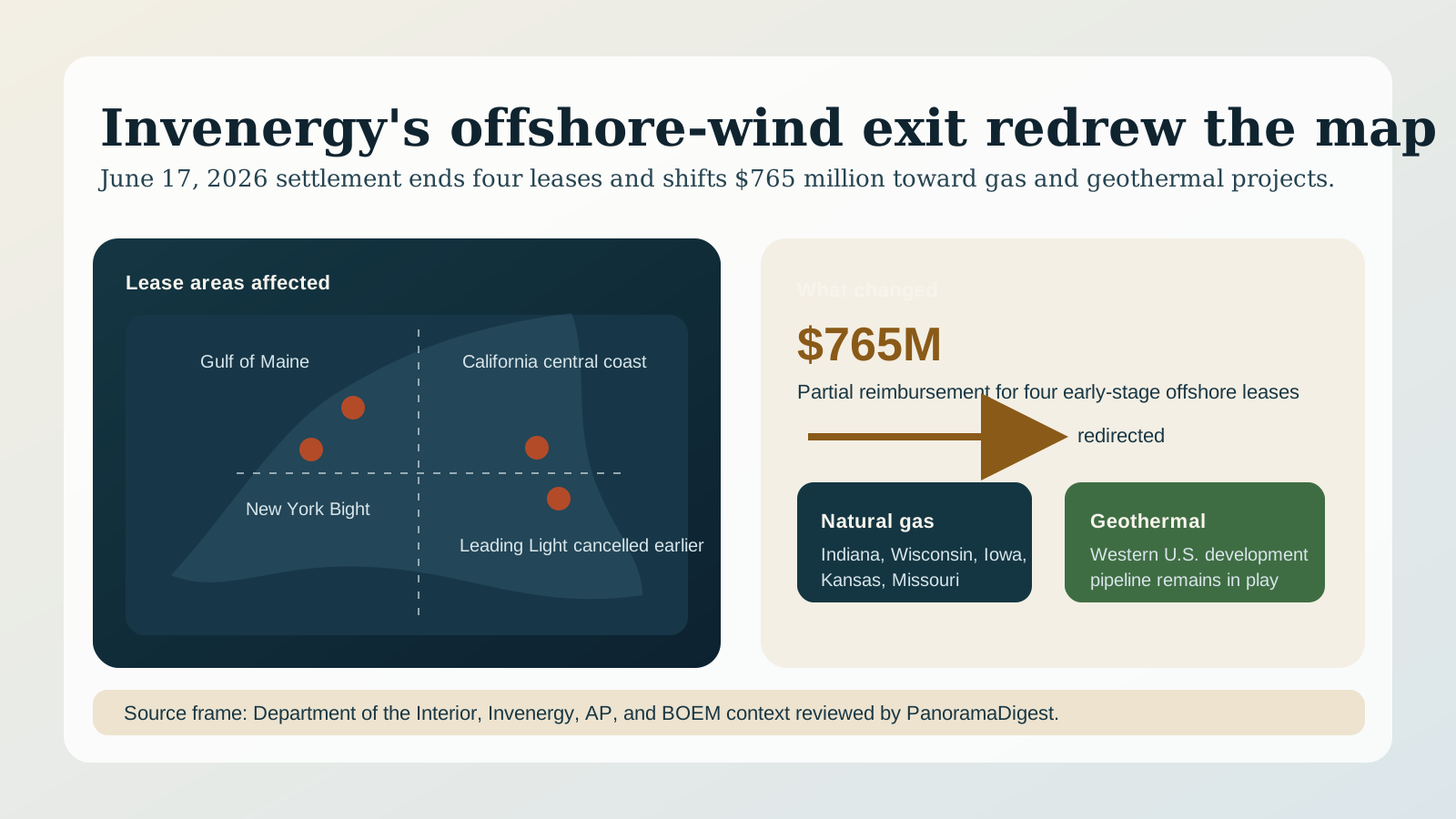
The most revealing part of the Trump administration's June 17, 2026 deal with Invenergy is not the headline dollar figure. It is the geography. Under the Department of the Interior's announcement, Invenergy will voluntarily terminate four offshore wind leases tied to the New York Bight, California's central coast and the Gulf of Maine, receive a partial reimbursement of $765 million, and redirect that capital into natural-gas projects in Indiana, Wisconsin, Iowa, Kansas and Missouri plus geothermal development in the West. That is not just a portfolio adjustment. It is Washington telling coastal states that one energy map is being erased while another is being drawn inland.
The immediate political pitch was straightforward. Interior Secretary Doug Burgum said the agreement would move investment toward dependable, secure energy infrastructure
. Invenergy's Daniel Runyan, in the same release, said the company was choosing projects that could move on a commercially reasonable timeline
. But the practical meaning is tougher for governors, utilities and ratepayers in places that had treated offshore wind as part of their future power mix. California, Maine and the Northeast are not losing a slogan here. They are losing optionality.
The settlement turns an energy debate into a capital-allocation story
According to Associated Press reporting, the new agreement lifts total federal spending on similar offshore-wind buyouts to nearly $2.6 billion. That matters because the federal government is no longer acting only as a referee in the energy transition. It is now paying companies to abandon one class of projects and rewarding them for shifting toward another.
| What the June 17 agreement changes | Before the deal | After the deal | Why it matters |
|---|---|---|---|
| Lease portfolio | Four early-stage offshore wind leases tied to the New York Bight, Gulf of Maine and California waters | Leases voluntarily terminated | Coastal states lose future clean-power options that were still in the development pipeline. |
| Capital already committed | $765 million tied up in lease payments | Partial reimbursement returned to Invenergy | The company gets liquidity back instead of carrying a long-dated political and permitting risk. |
| Replacement investment | Uncertain offshore construction timeline | Natural-gas plants in five Midwestern states and geothermal build-out in the West | Capital moves to projects management believes can reach the grid faster and with fewer federal obstacles. |
| Public-policy message | Offshore wind still sat inside long-range state planning assumptions | Federal buyouts now actively favor inland dispatchable energy | Developers and utilities have to recalculate what is politically durable enough to finance. |
That last row is the one executives will not miss. Offshore wind has always required patience, complicated supply chains and an unusually high tolerance for regulatory drag. What changed under this administration is that delay is no longer the only risk. The policy center of gravity itself has shifted. A project can survive engineering headaches. It struggles when the federal government starts offering a cash exit.
California and the Northeast are being told different things than the Midwest
The Bureau of Ocean Energy Management's California overview still describes five existing federal leases off the state, including central-coast areas near Morro Bay, as part of an ongoing offshore-wind planning framework. The BOEM page for Invenergy's New York Bight lease similarly shows a project that had remained in the preliminary stage of the federal authorization process. In other words, these were not fully dead paper assets waiting to be cleaned up. They were pieces of longer-horizon regional planning that now have to be reinterpreted through a harsher financing lens.
That creates a two-track message. Midwestern gas development is being framed as urgent and practical. Coastal clean-energy planning is being treated as optional, slow and too subsidy-dependent to defend. Investors may agree or disagree with that view on policy grounds, but they do not have to guess how the federal government wants the money to move. The settlement makes the preference explicit.
- February 2022 and December 2022: BOEM lease sales placed Invenergy in major offshore-wind areas tied to the New York Bight and California's central coast.
- November 2025: Invenergy canceled Leading Light Wind, its largest offshore project, after citing supply-chain, equipment and regulatory challenges.
- June 17, 2026: Interior and Invenergy announced a settlement ending four leases and redirecting $765 million into faster-build gas and geothermal projects.
Why this matters beyond one developer
Invenergy's own statement argues that U.S. electricity demand is rising fast enough to justify a sharper focus on projects that can deliver more megawatts sooner. That argument will resonate with utilities, large industrial buyers and data-center markets that care more about schedule certainty than ideological purity. Yet it also exposes the core problem for offshore wind in this moment: even if the long-term resource case survives, the near-term financing case weakens when developers can recover cash and redeploy it into assets with a clearer path to operation.
For households, this story is less abstract than it sounds. Energy transitions succeed when the projects people are promised eventually show up in bills, jobs, wires and capacity. They stall when capital leaves the queue. The June 17 settlement did not settle the offshore-wind argument for good. It did something more immediate. It showed that the market now has a federally endorsed escape hatch, and that alone changes how every unfinished coastal energy promise will be priced from here.
Reader Sentiment & Impact Pulse
How do you evaluate the primary outcome of this development?
Select an option to cast your perspective. Responses are anonymous and aggregated in real time.
Key Context & Frequently Asked Questions
On June 17, 2026, the Trump administration and Invenergy agreed to terminate four offshore wind leases in the New York Bight, Gulf of Maine and off California's central coast. The $765 million reimbursement is not just another energy headline. It is a vivid sign that federal policy is moving capital away from coastal clean-power plans and toward gas and geothermal projects that can be built on a faster commercial clock. This analysis from PanoramaDigest examines primary documentation, operational implications, and broader institutional impacts across business.
Read Next
Related Stories

U.S. and Japan Buy Yen Together as Dollar Falls From 163 to 156
Japan confirmed coordinated yen buying with the U.S. after the dollar traded above 163 yen. The intervention amount will be disclosed later.

OPEC+ Raises September Oil Production Target by 188,000 Barrels a Day
Seven OPEC+ countries raised their combined September production target by 188,000 barrels a day, bringing the published required total to 31.01 million.

Microsoft Azure Revenue Passes $100 Billion as Cloud Sales Rise 27%
Microsoft said Azure passed $100 billion in annual revenue for the first time, while quarterly Microsoft Cloud sales reached $59.3 billion.