Fox's $22 Billion Roku Deal Is Really a Fight to Own the TV Interface
Fox's proposed Roku takeover is less about adding another streamer and more about controlling the screen, ad data, and distribution layer that still shapes what television means.
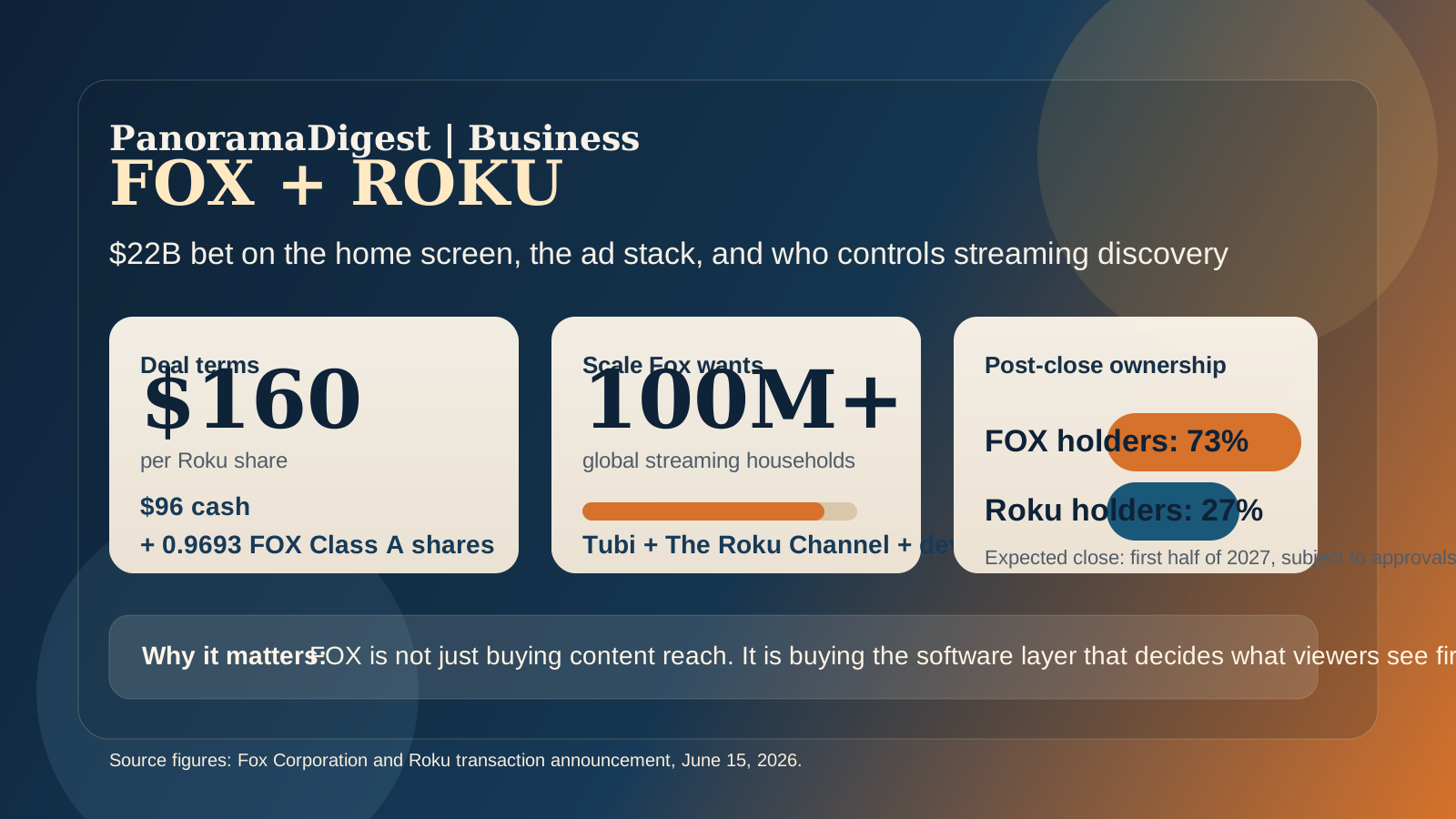
Fox's proposed $22 billion acquisition of Roku looks, at first glance, like another old-media company paying dearly to stay relevant in streaming. The sharper reading is that Fox is trying to buy something even harder to build than a hit service: the software layer that decides what millions of viewers see first, what advertisers can target, and which distributors still matter when the cable bundle keeps thinning out.
The headline terms are straightforward. Fox and Roku said on June 15, 2026, that Fox would pay $96 in cash plus 0.9693 shares of Fox Class A stock for each Roku share, valuing Roku at $160 per share and leaving Fox investors with roughly 73% of the combined company. Roku investors would own the remaining 27%. The companies said the deal would unite Fox's live sports, news, entertainment and Tubi assets with Roku's connected-TV operating system, The Roku Channel, ad technology, and relationships with more than 100 million global streaming households.
That scale matters because Fox is still stronger in content than in distribution plumbing. It owns rights people watch in real time, from sports to news, but it has had to rent access to the living room through cable operators, smart-TV makers, app stores, and streaming platforms. Roku offers a shortcut around that dependence. As Axios reported, the deal would pair The Roku Channel with Tubi while giving Fox a much larger position in ad-supported streaming. That is not cosmetic. It changes the leverage inside the ad market.
The prize is not just streaming scale. It is navigation power.
Media companies spent years chasing subscribers as if streaming's main question was who had the biggest library. The harder problem turned out to be discovery. Viewers may have dozens of apps, but only a few platforms decide which app tile appears first, which promotion gets surfaced, which free channel gets sampled, and which ads are sold with enough targeting to command premium rates. Roku sits in that layer. Fox clearly wants to stop being just another tenant inside it.
The companies said Roku will remain an open platform after the deal closes, and The Hollywood Reporter noted that Roku founder Anthony Wood is expected to stay involved and join Fox's board. That promise matters because Roku's value comes partly from not behaving like a closed company town. Device makers, streamers, and advertisers all need to believe the combined group will still distribute rivals fairly enough to keep the platform useful. If Fox turns Roku into a preference engine for only its own properties, it risks damaging the very neutrality that made Roku strategic in the first place.
| What Fox brings | What Roku brings | Why the combination matters |
|---|---|---|
| Live sports, news, entertainment rights, Tubi, and national ad relationships | Connected-TV operating system, device footprint, The Roku Channel, and first-party household data | Fox gains a direct route to the living room instead of depending on third-party distribution tollbooths |
| Strong monetization around live events and premium video inventory | Ad-tech tools built for streaming behavior and household-level targeting | The combined business can sell not only programming but the interface around it |
| Brand power and cash generation from legacy television | Software habits that shape discovery, placement, and recurring engagement | Fox buys a future-facing control point rather than merely another catalog |
The real test is whether Fox can protect Roku's openness while monetizing it harder
That balancing act will decide whether the transaction feels smart in a year or overconfident in three. Fox is not buying Roku at a bargain. It is buying a platform that works precisely because it serves households, hardware partners, advertisers, and content suppliers at the same time. Push too aggressively toward internal preference and the ecosystem gets nervous. Move too cautiously and the strategic premium looks excessive.
There is also a corporate-culture risk that spreadsheets rarely capture. Fox has traditionally excelled at programming and rights economics. Roku grew by obsessing over interface simplicity, platform partnerships, and the less glamorous mechanics of keeping streaming friction low. Those are not the same instincts. The combined company will need both. The danger is not that one side is weak. It is that the side with more power may undervalue the discipline that made the other side worth buying.
Why regulators may spend more time on incentives than on simple size
This is not the kind of merger that automatically reads as a classic consumer-price story. The bigger questions are about gatekeeping, ad-market power, and whether a platform that distributes much of the streaming world can stay credibly open after being absorbed by a major programmer. The companies have some arguments in their favor: they are pitching the deal as a response to audience migration, not as a plan to shrink choice, and the U.S. market still includes powerful rival platforms from Amazon, Google, Apple, Samsung, Comcast and others.
Reuters' market reporting, carried on syndication sites after the June 15 announcement, also highlighted the investor tension inside the deal: Roku traded below the offer price while Fox shares fell in premarket trading, a sign that Wall Street immediately understood both the strategic appeal and the execution risk. That gap matters. It suggests the market is still pricing in regulatory scrutiny, financing questions, and the possibility that platform neutrality becomes harder to preserve once a major programmer owns the gateway.
What to watch before this becomes more than an announcement
- Whether Fox keeps repeating the open-platform promise in investor, regulatory, and distribution filings rather than only in announcement-day messaging.
- How Anthony Wood's continued role is defined after closing, because that will signal whether Roku's operating culture remains intact or gets absorbed quickly.
- Whether Fox uses Roku mainly to deepen Tubi and live-event distribution, or whether it tries to reprice the broader streaming ad stack around its own portfolio.
- How competitors respond if they suspect preferential placement inside Roku's interface, recommendations, or monetization layers.
For now, the cleanest way to read the deal is this: Fox is wagering that in television's next phase, the most valuable company is not the one with the longest list of shows. It is the one that owns the front door, understands the household, and can charge for both attention and access.
Primary sources: Fox and Roku's official transaction announcement, Axios' reporting on the ownership split and Tubi rationale, and The Hollywood Reporter's reporting on management structure and industry context.
Read Next
Related Stories
U.S. and Japan Buy Yen Together as Dollar Falls From 163 to 156
Japan confirmed coordinated yen buying with the U.S. after the dollar traded above 163 yen. The intervention amount will be disclosed later.

OPEC+ Raises September Oil Production Target by 188,000 Barrels a Day
Seven OPEC+ countries raised their combined September production target by 188,000 barrels a day, bringing the published required total to 31.01 million.

Microsoft Azure Revenue Passes $100 Billion as Cloud Sales Rise 27%
Microsoft said Azure passed $100 billion in annual revenue for the first time, while quarterly Microsoft Cloud sales reached $59.3 billion.