Kenya Footprints Show Eight Large Hominins Moving Together 1.43 Million Years Ago
A PNAS study describes tracks from eight large hominins at Kenya's Koobi Fora, while leaving open whether they were Paranthropus boisei or Homo erectus.

Eight large hominins moved across the same lakeshore surface in northern Kenya about 1.43 million years ago, leaving a rare record of bodies and group movement rather than isolated bones. The footprints indicate that several individuals may have reached roughly 1.8 meters in height and 75 kilograms in mass. What they do not establish with certainty is the species that made them.
That qualification is central to the study published in PNAS on July 27, 2026. The tracks' internal shapes resemble footprints previously attributed to Paranthropus boisei, an extinct human relative known mainly from skulls and teeth. Their unusually large dimensions, however, also fit Homo erectus. The authors explicitly present both possibilities rather than treating the species identification as settled.
- Age of the track surface
- About 1.43 million years
- Individuals represented
- Eight hominins on one footprint surface
- Largest estimated stature
- About 1.8 meters, or 5 feet 11 inches
- Largest estimated mass
- About 75 kilograms, or 165 pounds
- Location
- Koobi Fora Formation, northern Kenya
- Competing attributions
- Paranthropus boisei or Homo erectus
The discovery is valuable whichever identification ultimately proves stronger. If the tracks belong to P. boisei, that species included larger bodies and more size variation than its sparse postcranial skeleton suggests. If they belong to H. erectus, their foot anatomy and gait varied much more than the currently known fossil sample has shown.
The footprint shape points one way and body size points another
Researchers did not identify the makers by footprint length alone. They compared the tracks' internal morphology, including how the foot appears to have contacted and loaded the sediment, with experimental data and other fossil tracks. Those patterns were more consistent with tracks attributed to P. boisei than with modern humans or the more human-like walking pattern generally associated with H. erectus.
Size complicates that result. Most fossils confidently assigned to P. boisei come from the head, including its characteristically large jaws and teeth. Bones below the neck are scarce, so conventional estimates have portrayed the species as smaller than contemporary H. erectus. Several Kenyan tracks exceed those skeletal estimates.
The study's abstract therefore describes attribution as an open test. A Max Planck Society research summary emphasizes the P. boisei interpretation, but the paper itself preserves the alternative. That difference does not invalidate the release; it shows why a press summary and the underlying publication answer slightly different questions.
Footprints also record a different kind of evidence from bones. A skeleton can reveal anatomy from one individual, sometimes accumulated or displaced after death. A track surface can preserve several living bodies using one place during a narrow interval. Sediment can distort a print, and stature and mass are estimates rather than direct measurements, but the surface captures behavior unavailable from an isolated jaw or limb fragment.
That separation between observation and inference also matters in other sciences. PanoramaDigest's review of a European heat-wave attribution study explains why measured temperatures and modeled counterfactuals support different claims. Here, the equivalent boundary lies between preserved track geometry and the species or social system inferred from it. Readers can follow more source-led research in the Technology & Science section.
Eight trackmakers support a group, not a complete social system
The eight individuals appear to have used the surface close enough in time for researchers to treat them as a moving group. Their estimated sizes are most consistent with several adults, including multiple large males. That makes the site unusually direct evidence that Early Pleistocene hominins sometimes traveled together.
It is a longer step from group movement to social organization. The tracks do not reveal kinship, sex directly, leadership, mating structure or why the individuals gathered. Adult males might have tolerated one another for safety or access to resources, as the research team proposes, but footprints cannot distinguish that explanation from other reasons for moving through the same place.
The wider Koobi Fora record gives the group a landscape. Researchers have documented hundreds of hominin footprints at more than half a dozen sites in East Turkana. Comparable lake-margin deposits occur roughly 40 kilometers apart, and the track record spans more than 100,000 years. That repetition suggests lakeshores were persistent places for obtaining water, food or other resources, not a one-time crossing.
Earlier work at Koobi Fora found differently shaped tracks on the same ancient surface, supporting the coexistence of P. boisei and H. erectus in the region. The new assemblage adds body-size range and group movement to that picture, while also exposing the limit of species labels based on footprints alone.
The most defensible conclusion is therefore broader than a single name: large-bodied hominins with a distinctive pattern of foot loading moved together along a Kenyan lakeshore 1.43 million years ago. Whether those walkers enlarge the known range of Paranthropus or the anatomical diversity of Homo erectus remains the question the tracks have made measurable.
Read Next
Related Stories
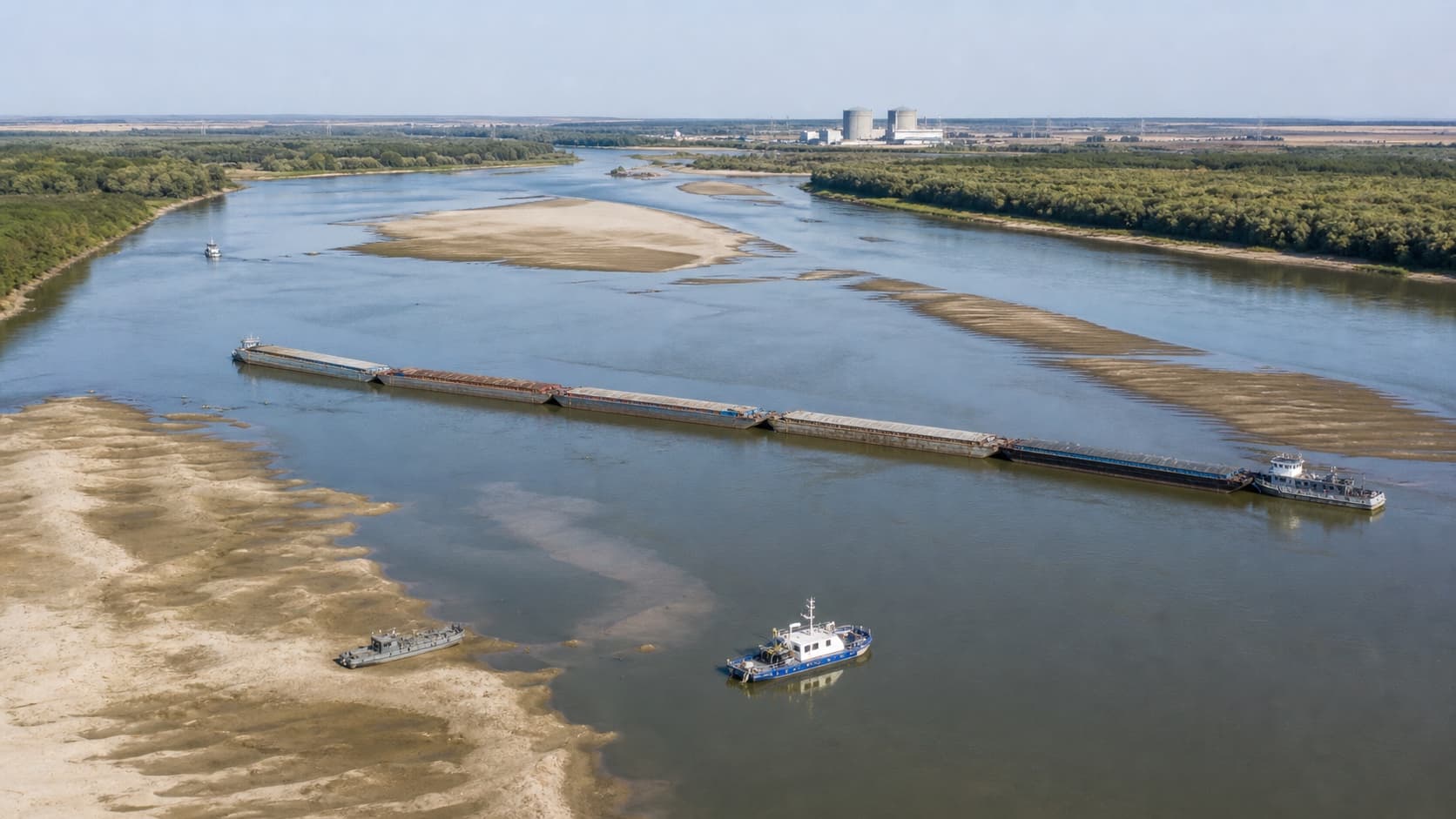
Romania Funds 7 Million Lei Danube Barge Plan to Keep Cernavoda Unit 2 Online
Romania approved a 7 million lei temporary barge intervention at the Bala-Dunarea Veche split to preserve the Danube flow needed by Cernavoda Unit 2.

Zoox Wins Federal Approval for Paid Robotaxis, but State Permits Still Control Launches
NHTSA cleared Zoox's steering-wheel-free robotaxi for a limited paid-service path, but state and local permits still determine where fares can begin.

Cernavoda Unit 1 Shuts Down as Danube Drought Cuts Cooling-Water Margin
Romania disconnected Cernavoda Unit 1 on July 28 after unprecedentedly low Danube water levels reduced its operating margin. The shutdown is preventive, not a nuclear incident.