Sam Bankman-Fried Lost His Appeal. The Harder Blow Is to Crypto's 'Everyone Got Paid Back' Story.
The appeals ruling against Sam Bankman-Fried did more than keep a 25-year sentence in place. It cut into one of crypto's favorite fallback arguments: that eventual recovery can erase the original abuse of customer money.
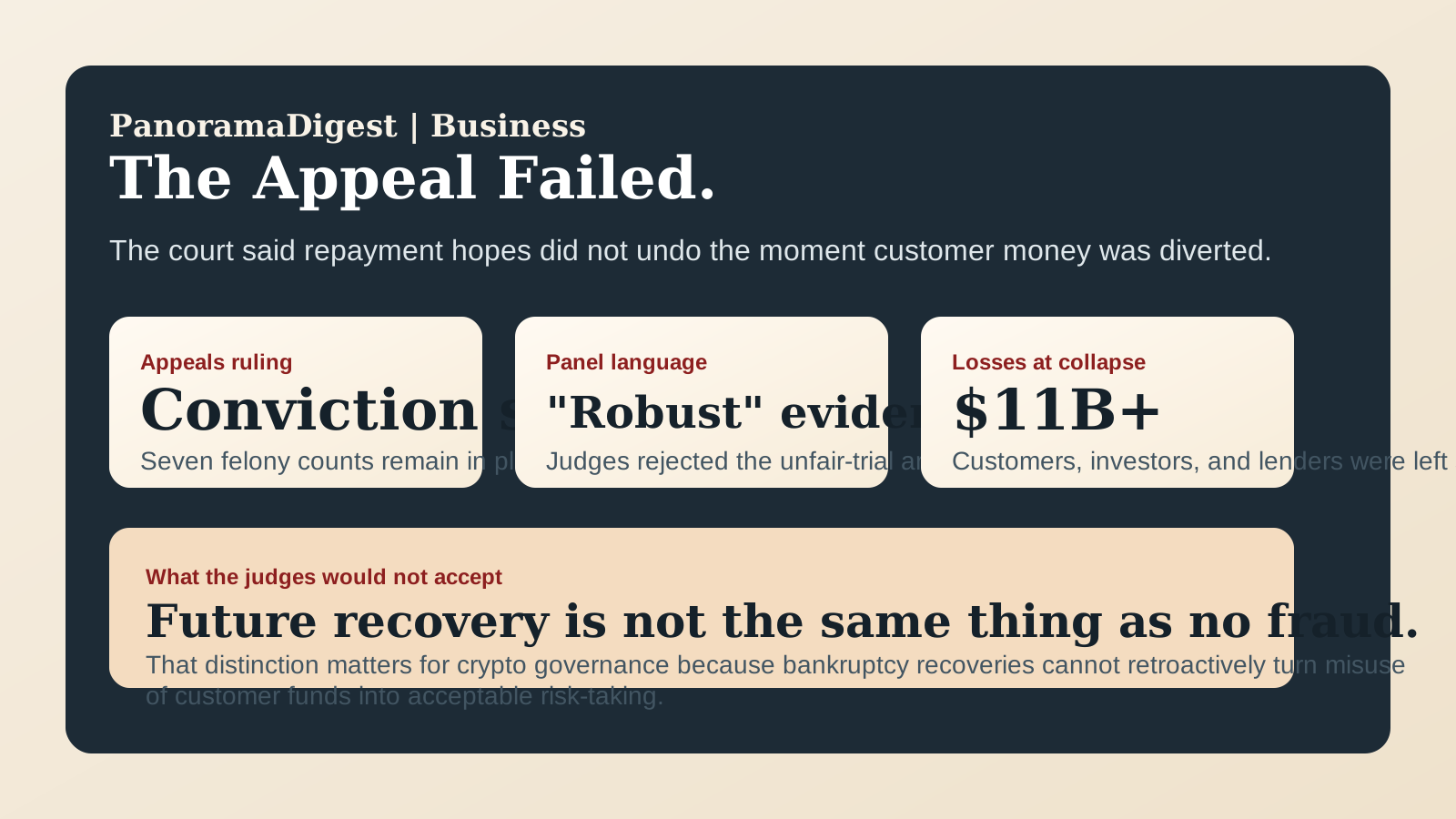
Sam Bankman-Fried's failed appeal matters for a reason larger than his own shrinking legal options. The Second Circuit did not just leave a 25-year sentence standing on June 12, 2026. It also pushed back against one of the most convenient stories that has lingered around the FTX collapse: that if customers may eventually recover meaningful value in bankruptcy, the original conduct starts looking more like mismanagement than fraud.
Forbes Breaking News — Disgraced FTX Founder Sam Bankman-Fried Loses Appeal Of 25-Year Sentence
Forbes' June 12 video gives the fast recap of the appellate decision. Use the direct YouTube link if the embedded player is blocked.
That is not how the appellate panel saw it. In current reporting from AP and ABC News, the court said the government's case was conservatively stated, robust
. Reuters, in a June 12 report distributed through the New York Post, said the panel also rejected the idea that Bankman-Fried's belief in a later recovery could cancel the fraud once customer funds had already been moved to Alameda Research.
The panel rejected the restitution theory, not just the appeal
Bankman-Fried's defense argued that his 2023 trial was distorted by rulings that kept jurors from hearing more evidence about whether FTX had enough assets to cover withdrawals and whether customers could be made whole over time. That line of argument has always done two jobs at once. Legally, it tries to narrow the harm. Commercially, it gives crypto loyalists a way to say the scandal was severe but not disqualifying.
The panel's answer was more damaging than a simple no. AP reported that the judges emphasized how FTX customers were reassured in public while funds were moved elsewhere, business records were falsified, and billions were spent or invested outside the promises customers thought governed their deposits. Reuters' account quoted Judge Barrington Parker's description of FTX as Bankman-Fried's personal piggy bank
. That language matters because it puts the focus back on control and misuse, not on whether the estate later uncovered enough residual value to soften the losses.
That distinction sounds technical until you remember what made FTX so corrosive. It was not just that a large company failed. Big companies fail all the time. It was that a platform presented itself as a place where customer assets were being handled responsibly while those same assets were used to fill holes elsewhere. If courts started treating later recovery as a meaningful defense to that behavior, every future financial blowup would get a new talking point: yes, the money moved where it should not have, but maybe some of it came back.
| Defense lane | What the panel signaled | Why it matters to markets |
|---|---|---|
| Customers could eventually recover value. | Fraud turns on the deceptive transfer and misuse of funds, not only the end-state recovery. | Platforms cannot market trust today and ask for moral credit tomorrow if the balance sheet later improves. |
| Trial rulings kept jurors from hearing the full liquidity story. | The judges said the evidence was strong enough that the verdict still stands. | Appeal options narrow when appellate courts see the factual record as overwhelming. |
| FTX was a chaotic business failure more than a clear theft case. | The panel kept the emphasis on misrepresentations, transfers, and concealed records. | That keeps governance and custody risk at the center of how investors read the collapse. |
Crypto's trust problem does not end when creditors recover more than expected
This is the business lesson a lot of the industry would prefer to blur. Bankruptcy recoveries can be important for victims, and they should be. But recoveries do not retroactively turn bad controls into acceptable controls. They do not turn opaque affiliated-party transfers into normal treasury management. And they do not make celebrity-backed trust theater look wise in hindsight.
That is why the ruling is a reputational setback for more than one defendant. FTX had already become crypto's most famous case study in what happens when customers are asked to trust structures they cannot inspect. The market has since tried to move on by emphasizing transparency dashboards, proof-of-reserves theater, or the idea that the worst actors have already been washed out. This appeal result interrupts that easy narrative. It reminds readers and investors that the core dispute was not over whether crypto is innovative. It was over whether customer money was treated as a boundary or as inventory.
The panel's approach also lines up with the blunt tone U.S. prosecutors used when Bankman-Fried was sentenced in March 2024. The Justice Department said then that the case involved multiple fraudulent schemes and more than $11 billion in forfeiture and victim harm exposure, according to its sentencing release. Friday's ruling did not create that record. It reinforced that appellate judges did not see a reason to unwind it.
What comes next is narrower and more political
Reuters reported that Bankman-Fried could still seek review from the full Second Circuit or ask the U.S. Supreme Court to take the case. ABC separately reported that the opinion landed in the same week he submitted a pardon application. Those are not equivalent paths. En banc and Supreme Court review are legal long shots. A pardon request is something else entirely: an admission that courtroom routes are starting to look less promising than political ones.
Readers who want a quick video recap can use the Forbes Breaking News segment here: Disgraced FTX Founder Sam Bankman-Fried Loses Appeal Of 25-Year Sentence. If the embedded player on this page does not load, the direct YouTube link remains available.
The larger takeaway is plain. The appeals court did not say every crypto failure is criminal. It said this one still reads like fraud even after years of cleanup, spin, and recovery math. For a sector that keeps insisting the future belongs to faster, more lightly intermediated finance, that is a damaging reminder that trust is not measured only at the end of the bankruptcy process. It is measured at the moment customers hand over the money.
For further reporting on this subject, see our rule of law coverage.
Read Next
Related Stories

China Q3 GDP Growth Rebounds to 4.5%: Retail and Investment Still Lag
China's Q3 GDP rose 4.5%, but September retail sales and nine-month investment show an uneven recovery. A guide to the figures, periods and price bases.
2027 Social Security COLA: The 3.6% Increase in Dollars and Payment Dates
The 2027 Social Security COLA is 3.6%. Our worked examples separate the gross increase from the bank deposit, with the official calculation and payment timing.

EU Greenwashing Rules Start September 27: How to Check Labels and Guarantees
A practical guide to the EU rules applying from September 27: environmental claims, certification labels, GARAN guarantees and the limits of old-stock flexibility.