Utah-Otro Capital Deal: College-Athletics Funding and Governance
The University of Utah's finalized Otro Capital partnership matters because it pushes college athletics into a new operating model, separating commercial growth from coaching and athlete support while daring the rest of the industry to follow.
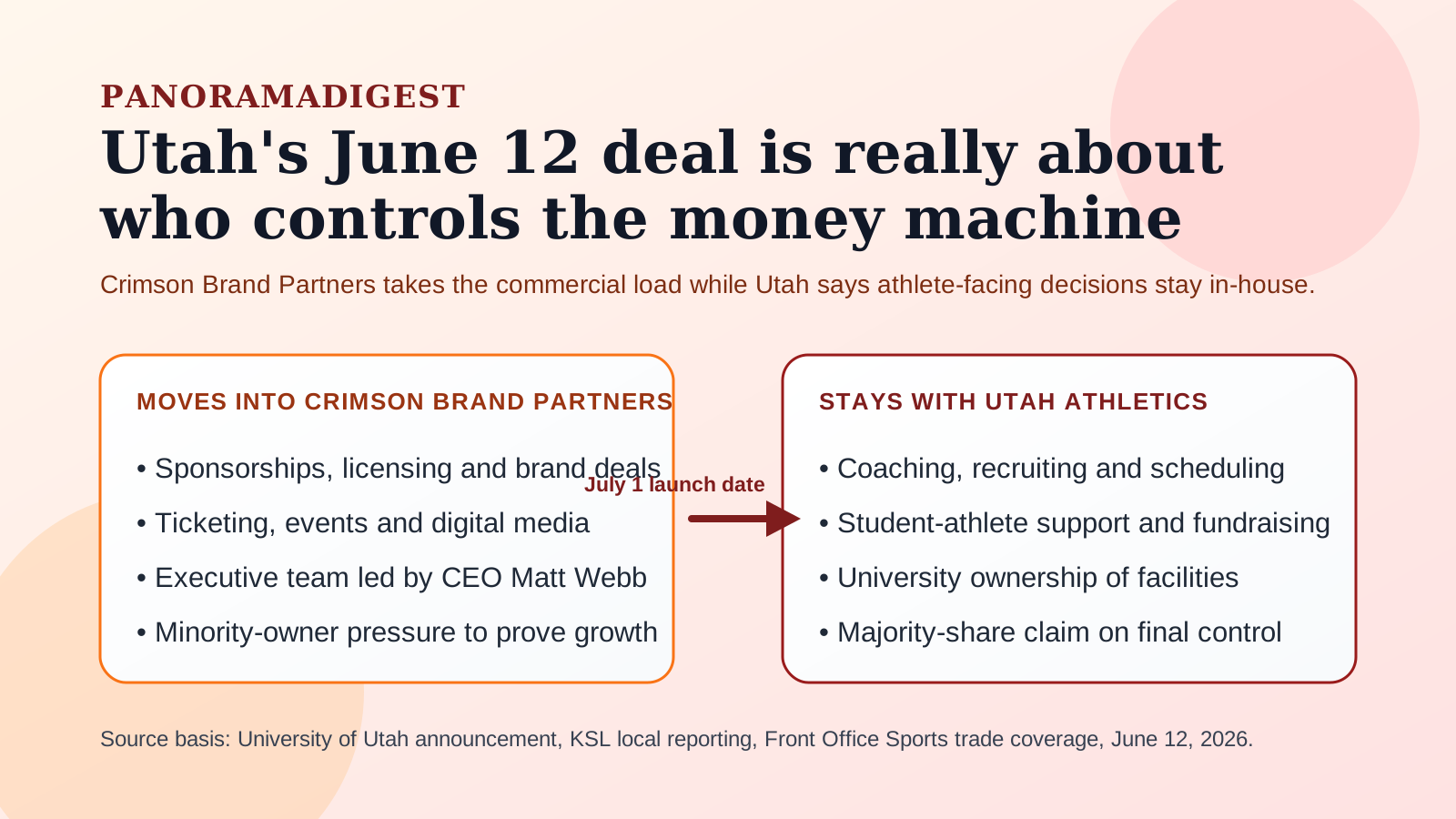
The University of Utah's newly finalized deal with Otro Capital is being sold as a first-of-its-kind financial breakthrough for college athletics. That is true, but it is also incomplete. Friday's announcement matters less because a university found new money than because it found a new structure. According to the University of Utah's June 12 announcement, the school and its foundation have now closed the partnership that creates Crimson Brand Partners, a new company built to run major commercial functions around Utah athletics and parts of the broader university brand. KSL's local reporting and Front Office Sports' industry coverage make the larger point harder to ignore: this is not just a funding story. It is a control story.
Video Link
Utah has finalized its equity partnership with Otro Capital
This provider does not render reliably inside PanoramaDigest. Open it directly on Ross Dellenger.
Watch on Ross DellengerRoss Dellenger — Utah has finalized its equity partnership with Otro Capital
Dellenger's June 12 post is a concise public-facing summary of the finalized deal and the new Crimson Brand Partners leadership team. Use the direct X link if the PanoramaDigest media card does not render in your browser.
That distinction matters because college sports has spent the past few years pretending every pressure point could be solved with one more revenue line. Revenue still matters, especially with athlete-compensation demands, media fragmentation and facility costs all climbing. But Utah is not merely adding a sponsor or taking a richer television check. It is dividing athletics into two operating lanes: the commercial machine goes one way, the coaching and athlete-development mission goes another. If that split works, other schools will copy it. If it fails, the warning will travel just as quickly.
What Utah is actually changing
The cleanest way to understand the deal is to ignore the headline phrase private equity
for a minute and look at the operating map. Utah said Crimson Brand Partners will handle events at stadiums and arenas, branding, licensing, sponsorships, ticketing and digital media. The university says coaching, recruiting, scheduling, student-athlete support and private fundraising remain inside the university structure. Athletics facilities also remain university-owned. That is not a small detail. It is the whole bet.
| Moves into Crimson Brand Partners | Stays with Utah athletics | Why the split matters |
|---|---|---|
| Branding, licensing and sponsorships | Coaching and recruiting | Utah is trying to keep competitive decisions under university control while outsourcing growth pressure to a commercial arm. |
| Ticketing and digital media | Student-athlete support | The school is separating revenue extraction from the functions most directly tied to athlete welfare. |
| Event operations in stadiums and arenas | Scheduling and core team operations | That line is supposed to stop game-day monetization from quietly becoming roster governance. |
| Board participation for Otro Capital as a minority owner | Majority institutional ownership by Utah | The deal's credibility depends on whether majority ownership actually means majority discipline when commercial incentives get sharper. |
In plain terms, Utah is trying to build a business shell around college sports without fully surrendering the sports part. That is smarter than pretending the old model can absorb new financial realities untouched. It is also riskier than the celebratory language suggests. Once a for-profit vehicle exists, it develops its own internal logic: growth targets, executive expectations, staffing changes and pressure to prove the model deserves imitation.
The leadership hires show this is built to scale, not to sit quietly
Utah did not finalize the deal and then leave the organization vague. The university said Matt Webb, a veteran of professional-sports commercial operations, will serve as chief executive officer of Crimson Brand Partners, with athletics director Mark Harlan chairing the board. KSL reported that Alex Schulte, Joel Adams and Garrett Best are also joining the senior leadership group. That matters because the university is not staffing a symbolic advisory panel. It is building an operating company with executives whose backgrounds are designed for revenue expansion, not campus nostalgia.
That is why the rest of college sports should read this as a prototype rather than a curiosity. Front Office Sports reported that Utah officials still have an eventual exit strategy in mind, even if the school did not spell out the mechanics on June 12. The existence of an exit idea tells you the partnership is being treated like an investable structure, not just a one-off rescue package. Once that is true, every future question gets harder: how much control minority owners exert in practice, how universities define mission drift and what happens if commercial targets start colliding with the public promises made to athletes, Olympic programs and campus stakeholders.
The most revealing detail may be the jobs, not the headline
There is another reason this story deserves sports coverage rather than a narrow finance brief. Front Office Sports reported that Utah has already begun layoffs and role transitions as part of the shift, while KSL described positions moving out of the athletic department and into the new company structure. That is where theory becomes real life. A private-equity model does not enter college athletics as an abstract governance chart. It enters through payroll, job descriptions and the daily question of who now works for the university and who works for the growth vehicle built around it.
Supporters of the deal will argue that this is precisely the point: college departments need modern commercial talent, cleaner revenue systems and enough capital flexibility to protect non-revenue sports over the long term. Utah itself is framing the move partly that way, including for women's and Olympic programs. Critics will counter that the same structure could normalize a future in which universities talk about athlete experience while increasingly managing athletics as a portfolio of monetizable assets. Both readings are credible. That is why this is a governance test.
Utah may be first, but the real audience is every other ambitious athletic department
This belongs in the sports section even without a scoreboard because the pressure now is institutional. Utah has to prove that a public university can invite private-equity logic into college sports without letting that logic take over the room. If the school can grow commercial revenue while preserving real institutional control over athlete-facing decisions, it will have built a model other programs will study closely. If it cannot, Friday's deal will still matter, only for a different reason: it will have shown where the red lines actually are.
Readers who want the most direct public shorthand for the June 12 announcement can use Ross Dellenger's post on X here: Utah has finalized its equity partnership with Otro Capital. If PanoramaDigest's media card does not render in your browser, that direct link remains the fallback path.
There is no world in which college sports returns to its old innocence. Utah is not trying to preserve that fiction. It is trying to get in front of the next era before the next era chooses for it. On June 12, 2026, that made the Utes more than a school closing a deal. It made them the first live test of whether commercial reinvention in college athletics can be contained once it has been invited inside.
Continue reading: Big 12 Sues Texas Tech Over Brendan Sorsby: Eligibility and League Rules.
Read Next
Related Stories

Big 12 Sues Texas Tech Over Brendan Sorsby: Eligibility and League Rules
The Big 12's lawsuit against Texas Tech is bigger than one quarterback. It asks whether a conference can still defend its own integrity rules when a member school, a state attorney general and a court order all push the other way.
WNBA Finals Game 2: Atlanta Wins 79-65 With a 14-Point Free-Throw Edge
Atlanta and Golden State scored 49 points each from field goals. Our Game 2 breakdown shows how free throws produced the 79-65 margin, plus revised Game 3 times.
FIFA Drops $20 Billion World Cup Equity Plan as UEFA Withdraws Confidence in Infantino
FIFA withdrew its $20 billion World Cup equity plan after opposition across three confederations. UEFA's no-confidence statement now shifts the dispute to Infantino's 2027 election.