Clive Davis Died at 94. His Real Legacy Was Building Stars Slowly.
Clive Davis died on Monday, June 22, 2026, at 94 in Manhattan. His career mattered not just because of the artists he signed, but because he turned patient artist development into one of the music business's last enduring forms of power.
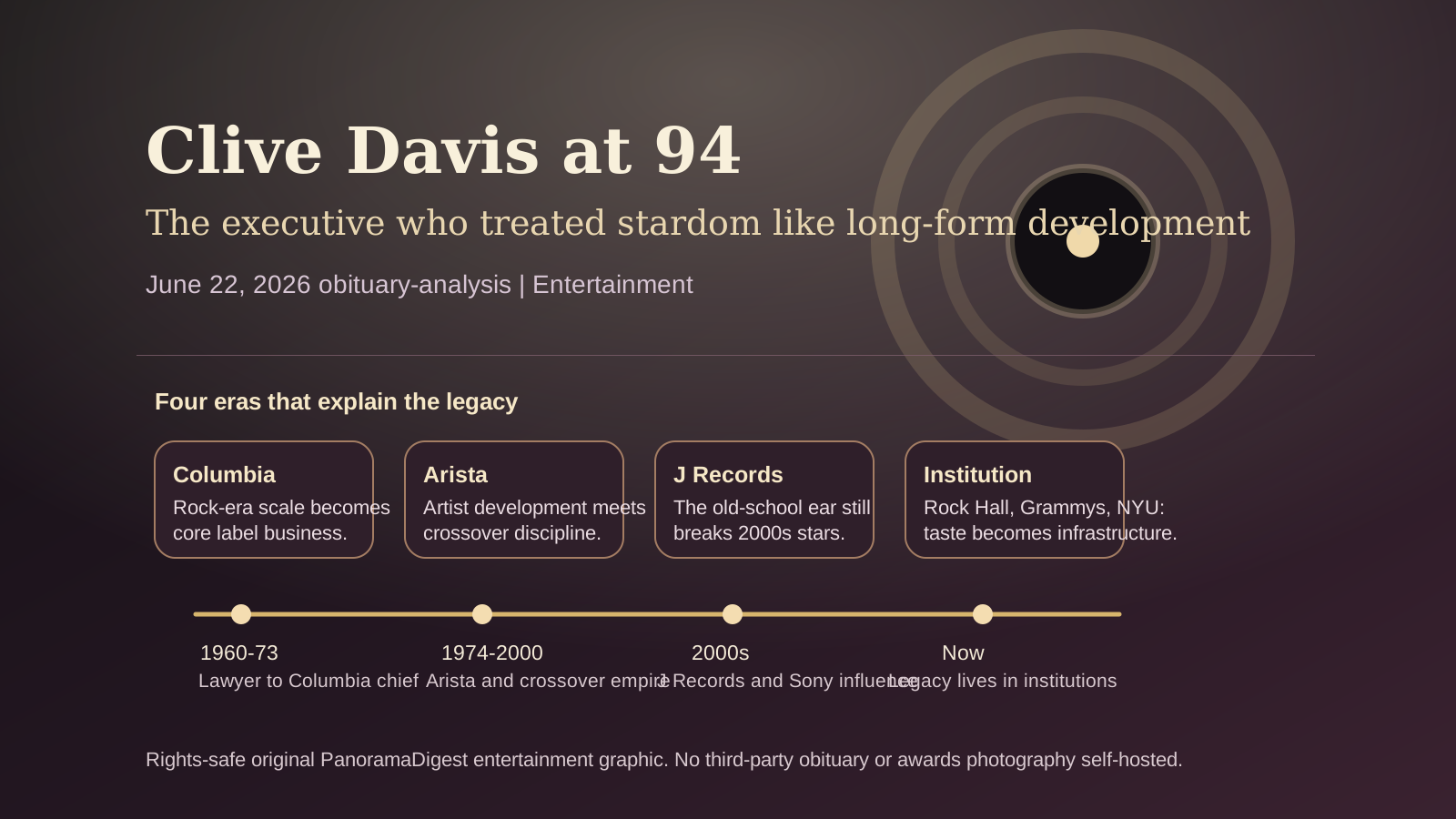
Clive Davis died on Monday, June 22, 2026, at age 94 in Manhattan, and the first wave of tributes understandably focused on the size of the names attached to him. Whitney Houston. Alicia Keys. Santana. Bruce Springsteen. Janis Joplin. That roll call is real, but it can also flatten what made Davis more consequential than the average music-industry titan. He did not simply discover stars. He built a repeatable system for making audiences stay with them.
Rock & Roll Hall of Fame / YouTube — Clive Davis Acceptance Speech at the 2000 Rock & Roll Hall of Fame induction
The Rock Hall speech is a concise primary-era artifact of how Davis framed his own place in the business. If the player is blocked, the direct YouTube link remains visible in the article body.
The most solid immediate reporting came from The Associated Press, which said Davis' death was confirmed by his publicist Aliza Rabinoff and accompanied by a family statement. ABC7 in New York reported that relatives said he died peacefully of age-related illness at his Manhattan home. Those are the immediate facts. The larger entertainment story is what disappears with him: a version of music power that depended less on viral acceleration than on taste, sequencing, repertoire, and the patience to shape a career across decades instead of quarters.
“Vision, instincts, and relentless pursuit of excellence shaped the soundtrack of countless lives.”
Family statement reported by The Associated Press on June 22, 2026
That line risks sounding ceremonial until you place it against the institutions Davis kept leaving behind. The Rock & Roll Hall of Fame, which inducted him in 2000, still describes him as a producer and executive with an uncanny eye for talent. The Recording Academy's artist page shows four Grammy wins and five nominations tied to the records and careers he shepherded. And NYU's Clive Davis Institute remains a living monument to the idea that the business side of music is not a side issue at all. It is part of the art form's architecture.
| Era | What Davis built | Why it still matters |
|---|---|---|
| Columbia Records | He helped turn rock and album-era ambition into core label business, not fringe experimentation. | Modern streaming strategy still depends on executives who can spot cultural shifts before the spreadsheets catch up. |
| Arista Records | He paired artist development with crossover discipline, especially around voices like Whitney Houston and veterans like Aretha Franklin. | The lesson was that branding and repertoire work best when they deepen an artist rather than flatten one. |
| J Records and Sony | He proved an older-school hitmaker could still break or steady major careers in the 2000s, including Alicia Keys and Kelly Clarkson. | That undercut the lazy assumption that every generation of executives becomes obsolete on schedule. |
| Institutional legacy | He turned the pre-Grammy gala, the Hall of Fame circuit and the NYU institute into extensions of his taste-making authority. | His influence outlived radio formats because he embedded it in the culture's gatekeeping machinery. |
The better entertainment frame here is less gossip and more infrastructure
Davis' death is not most interesting as a society-page event, even though he spent years orbiting one of the industry's most famous annual parties. The better cultural question is whether the kind of executive he represented can still exist in a business now trained to confuse instant visibility with durable career design. Davis belonged to an era that believed in timing albums, choosing singles, refining image, and finding the exact point where mainstream appetite met individual talent. That process could be controlling, even manipulative, and the record is not spotless. The AP obituary notes the Milli Vanilli debacle, the 2007 clash with Kelly Clarkson over My December, and the long trail of arguments that came with a strong-willed tastemaker. But even those conflicts make the same point from the opposite side: Davis mattered because his decisions were consequential enough to fight over.
That is why Whitney Houston remains central to his public memory. In almost every obituary, Houston's arc appears as both triumph and burden, and not by accident. She was the clearest example of what Davis believed a great executive could do: identify rare talent, place it inside a commercial frame broad enough to dominate, and keep adjusting the machinery around it as the culture moved. In the streaming age, when so much music discourse treats audience behavior as an algorithmic weather pattern, that kind of hands-on career authorship can look almost antique. It was not antique. It was power.
Why his death lands differently in 2026
There is a reason the news hit harder than a routine obituary for a nonperforming industry elder. Davis belonged to one of the last generations of executives whose names became public shorthand for an entire style of cultural mediation. Readers did not need to know every contract clause to understand what his presence signaled: if Clive Davis was attached, the artist, event or comeback had been filtered through a set of ears that still carried institutional weight.
That weight is harder to reproduce now. Labels still have power, but much of it has shifted from artist-making mythology toward catalog management, platform leverage, and the endless optimization of attention. Davis never escaped commerce; he mastered it. What separated him from so many successors was that he made commerce feel interpretive. His best work suggested that executive taste could still function like criticism with consequences.
That broader tension between cultural craft and the business of attention is exactly what PanoramaDigest's recent analysis of why family movies still have to fight the tablet economy was really about too. Different medium, same question: who still knows how to build durable audience attachment rather than a passing spike?
- Immediate fact: Davis died on June 22, 2026, at 94, with his death confirmed through his publicist and family reporting.
- Industry fact: His influence ran through Columbia, Arista, J Records and Sony, not one isolated label chapter.
- Cultural fact: He represented a slower, more interventionist model of artist development that the modern business has not truly replaced.
That is the real reason Clive Davis' death matters beyond nostalgia. It marks another narrowing of the bridge between executive authority and cultural intuition. The modern music business can still manufacture moments. Davis spent a lifetime proving that moments were the easy part. The harder achievement was building careers that survived them.
Reader Sentiment & Impact Pulse
How do you evaluate the primary outcome of this development?
Select an option to cast your perspective. Responses are anonymous and aggregated in real time.
Key Context & Frequently Asked Questions
Clive Davis died on Monday, June 22, 2026, at 94 in Manhattan. His career mattered not just because of the artists he signed, but because he turned patient artist development into one of the music business's last enduring forms of power. This analysis from PanoramaDigest examines primary documentation, operational implications, and broader institutional impacts across entertainment.
Read Next
Related Stories

Vincent Pastore Dies at 80: The Sopranos Actor's Career Beyond Big Pussy
Vincent Pastore, who made friendship and betrayal inseparable as Big Pussy on The Sopranos, has died at 80. His manager confirmed the death to AP.

Ryan Gosling Will Play Ghost Rider in Marvel's 2028 Film Directed by Shawn Levy
Marvel confirmed Ryan Gosling as its new Ghost Rider at San Diego Comic-Con. Shawn Levy will direct the 2028 film, giving the MCU character his first standalone movie since the rights returned to Marvel.
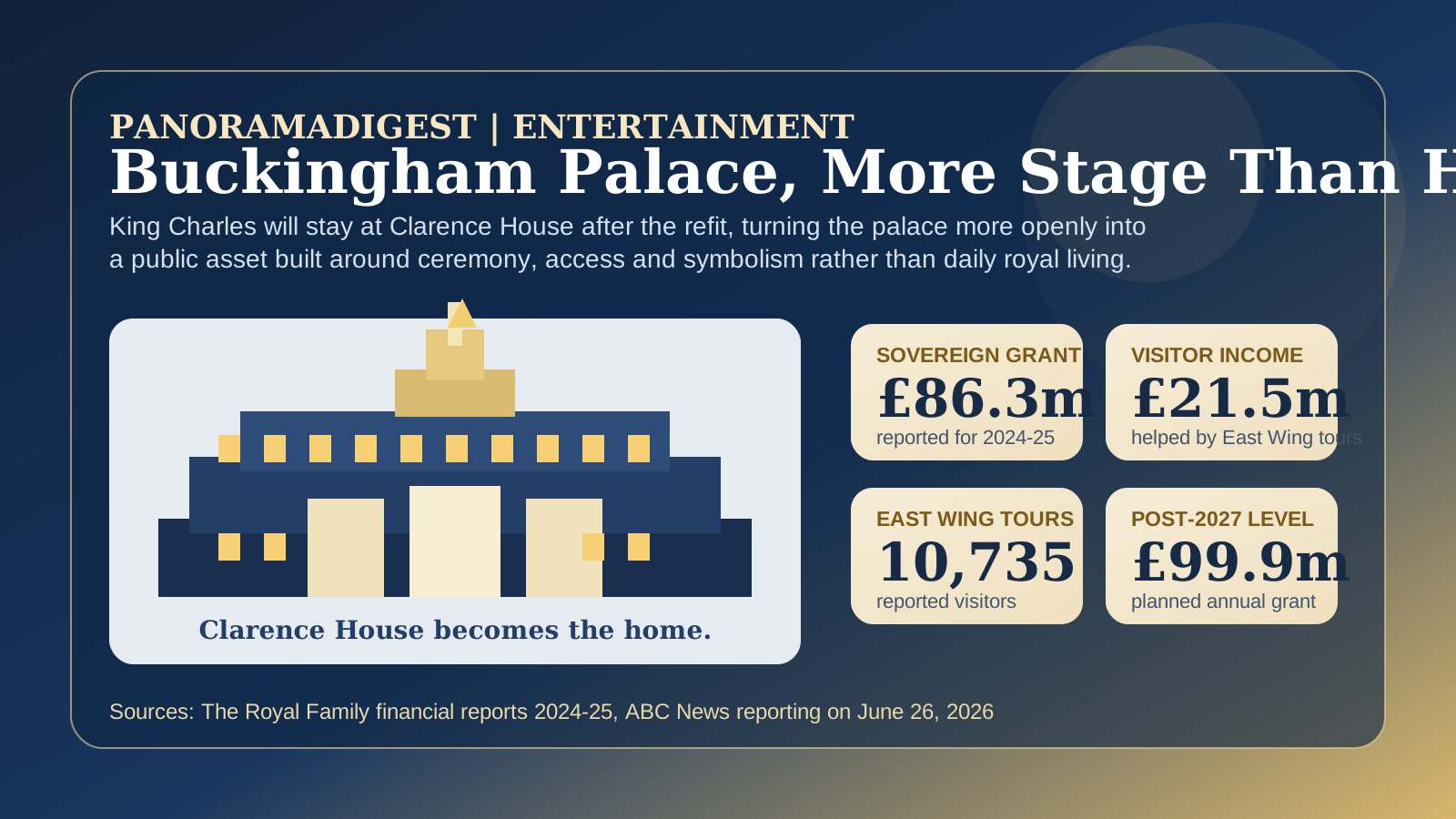
King Charles Won't Live at Buckingham Palace. That Makes the Monarchy's Biggest Symbol More Stage Than Home.
King Charles III and Queen Camilla will stay at Clarence House after Buckingham Palace's renovation. The larger cultural shift is that Britain's most famous royal address is being treated less as a private home and more as a public-facing stage set whose value must now be justified in visits, events and visible utility.