King Charles Won't Live at Buckingham Palace. That Makes the Monarchy's Biggest Symbol More Stage Than Home.
King Charles III and Queen Camilla will stay at Clarence House after Buckingham Palace's renovation. The larger cultural shift is that Britain's most famous royal address is being treated less as a private home and more as a public-facing stage set whose value must now be justified in visits, events and visible utility.
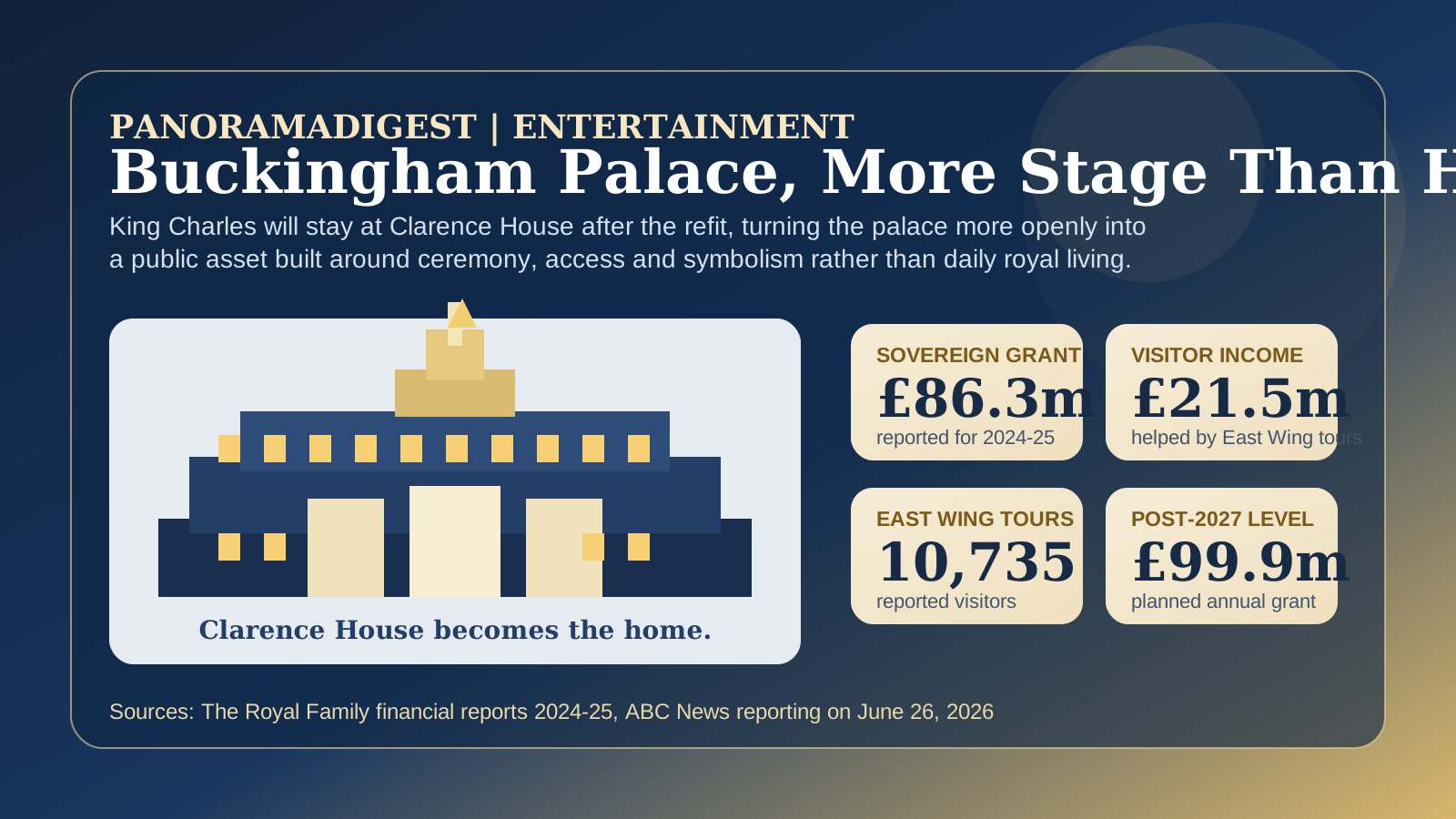
King Charles III's decision not to move into Buckingham Palace after its renovation closes next year is easy to frame as royal eccentricity. It is actually a cleaner statement about what the modern monarchy thinks Buckingham Palace is for. The Royal Household's 2024-25 financial report presented the palace less as a family home than as a restored national platform: a place for state events, summer openings, public tours and the careful monetization of symbolism. ABC's June 26 report says Charles and Queen Camilla will remain at Clarence House, ending the assumption that refurbishment would restore the palace to its old residential role.
That matters because Buckingham Palace has never been just another address. It is the monarchy's most recognizable prop, the backdrop for balcony scenes, crises, mourning rituals, diplomatic theater and British tourism itself. Once the sovereign declines to live there, the building stops pretending to be a private domestic center that occasionally opens its doors. It becomes, more plainly, the monarchy's headquarters, museum and event venue in one.
The palace now reads more like a brand platform than a residence
The official numbers make that interpretation hard to ignore. The Royal Household said the Sovereign Grant remained at 86.3 million pounds in 2024-25, including 34.5 million pounds for the Buckingham Palace reservicing program. It also said supplementary income rose to 21.5 million pounds, helped by a record year for palace visitors and special tours of the newly restored East Wing, which drew 10,735 visitors. Those are not the metrics of a private family seat. They are the metrics of an institution learning to explain itself through footfall, programming and preserved heritage.
ABC added the sharper political layer: the Sovereign Grant is set to rise to 137.9 million pounds in the 2026-27 financial year before dropping to 99.9 million pounds annually from the following year through 2032, while the same disclosure also revealed that Charles paid 12.9 million pounds in tax in 2024-25 on a voluntary basis. That combination matters. It suggests the palace story is no longer just about tradition or comfort. It is about optics, accountability and whether the monarchy can keep defending expensive symbols by making them feel legible to the public.
| Question | Old Buckingham Palace idea | What the new decision signals |
|---|---|---|
| What is the palace for? | The sovereign's official home first, public venue second. | A ceremonial workplace and public-facing landmark first, with residential symbolism downgraded. |
| How is value justified? | By continuity, prestige and inherited ritual. | By access, state use, tourism pull and visible institutional function. |
| What does Clarence House represent? | A secondary royal residence nearby. | The actual private base for a king who seems to prefer separation between home life and spectacle. |
| What changes for the public? | The myth of the palace as lived-in center survives. | The palace looks more openly like a national stage set that must earn trust in public view. |
Charles is choosing separation over inherited theater
There is also a personal logic here that should not be dismissed as trivial. Buckingham Palace is enormous, historic and globally famous, but it is also unwieldy. ABC noted that Charles has lived at Clarence House since 2003, and the preference has the feel of habit turned into constitutional reality. A monarch in his late seventies may simply see little value in moving into a 775-room complex that works better as an office, reception engine and diplomatic set than as a practical daily home.
That practical reading does not make the choice small. It makes it more revealing. Queen Elizabeth II kept the palace myth intact even when the building also functioned as a national machine. Charles appears more willing to let the machine show. The result is not anti-tradition. It is a colder, more managerial version of tradition, one that separates the monarchy's emotional image from its operational base.
- 2017: The reservicing program begins with the stated aim of modernizing essential systems and protecting the building for future generations.
- 2024-25: The Royal Household reports record visitor-driven supplementary income and special East Wing tours, pushing the palace further into public-asset logic.
- June 26, 2026: Financial disclosures confirm Charles and Camilla do not plan to move in after the renovation finishes.
- From 2027 onward: The argument for the palace depends less on lived monarchy and more on how well the institution turns ceremony, access and stewardship into public consent.
Why this story lands beyond royal gossip
The entertainment lens is useful here because this is not just a constitutional footnote. It is a story about the business of attention. Buckingham Palace has always been a set as much as a structure. The balcony wave, the guard change, the gates, the crowd shots and the flyovers all work because the building functions as instantly understood cultural scenery. Once the king stops living there, that scenery does not weaken. It becomes easier to read as scenery, and therefore easier to question in budget terms.
The monarchy may decide that is a price worth paying. A palace that is more open, more tourable and more visibly useful can still serve the institution well, especially if it lowers the sense that public money is underwriting pure private luxury. But the trade is real. The more Buckingham Palace becomes a curated public product, the harder it is to sell the romance that its cost is bound up with intimate royal life. That romance has long helped smooth over the accounting.
So the Charles decision should not be read as a quirky housing preference. It is closer to a branding adjustment forced by modern scrutiny. Buckingham Palace is surviving, but in a more honest category. It is no longer the unquestioned family hearth of the sovereign. It is Britain's grandest stage, preserved at enormous cost, and now judged more directly on how well the show serves the public that pays for it.
Continue reading: Norway's Høiby Verdict Tested Whether Royal Distance Was Real or Merely Polite.
Read Next
Related Stories

Netflix Cuts 2026 Ad Revenue Forecast to $2.7 Billion: The 10% Change Explained
Netflix lowered its annual ad outlook, not last year's sales. A calculation table separates the 10% revision, its revenue share and the company's quarterly results.

Vincent Pastore Dies at 80: The Sopranos Actor's Career Beyond Big Pussy
Vincent Pastore, who made friendship and betrayal inseparable as Big Pussy on The Sopranos, has died at 80. His manager confirmed the death to AP.

Ryan Gosling Will Play Ghost Rider in Marvel's 2028 Film Directed by Shawn Levy
Marvel confirmed Ryan Gosling as its new Ghost Rider at San Diego Comic-Con. Shawn Levy will direct the 2028 film, giving the MCU character his first standalone movie since the rights returned to Marvel.