The Latest U.S. Drug-Boat Strike Is Really a Proof Problem, Not a Victory Lap
U.S. Southern Command said its June 21 strike killed two men and left six survivors, but the public record still does not clearly prove what was on the vessel, whether the survivors were rescued, or why major reports first disagreed on whether the strike happened in the Caribbean or the eastern Pacific.
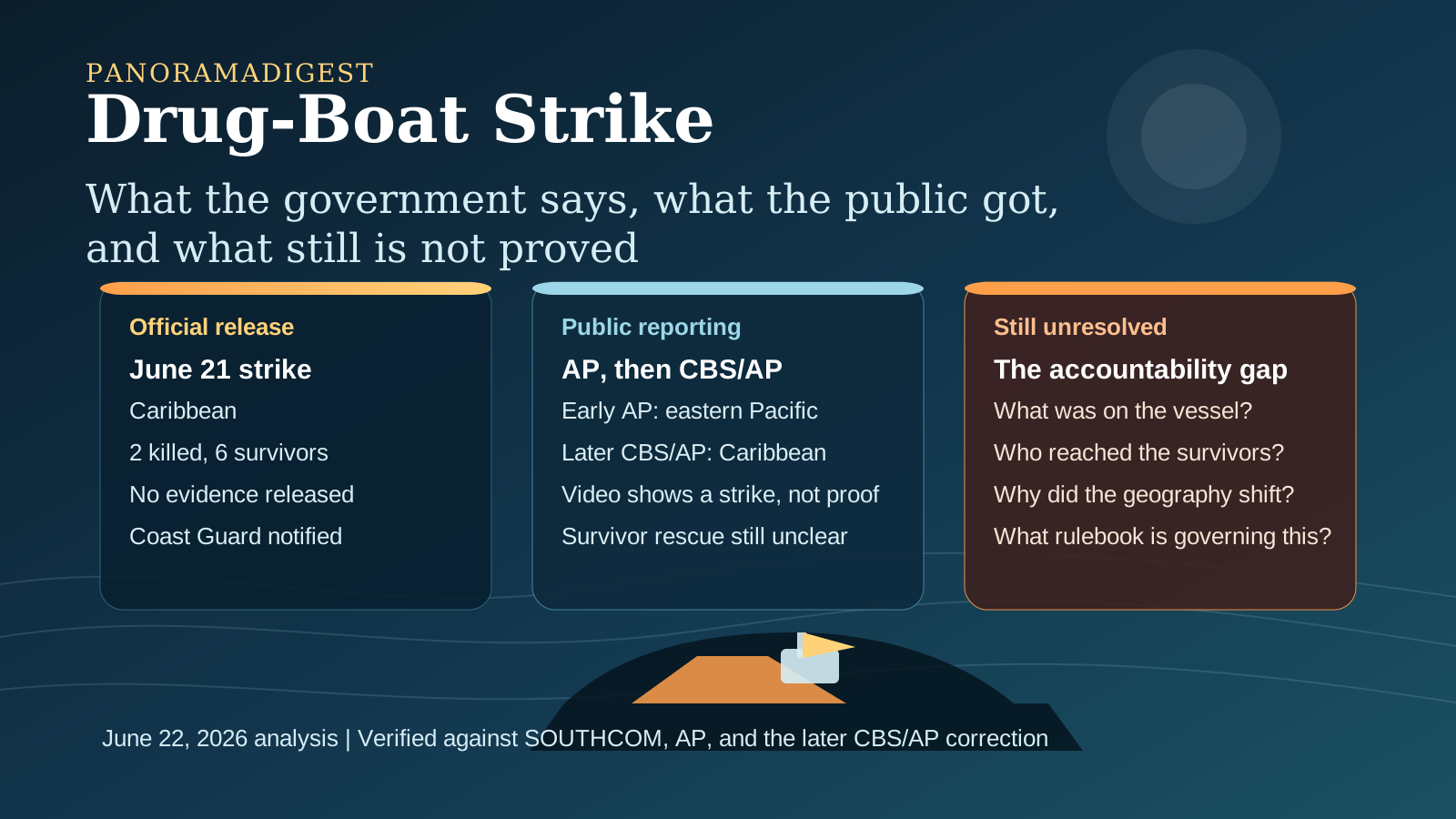
U.S. Southern Command says its June 21, 2026 strike on an alleged drug-trafficking boat killed two men and left six survivors. That is the official headline. The harder public-interest story begins one layer down. The military still has not publicly shown evidence that the vessel was carrying drugs, it has not clarified whether the six survivors were rescued, and the same event spent part of Monday moving through the news cycle with a basic geographic contradiction attached to it.
On SOUTHCOM's official June 21 release and matching DVIDS video page, the command says the boat was operating along known narco-trafficking routes in the Caribbean. The Associated Press' June 22 report described an eastern Pacific strike that killed two people and left six survivors. CBS, carrying AP reporting later in the day, published an updated version that said the story had been corrected to reflect that the strike happened in the Caribbean. That kind of correction does not make the event unimportant. It does show why the real accountability test is not whether officials can release ten seconds of black-and-white impact footage. It is whether they can keep the basic factual record stable while asking the public to trust the broader campaign behind it.
See the official release video: SOUTHCOM's June 21 DVIDS page is here: Lethal Kinetic Strike, June 21, 2026. PanoramaDigest reviewed it for verification, but did not embed it because the current DVIDS player does not render reliably inside PanoramaDigest's article template.
The command confirmed the strike. It did not prove the central claim.
SOUTHCOM's language follows a familiar pattern by now. The command says intelligence confirmed the vessel was operating along known trafficking routes, that it was engaged in narco-trafficking operations and that the Coast Guard was notified after the strike. What the public still does not have is the thing that would let independent readers test the claim rather than merely receive it: evidence that the boat was in fact carrying illicit cargo or otherwise unmistakably tied to the drug trade. AP noted the same gap in its June 22 reporting, writing that the military did not provide evidence the vessel was ferrying drugs.
That matters because this is no longer an isolated action. AP reported that the latest strike pushes the campaign to more than 60 boat strikes and more than 210 deaths since the Trump administration began targeting what it calls narcoterrorists in September. A repeated operation can make officials feel as though the burden of explanation shrinks with each new action. In a democracy, the opposite should happen. Repetition makes the demand for proof more urgent, not less.
| What is verified | What the public still does not know | Why the gap matters |
|---|---|---|
| SOUTHCOM says the June 21 strike killed two men and left six survivors. | Whether those six survivors were rescued. | A lethal operation does not end at impact if survivors are left in the water. |
| The official June 21 release places the strike in the Caribbean. | Why major public reporting initially described the strike as occurring in the eastern Pacific. | If basic geography shifts, readers have reason to question the precision of the rest of the public record. |
| Officials say the boat was engaged in narco-trafficking operations. | What evidence supports that claim in this specific case. | The legal and moral case for repeated lethal strikes depends on more than official assertion. |
| A short official video of the strike was released. | What happened before the strike and after the blast. | Ten seconds of impact footage shows force, not context. |
The survivor question is where the moral pressure now sits
The current dispute is not only about whether the boat was a lawful target. It is also about what the United States owes people who are still alive after one of these strikes. AP reported that it remains unclear whether the survivors from the latest strike were rescued. CBS' updated version said the Coast Guard had no comment on the survivors from the current case while noting that the service had previously suspended a search for survivors after the June 16 strike with no signs of survivors or debris.
That uncertainty is not a side note. It is the point at which operational language collides with ordinary human judgment. If officials are going to argue that these are disciplined counter-narcotics actions and not simply punitive demonstrations of force, then rescue outcomes and follow-up procedures have to be part of the public record. Otherwise the campaign invites a grim pattern: the state tells the public who the targets were supposed to be, releases a narrow slice of proof, and leaves the most morally loaded questions outside the frame.
Why the geography mismatch is more than an embarrassing correction
The Caribbean-versus-Pacific discrepancy might look small compared with the strike itself. It is not small. Geography determines which route is being discussed, which operational story the government is telling, which prior incidents the public should compare and how seriously to take official precision in a campaign already facing legal scrutiny. CBS' editor's note matters precisely because it shows that a later version of the story no longer matched the first public description.
That should push readers toward a sober conclusion. The administration may believe these strikes are politically popular because they sound decisive. But decisive language is not the same thing as a durable factual record. When the public has to assemble the truth from an official release, a wire report, a later correction and an unanswered rescue question, the campaign stops looking like a clean show of control. It starts looking like an accountability system running behind the pace of the weapons.
The test now is whether officials will publish more than a conclusion
The easiest next move for the administration would be another round of broad language about smugglers, terrorist designations and disrupted routes. The more serious next move would be narrower and more useful: clarify whether the six survivors were recovered, explain why the location reporting changed, and release enough underlying evidence to let the public understand why this specific vessel was targeted. Those are not hostile demands. They are the minimum standard for a campaign that has already become routine enough to risk normalizing its own opacity.
The latest strike therefore should not be read as a clean success story. It should be read as a proof problem. The government has shown that it can hit a boat. It has not yet shown that it can carry the public case for these strikes with the same precision it claims to bring to the operation itself.
Reader Sentiment & Impact Pulse
How do you evaluate the primary outcome of this development?
Select an option to cast your perspective. Responses are anonymous and aggregated in real time.
Key Context & Frequently Asked Questions
U.S. Southern Command said its June 21 strike killed two men and left six survivors, but the public record still does not clearly prove what was on the vessel, whether the survivors were rescued, or why major reports first disagreed on whether the strike happened in the Caribbean or the eastern Pacific. This analysis from PanoramaDigest examines primary documentation, operational implications, and broader institutional impacts across news.
Read Next
Related Stories

Andy Burnham Praises Greenland Deal Ahead of Anticipated Meeting With Donald Trump
Mayor Andy Burnham has welcomed a strategic commercial partnership involving Greenland, emphasizing the vital role of regional diplomacy ahead of an expected meeting with Donald Trump.
Jury Convicts Driver of Negligent Homicide in Death of Reporter Covering Super Bowl
A Louisiana jury has found a driver guilty of negligent homicide in the fatal striking of a journalist covering Super Bowl events in New Orleans. The verdict brings legal accountability to a tragic case that underscored pedestrian safety challenges during major national entertainment spectacles.

Jensen Huang Reframed AI Doom Debate as National Opportunity in Discourse With Donald Trump
Nvidia CEO Jensen Huang addressed existential AI fears during conversations with Donald Trump, advocating for American leadership and innovation over restrictive regulatory caution.