The Supreme Court Restored the Etan Patz Conviction. The Harder Question Is What Closure Means After 47 Years.
The Supreme Court restored Pedro Hernandez's conviction on June 22, 2026, in the Etan Patz case. The ruling matters not only because it ends the immediate retrial threat, but because it treats procedural finality as the law's answer in a case that still carries a deep public argument about confession evidence, time and closure.
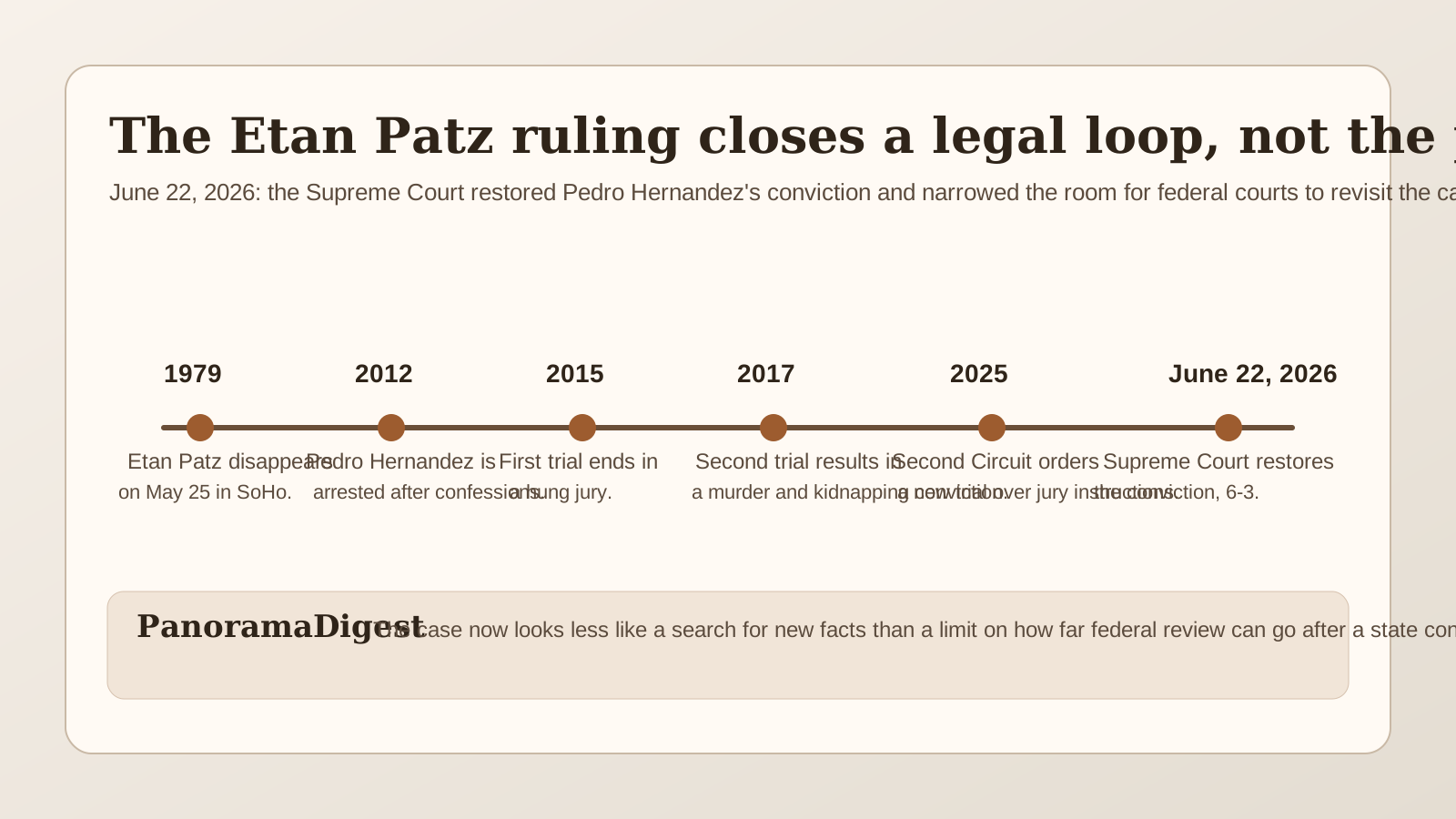
On Monday, June 22, 2026, the Supreme Court restored Pedro Hernandez's conviction in the 1979 disappearance of 6-year-old Etan Patz, reversing the federal appeals ruling that had reopened the case for a possible third trial. The legal headline is straightforward enough. In McCarthy v. Hernandez, a six-justice majority said the Second Circuit had gone too far when it granted habeas relief over the trial judge's response to a jury note about Hernandez's confessions. The harder public story is what kind of closure this actually delivers. After nearly half a century, the Court has offered New York procedural finality. It has not erased the unease that always follows a conviction built around disputed confessions in a case with no recovered body.
That distinction matters because the opinion is less a sweeping retelling of Etan Patz's disappearance than a forceful reminder of how narrow federal post-conviction review has become. The Court said no clearly established federal law required the state trial judge to give the instruction Hernandez wanted, and it stressed that federal courts do not get to undo a state conviction simply because they doubt the weight or reliability of the evidence. AP's report on June 22 captured the immediate outcome: the 2017 murder and kidnapping conviction is back in place, and the Manhattan retrial path that had been looming since last year's appellate reversal is no longer the default next step.
Why the Court's opinion is bigger than one notorious New York case
The per curiam opinion is blunt about what it is doing. It says the Second Circuit exceeded its authority under the federal habeas statute, especially because the state courts had already upheld the trial judge's handling of the jury note under New York law. That matters beyond this single case. The justices were effectively warning lower federal courts against using due-process theory to revisit state convictions unless the Supreme Court itself has already spoken clearly on the specific rule at issue. In practice, that makes it harder for defendants to convert a troubling trial record into federal relief after state appellate review has ended.
For readers who do not track criminal procedure, the key point is simple. Monday's ruling was not a fresh trial-style weighing of whether Hernandez's confessions were persuasive. It was a statement about who gets to second-guess the state court after the fact. The opinion says that lane is much narrower than the Second Circuit treated it. That gives Manhattan prosecutors the certainty they wanted, but it also means the public should be careful not to confuse legal narrowness with emotional certainty. A case can survive federal review and still leave people arguing about how much confidence they place in the underlying evidence.
| Date | What changed | Why it matters now |
|---|---|---|
| May 25, 1979 | Etan Patz disappeared while walking to a school-bus stop in SoHo. | The case became one of the most defining missing-child investigations in modern New York. |
| May 2012 | Pedro Hernandez was arrested after confessing during police questioning and later on video after Miranda warnings. | The prosecution's case would revolve around those confessions because Etan's body was never found. |
| 2015-2017 | A first trial ended in a hung jury, then a second trial ended in a conviction. | The split jury history is part of why the case never felt simple, even after the guilty verdict. |
| July 2025 | The Second Circuit overturned the conviction over the trial judge's answer to a jury note about the confessions. | That ruling reopened the possibility of a third trial and put the case back into procedural motion. |
| June 22, 2026 | The Supreme Court restored the conviction by a 6-3 vote. | The immediate retrial threat is gone, and the Court has reinforced how limited federal habeas review is. |
What closure can and cannot mean here
Etan Patz's disappearance changed how the country talks about missing children long before this case ever reached the current Court. That history is part of why Monday's ruling will feel definitive to some readers and unsatisfying to others. The law can decide whether a conviction stands. It cannot fully settle the discomfort of a case that lived for decades as an absence, then turned on statements the defense has always said were false and unreliable. The Court's opinion does not pretend otherwise. It simply says that whatever doubts a federal panel may have seen in the record, AEDPA does not let those doubts substitute for a clearly established constitutional rule.
There is also a practical civic reason to sit with that distinction. Americans often talk about high-profile criminal cases as if every final ruling must deliver moral clarity. Sometimes it does not. Sometimes it delivers an answer about institutional boundaries. Monday's answer was that federal judges are not free to keep reopening this conviction on a thinner theory than the statute allows. That is a real legal conclusion. It is just not the same thing as healing.
| What Monday's ruling clearly does | What Monday's ruling does not do |
|---|---|
| Restores Hernandez's 2017 conviction and removes the immediate path to a third trial. | Resolve every public argument about the reliability of the confessions or the emotional meaning of the case. |
| Reinforces that federal habeas relief is tightly limited after state courts have ruled. | Create a broad new factual finding about what happened in SoHo on May 25, 1979. |
| Signals that the Second Circuit read due process and jury-instruction law too expansively here. | Turn a painful, body-less disappearance into a case that suddenly feels uncomplicated. |
What readers should watch next
The next developments are likely to be narrower than the public memory of the case itself. The conviction has been restored, so the immediate procedural drama should cool unless there is a new collateral move. What remains worth watching is how officials describe the ruling, and whether they frame it honestly as a limit on federal review rather than as some newly discovered burst of evidentiary certainty. The distinction is important because cases like this teach the public how the justice system talks about itself under pressure.
For New York, Monday's decision closes a chapter that had unexpectedly reopened. For the country, it is a reminder that procedural finality can arrive long before a story stops hurting. That is not a contradiction. It is often what the law looks like at the far end of time.
Reader Sentiment & Impact Pulse
How do you evaluate the primary outcome of this development?
Select an option to cast your perspective. Responses are anonymous and aggregated in real time.
Key Context & Frequently Asked Questions
The Supreme Court restored Pedro Hernandez's conviction on June 22, 2026, in the Etan Patz case. The ruling matters not only because it ends the immediate retrial threat, but because it treats procedural finality as the law's answer in a case that still carries a deep public argument about confession evidence, time and closure. This analysis from PanoramaDigest examines primary documentation, operational implications, and broader institutional impacts across news.
Read Next
Related Stories

Patrick Clancy Breaks Silence on Grief and Justice Following Mistrial
In his first interview since the declaration of a mistrial, Patrick Clancy opens up about the overwhelming personal toll of his ongoing legal and emotional journey.
ICE Officer Shoots Venezuelan Food Delivery Worker in Austin, Legal Representation Confirms
An Immigration and Customs Enforcement officer shot a Venezuelan food delivery driver in Austin, Texas, sparking immediate local outcry and intensifying scrutiny over federal enforcement tactics in sanctuary jurisdictions.
Andy Burnham Praises Greenland Deal Ahead of Anticipated Meeting With Donald Trump
Mayor Andy Burnham has welcomed a strategic commercial partnership involving Greenland, emphasizing the vital role of regional diplomacy ahead of an expected meeting with Donald Trump.