Utah Has Fought Measles for a Year. The Harder Battle Is Stopping a Slowdown From Looking Like Control.
Utah's measles outbreak has crossed the one-year mark with more than 680 cases. The immediate curve has cooled, but the deeper warning is that a slower outbreak is not the same thing as restored protection.
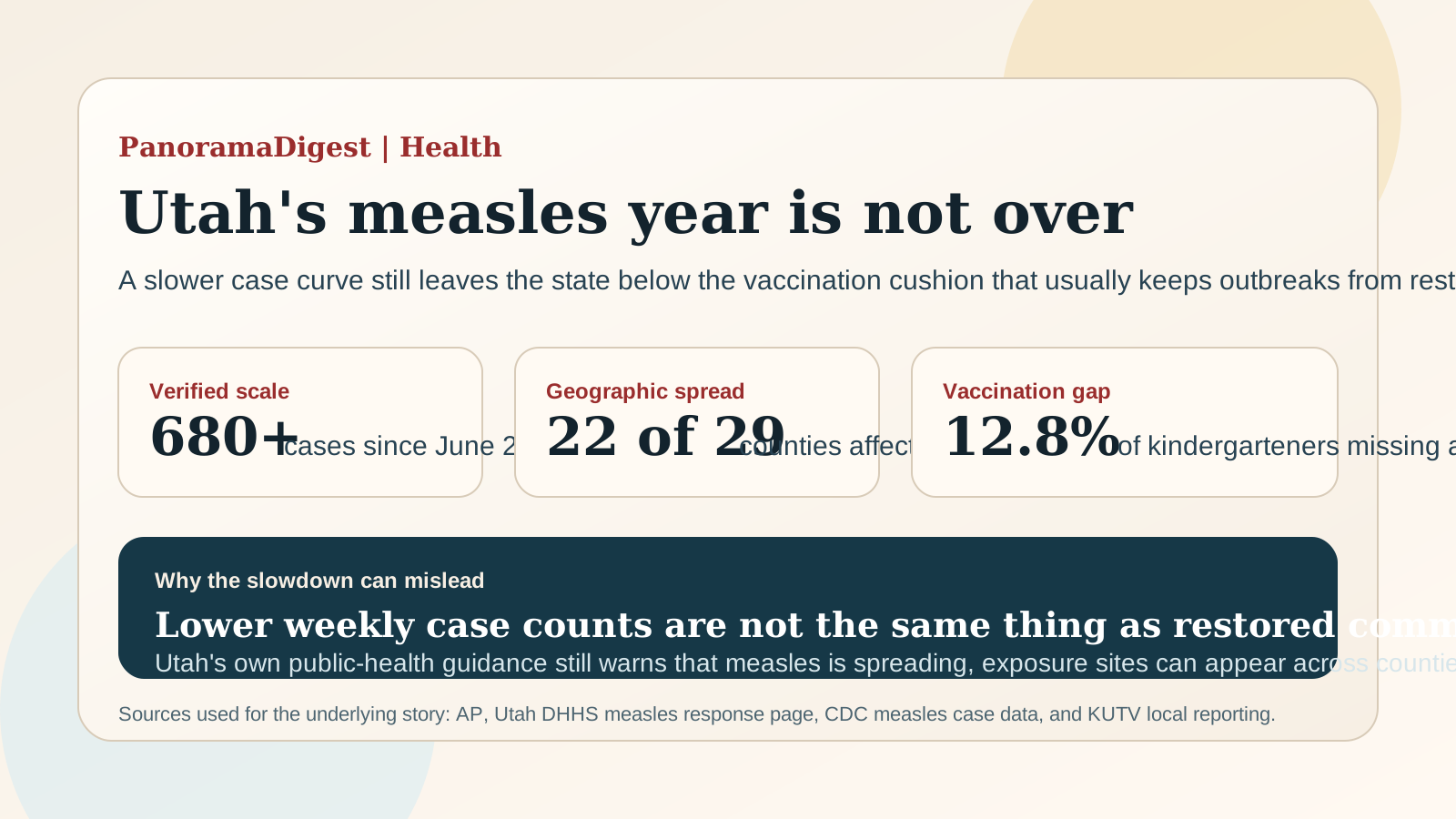
Utah's measles outbreak crossed a threshold on June 20, 2026 that no state wants to explain away as a technicality. It has now been a full year since the first outbreak began on June 20, 2025, and The Associated Press reported that more than 680 people have gotten sick in that span. The question for readers is not whether the pace has cooled from its most alarming weeks. It has. The harder question is whether Utah has rebuilt enough protection to keep that slowdown from becoming a false sense of closure.
KUTV 2 News Salt Lake City — Utah reports nearly 700 measles cases since outbreak began, threatens elimination status
KUTV's local summary tracks the case total and the elimination-status warning. If the player does not load in your browser, use the direct YouTube link in the article.
Utah's own public-health response page still carries active exposure guidance, symptom-watch instructions and a standing warning that measles is spreading in the state even when every exposure site is not yet known. CDC data showed 2,104 confirmed U.S. cases as of June 18, 2026, with 93% tied to outbreaks. Utah is not carrying that national burden alone, but it has become one of the clearest demonstrations of what happens when a highly contagious virus meets communities whose vaccination cushion has worn thin. A calmer week is not the same thing as a safe baseline.
What the year mark actually shows
AP's reporting makes the scale plain. Utah's outbreak has touched 22 of the state's 29 counties. The virus has shown up not only in households and clinics, but also in big-box stores, restaurants and youth sporting events. One of the clearest accelerants came in February, when an exposure at the state high school wrestling championship was linked to at least 46 cases among attendees. That is why this outbreak feels different from a narrow local flare-up. It has kept finding ordinary places where people assume the risk belongs somewhere else.
The same AP report also captures the key structural fact behind the spread: in the last school year, 12.8% of Utah kindergarteners were missing their measles vaccine, leaving the state well short of the 95% coverage level usually associated with community protection. In the TriCounty region of Daggett, Duchesne and Uintah counties, more than 16% of kindergarteners were missing measles vaccination, according to the state data AP cited. That is not a messaging problem first. It is an exposure math problem. Once measles reaches a community with that much room to move, public-health officials are often left trying to limit damage rather than prevent ignition.
Why a slower curve can still be dangerous
Public-health stories often tempt readers into a simple rhythm: cases rise, officials respond, the curve bends, the emergency passes. Utah is a warning against that tidy sequence. AP reported that state epidemiologist Leisha Nolen still sees little room to relax because the return to school and colder weather in the fall could create the next opening for transmission. That is the right frame. Measles does not need a dramatic statewide surge every week to remain a serious policy failure. It only needs enough lingering transmission to reach the wrong school, the wrong church network, the wrong household cluster or the wrong county with weaker vaccine coverage.
KUTV's recent local reporting underscored the same broader concern: Utah is carrying one of the country's largest measles burdens, and the state's exemption culture has become part of the backdrop rather than a side note. That matters because outbreaks end fastest when the public reads vaccination as civic infrastructure instead of an individual lifestyle preference. Once the argument shifts toward accommodation of recurring preventable spread, the state starts treating measles like bad weather: unpleasant, seasonal and somehow inevitable. It is none of those things.
| Verified fact | Why readers should care |
|---|---|
| More than 680 Utah cases since June 20, 2025 | A one-year outbreak is evidence of sustained in-state transmission, not a short containment failure. |
| Cases reached 22 of 29 counties | The problem is statewide enough that local reassurance can become misleading. |
| Utah kindergarten coverage fell below the 95% community-protection benchmark | The virus still has room to travel when it finds exposed schools, families or events. |
| The wrestling championship exposure led to at least 46 linked cases | High-contact youth settings can still turn one exposure into a regional amplifier. |
| CDC counted 2,104 confirmed U.S. cases as of June 18 | Utah's struggle is part of a larger national relapse, not an isolated local anomaly. |
The policy test is what Utah does before fall, not after
Utah officials and local health departments have not done nothing. AP described exclusion policies for unvaccinated students, isolation guidance and more direct conversations with vaccine-hesitant families. The state response page still offers practical instructions for symptoms, exposure windows and early MMR conversations with clinicians. Those are real tools, and they matter. But they are downstream tools. They help once the virus is already moving.
The larger question is whether Utah treats this anniversary as a moment for administrative maintenance or for political honesty. If the state is still below the coverage level that makes outbreaks hard to sustain, then the goal cannot simply be to survive the summer with better optics. The goal has to be to harden the communities that measles keeps finding first. That means talking less like the outbreak is fading naturally and more like a preventable gap in protection is still open.
- June 20, 2025: the first outbreak in the current cycle begins, starting the one-year clock AP measured on Saturday.
- Winter and spring 2026: spread reaches multiple counties, including a major cluster tied to the state high school wrestling championship.
- Spring 2026: AP reports 74 TriCounty cases as local officials lean on school exclusions, isolation and vaccination outreach.
- June 18, 2026: CDC posts 2,104 confirmed U.S. measles cases, showing how deeply outbreak transmission still defines the national picture.
- June 20, 2026: Utah reaches the one-year mark with more than 680 cases and no clear evidence that the underlying vulnerability has closed.
That is why Utah's outbreak should not be read as a static health statistic. It is a test of whether a state can recognize the difference between a slower emergency and a solved one. Measles does not negotiate with mood, fatigue or calendar anniversaries. If Utah enters the fall still short of the coverage that actually interrupts transmission, the next flare-up will not be a surprise. It will be a deferred consequence.
Source card: The KUTV clip below is the cleanest current local video summary tied directly to Utah's case total and elimination-status warning. If the embed does not load, use the direct KUTV YouTube link. For text-based verification, keep the AP report, Utah DHHS guidance and the CDC case page open together.
Reader Sentiment & Impact Pulse
How do you evaluate the primary outcome of this development?
Select an option to cast your perspective. Responses are anonymous and aggregated in real time.
Key Context & Frequently Asked Questions
Utah's measles outbreak has crossed the one-year mark with more than 680 cases. The immediate curve has cooled, but the deeper warning is that a slower outbreak is not the same thing as restored protection. This analysis from PanoramaDigest examines primary documentation, operational implications, and broader institutional impacts across health.
Read Next
Related Stories

Understanding Adult-Onset Allergies: Why the Immune System Can Malfunction Later in Life
New immunological research highlights a growing surge in adult-onset allergies, revealing how environmental shifts and cellular misfires cause mature immune systems to suddenly treat familiar substances as dangerous threats.

Tampa Resident Becomes Florida's First Recorded Dengue Fever Fatality
Health officials have confirmed the first-ever recorded death from locally acquired dengue fever in Florida, prompting renewed concerns over expanding vector-borne diseases in the United States.
Pennsylvania Governor Shapiro Condemns RFK Jr. and Trump Over Measles Response as 'Incompetence'
Pennsylvania Governor Josh Shapiro launched a sharp critique against Donald Trump and Robert F. Kennedy Jr., labeling their public health commentary on measles as dangerous incompetence amid rising vaccine skepticism.