Trump's New Air Force One Is Really a Bridge Plane With Three Deadlines
President Donald Trump unveiled the new Air Force One on Friday, June 19, 2026, after the Air Force formally brought the modified Qatari Boeing 747 to Joint Base Andrews. The showy reveal settled the optics question first, but the harder public-interest story is still about delivery delays, security thresholds and what it means to normalize a foreign-gift workaround for presidential transport.
The easiest way to read Friday's rollout at Joint Base Andrews is as a made-for-television reveal: a hulking Boeing 747 in red, white and navy, a hangar full of Air Force personnel, and President Donald Trump arguing that the United States should arrive abroad in an aircraft no rival can top. The more useful reading is less theatrical. The new Air Force One is not the end of the presidential-airlift story. It is a bridge plane created because the normal replacement timeline broke down, and because Washington decided an interim answer was politically worth the cost, the symbolism and the scrutiny.
CNN — Trump unveils the new Air Force One at Joint Base Andrews
CNN's live Joint Base Andrews stream shows the June 19, 2026 rollout; if the player is blocked, use the direct YouTube fallback link in the article body.
The official milestone is real. In a June 19 release, the Air Force said the VC-25B Bridge aircraft arrived at Joint Base Andrews and would begin commissioning flights after its final government modifications. The service described it as a secure executive platform delivered to the Presidential Airlift Group. The bigger implication is that the United States now has an interim presidential jet born from two pressures at once: Boeing's delayed long-term replacement program and Trump's determination to put his preferred design into service sooner.
Watch: CNN's live Joint Base Andrews video shows the rollout and Trump's remarks, with a direct fallback link for readers whose browsers block the embedded player.
The unveiling solved the image problem before it solved the procurement problem
That distinction matters because the administration did not unveil a clean-sheet future fleet. It unveiled a workaround. The Air Force said on May 1 that the bridge aircraft had completed modification and flight testing and was being prepared for summer rollout. On Friday, The Associated Press reported that Trump used the unveiling to celebrate both the plane's luxury and his preferred color scheme while again pointing to Boeing's delays. That is the practical heart of the story. A president who wanted a more dramatic symbol of American power got one because the ordinary replacement process could not deliver on schedule.
Presidential aircraft are always partly about theater. They carry commanders in chief, delegations, symbolism and deterrence in one metal shell. But the public-interest standard cannot stop at whether the livery looks stronger on television. The real test is whether an interim fix makes the transport mission more reliable without quietly teaching Washington that procurement failures can be patched through extraordinary political workarounds whenever enough prestige is on the line.
Why the Qatar origin still hangs over the aircraft
The official Air Force language is careful, but the jet's origin remains politically inseparable from the rollout. AP reported that the plane was formerly owned by Qatar and converted into the official U.S. presidential aircraft, while CBS News reported that the U.S. had accepted the luxury Boeing 747 as a gift from the Qatari government last year. Even if the aircraft now sits inside a disciplined military program, its diplomatic biography does not disappear. Every future trip on the plane carries a second storyline: not just where the president is going, but how the United States chose to bridge its own delay problem with a foreign-sourced asset.
That does not automatically make the decision illegitimate. Governments use interim platforms, leased assets and modified foreign-built systems all the time. What makes this case different is the symbolism at the very top of state power. Air Force One is not just transportation. It is one of the country's most recognizable public objects. That is why the foreign-gift dimension will keep attracting ethics arguments even after the mechanical and communications systems have been secured to military standards.
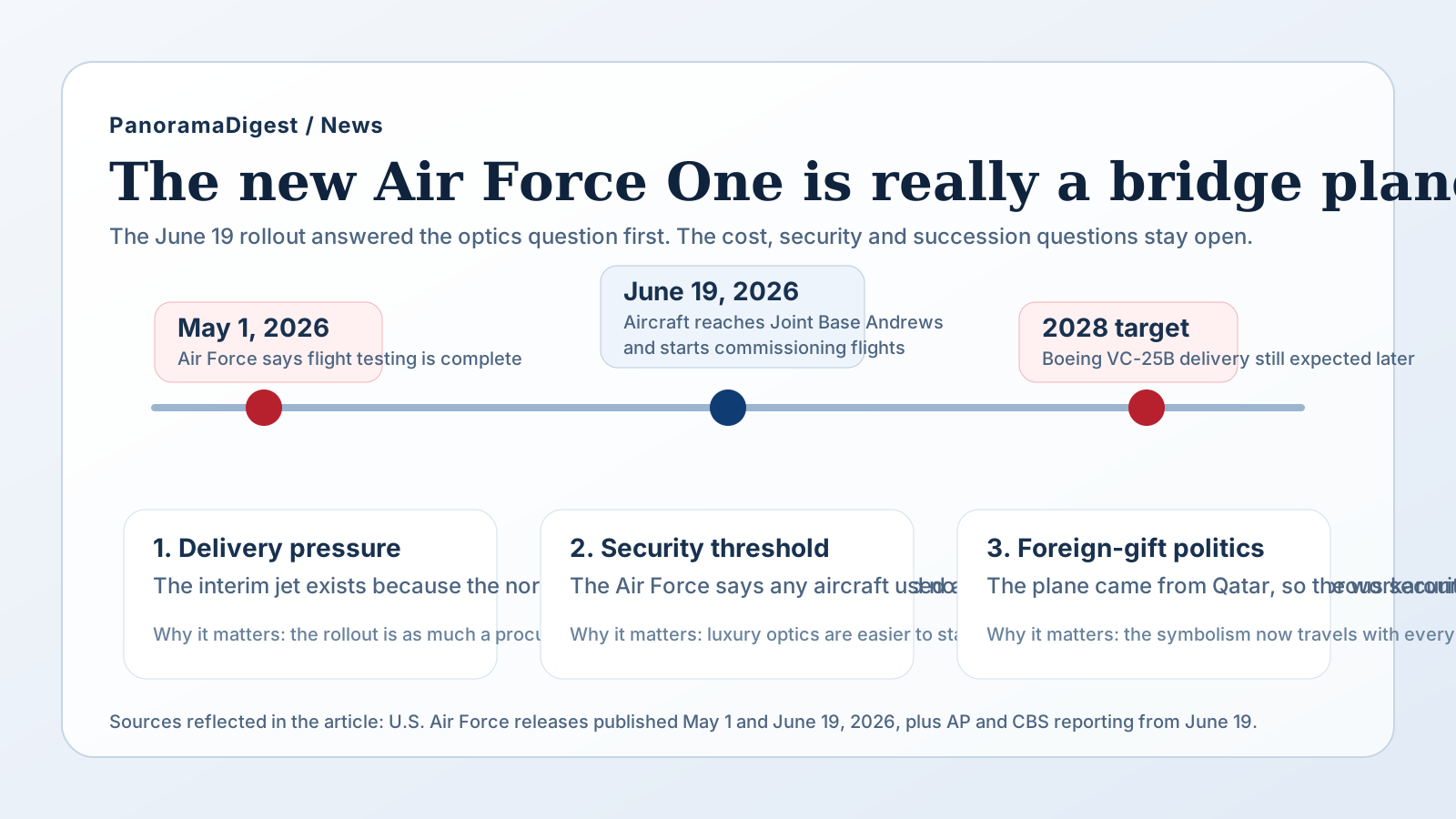
| Date | What changed | Why readers should care |
|---|---|---|
| May 1, 2026 | The Air Force said the VC-25B Bridge aircraft completed modification and flight testing. | The interim platform was already being framed as a schedule solution, not just a ceremonial curiosity. |
| June 19, 2026 | The aircraft arrived at Joint Base Andrews and Trump used the unveiling to present it as the new Air Force One. | The political and visual story went public before the bridge concept had time to become routine. |
| 2028 target | The long-delayed Boeing replacements are still expected later, according to same-day reporting. | The bridge plane only makes sense if it truly bridges to a normal fleet rather than replacing accountability for the old deadline slips. |
The security argument is more important than the luxury argument
This is where the story should stay boring, because boring is what serious aircraft programs are supposed to look like. The Air Force said Friday that any plane used as Air Force One must meet rigorous security requirements. AP added that the service kept much of the previous head-of-state interior layout while modifying the aircraft under an engineering approach centered on secure presidential transport. That is the right hierarchy. The upholstery, color scheme and dramatic stairs may dominate the images, but none of that matters if the mission systems, communications hardening and protective standards do not justify the political haste that produced the bridge plan.
Readers have already seen a version of this dynamic elsewhere: a technical issue becomes harder to trust once the official handling starts looking more performative than procedural. PanoramaDigest made that case recently in its look at the White House's delayed voting-machine study, where the deeper risk was not the hardware alone but the loss of confidence around how government disclosed it. Air Force One is a different subject and a higher-security environment, but the institutional lesson is similar. Spectacle can coexist with competence. It can also conceal whether competence was the real priority.
What Friday actually settled, and what it did not
Friday settled three things. First, the bridge aircraft is no longer a speculative project; it is now physically at Andrews and entering commissioning flights. Second, Trump got the visual result he has wanted since his first term: a more aggressive color scheme and a public object that looks unmistakably tied to his aesthetic preferences. Third, the administration showed that it was willing to spend political capital defending the interim solution as the price of appearing stronger and less delayed.
What Friday did not settle is just as important. It did not erase the fact that Boeing's direct replacement program still frames the whole episode. It did not dissolve the ethics criticism that comes with using a formerly Qatari-owned luxury jet as a presidential bridge platform. And it did not answer the long-term question of whether the bridge aircraft will be remembered as a disciplined continuity tool or as a warning that prestige programs invite looser standards once timelines slip badly enough.
The right way to watch this plane now is not as a one-day unveiling story. It is as a rolling accountability story with three checkpoints: whether commissioning flights stay routine and quiet, whether the promised Boeing replacements stop sliding, and whether the United States can treat its most symbolic aircraft as a national-security asset first and a branding device second. Friday delivered the image. The harder part begins after the cameras leave the hangar.
Reader Sentiment & Impact Pulse
How do you evaluate the primary outcome of this development?
Select an option to cast your perspective. Responses are anonymous and aggregated in real time.
Key Context & Frequently Asked Questions
President Donald Trump unveiled the new Air Force One on Friday, June 19, 2026, after the Air Force formally brought the modified Qatari Boeing 747 to Joint Base Andrews. The showy reveal settled the optics question first, but the harder public-interest story is still about delivery delays, security thresholds and what it means to normalize a foreign-gift workaround for presidential transport. This analysis from PanoramaDigest examines primary documentation, operational implications, and broader institutional impacts across news.
Read Next
Related Stories

Jensen Huang Reframed AI Doom Debate as National Opportunity in Discourse With Donald Trump
Nvidia CEO Jensen Huang addressed existential AI fears during conversations with Donald Trump, advocating for American leadership and innovation over restrictive regulatory caution.

Old Trails Fire Damage Estimate Reaches 640 Structures in Spokane
Spokane County's preliminary estimate says the Old Trails fire destroyed 640 structures, while evacuation zones remain active across northwest Spokane.

USCIS Can Now Refer Asylum Cases to Immigration Court Without an Interview
A DHS rule effective July 28 lets USCIS send some affirmative asylum applications directly to immigration court. Referral is not a denial, but the interview is no longer guaranteed.