Boston Logan's Near Miss Was Resolved Safely. The Harder Question Is Why the Margin Got That Thin.
The FAA's Boston Logan investigation starts with a Delta go-around and an intersecting departure. The more useful public question is what the close call says about how much modern airport safety depends on the last layer working exactly on time.
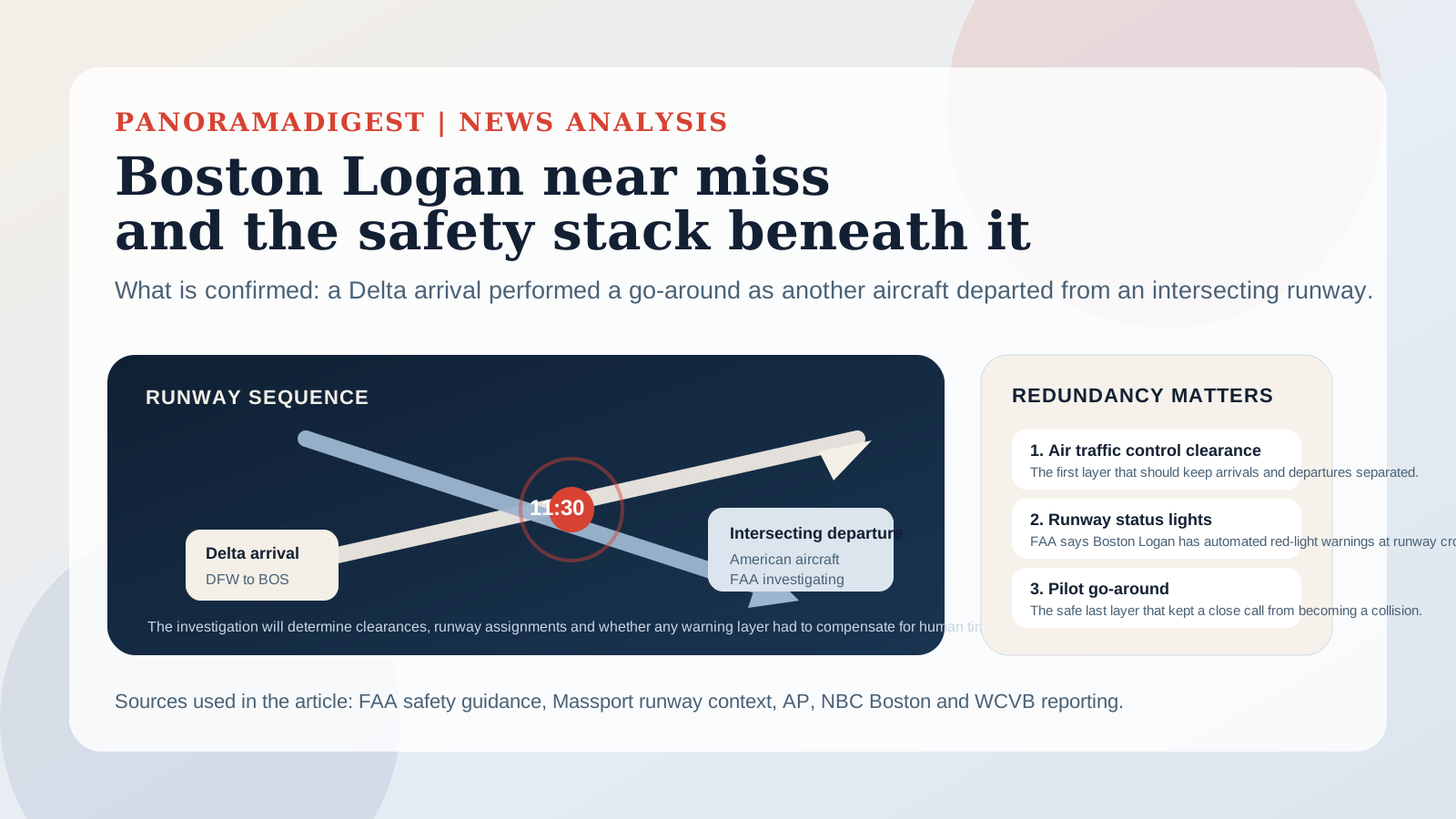
The most important fact in Boston Logan's latest runway scare is also the most misleading one if readers stop there: the system worked. A Delta Air Lines flight from Dallas executed a go-around on Saturday, June 21, 2026, and landed safely after another aircraft departed from an intersecting runway, according to the Federal Aviation Administration and multiple local reports. Nobody was hurt. That is real news, and it matters. But it should not end the conversation. Safety systems are supposed to prevent catastrophe. They are also supposed to keep the last line of defense from becoming the line that gets used this often.
WCVB — Close call at Logan Airport between Delta, American flights under investigation
WCVB's current report outlines the FAA investigation into the Boston Logan incident; if the embedded player is blocked, the story includes a direct YouTube fallback link.
Associated Press reported that Delta flight 2351, arriving from Dallas, had 129 passengers and six crew members aboard when it performed the aborted landing. NBC Boston, citing an FAA spokesperson, said the maneuver happened around 11:30 a.m. because another aircraft was departing from an intersecting runway. Delta said the crew followed established procedures with air traffic control. That is exactly what passengers want to hear in the moment. The larger civic question is what those established procedures had to absorb.
Watch: WCVB's current report on the incident is here: Close call at Logan Airport between Delta, American flights under investigation. If the embedded player is blocked in your browser, that direct link remains available.
What is confirmed, and what still is not
The FAA has opened the investigation, but the public record is already clear on a few points. The incident involved an arriving Delta aircraft and an American Airlines departure. The Delta crew executed a go-around and later landed safely. The runway issue involved an intersecting departure path, not some abstract midair alarm detached from airport geometry. What is not yet settled is the chain of decisions inside the minute that mattered most: which clearances were issued, how the traffic was sequenced, whether any automated warning systems illuminated, and whether the event reflects a one-off lapse or the sort of tight runway math that legacy airports live with more often than passengers realize.
| What we know now | What is still under investigation | Why the distinction matters |
|---|---|---|
| Delta flight 2351 from Dallas performed a go-around and landed safely. | The exact clearance sequence between tower instructions and aircraft movements. | The safety story depends on whether this was caught early by procedure or late by necessity. |
| The FAA says another aircraft was departing from an intersecting runway. | Which runway geometry and timing choices created the conflict window. | Intersecting-runway operations are normal at Logan, but the acceptable margin is not infinite. |
| No injuries were reported and the passengers deplaned normally. | Whether automated runway-warning systems or cockpit alerts were part of the safe outcome. | If redundancy helped, the investigation will need to show which layer was decisive. |
Boston Logan is built for complexity, which is exactly why redundancy exists
Massport's own official explanation of how Logan operates notes that the airport uses six runways aligned in multiple directions. That layout helps the airport adapt to wind, weather and traffic demand, but it also means runway operations can involve crossing or intersecting patterns that require disciplined sequencing. None of that is scandalous. It is the normal operating reality of a dense, weather-sensitive coastal airport that has to move a lot of people through limited space.
The FAA's own runway-safety material makes the second point just as plainly. On its Runway Status Lights guidance page, the agency says Boston Logan is one of the U.S. airports equipped with automated red-light systems designed to signal when it is unsafe to enter, cross or begin takeoff on a runway. The FAA explains that these lights are an independent advisory layer, not a substitute for tower clearance. That distinction matters because it shows how the system is built: first with controller instructions, then with automated warning logic, and finally with pilot judgment. Saturday's near miss appears, at minimum, to have reached that final stage.
The reassuring fact is that pilots are trained for this. The warning is that they had to use it.
Go-arounds are not evidence of panic. They are standard maneuvers, and the FAA says as much. But routine does not mean trivial. A go-around exists because aviation assumes that spacing, weather, traffic or runway occupancy will sometimes make a landing continuation unsafe. In other words, it is one of the industry's deliberately preserved escape hatches. Readers should want that hatch to work every time. They should also want investigators to explain why it had to open at all on a clear weekend arrival into one of the country's busiest airports.
That is why this story should not be flattened into either of two lazy takes: either "nothing happened" because the flight landed safely, or "aviation is collapsing" because the clip sounds dramatic. The more honest middle ground is harder and more useful. Modern commercial aviation remains extraordinarily safe because it layers clearances, surveillance, automated warnings and crew training on top of one another. But every close call is still a governance story, because it tests whether the layers are merely present or whether the system is being pushed into relying on them too late.
Recent aviation stories have already put that distinction in front of readers, including the Missouri skydiving crash that PanoramaDigest examined as a facts-before-answers test. Logan is not that kind of tragedy. It is, however, the kind of near miss that reminds regulators and travelers that safe endings still deserve unsentimental scrutiny.
What the FAA needs to show next
The cleanest outcome from here is not a dramatic revelation. It is a precise reconstruction. Investigators should be able to show the clearance chain, the runway movements, the timing margin and whether any runway-status-light or cockpit warning layer activated. If the answer is that the system behaved exactly as designed and still produced a narrow window, then the public deserves to know whether design tolerances at high-volume airports are being stretched more often than agencies admit. If the answer is that a specific human or procedural error created the problem, then the lesson is narrower but no less important.
For passengers, the fair takeaway is neither alarm nor complacency. It is respect for the part of aviation that rarely makes the ad copy: the industry stays safe because trained people and layered systems catch bad geometry before it becomes a headline written in the past tense. Boston Logan's latest close call ended in the present tense. That is good news. The investigation now has to explain whether it was also a warning.
Reader Sentiment & Impact Pulse
How do you evaluate the primary outcome of this development?
Select an option to cast your perspective. Responses are anonymous and aggregated in real time.
Key Context & Frequently Asked Questions
The FAA's Boston Logan investigation starts with a Delta go-around and an intersecting departure. The more useful public question is what the close call says about how much modern airport safety depends on the last layer working exactly on time. This analysis from PanoramaDigest examines primary documentation, operational implications, and broader institutional impacts across news.
Read Next
Related Stories

Jury Convicts Driver of Negligent Homicide in Death of Reporter Covering Super Bowl
A Louisiana jury has found a driver guilty of negligent homicide in the fatal striking of a journalist covering Super Bowl events in New Orleans. The verdict brings legal accountability to a tragic case that underscored pedestrian safety challenges during major national entertainment spectacles.

Jensen Huang Reframed AI Doom Debate as National Opportunity in Discourse With Donald Trump
Nvidia CEO Jensen Huang addressed existential AI fears during conversations with Donald Trump, advocating for American leadership and innovation over restrictive regulatory caution.

Old Trails Fire Damage Estimate Reaches 640 Structures in Spokane
Spokane County's preliminary estimate says the Old Trails fire destroyed 640 structures, while evacuation zones remain active across northwest Spokane.