Caltech's Nevada Radio Array Is Really a Bet That Astronomy Can Stop Waiting for the Data
Caltech's Deep Synoptic Array is not just another giant telescope project. It is a wager that radio astronomy's next leap will come from turning raw signals into usable images fast enough for the rest of science to move with them.
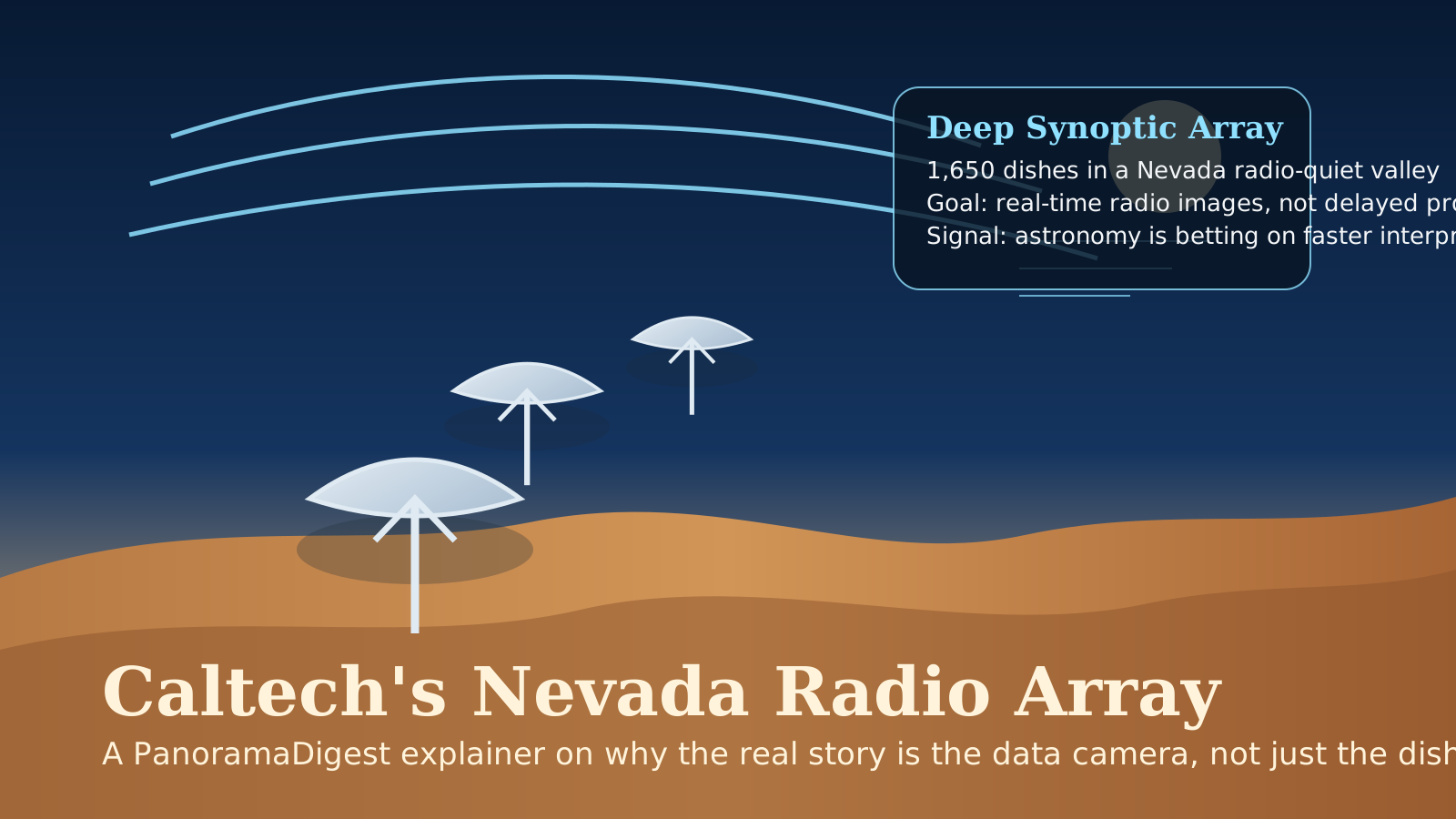
Caltech's plan to build the Deep Synoptic Array in a remote Nevada valley can sound, at first glance, like a familiar kind of science headline: more dishes, more data, more cosmic ambition. The real story is sharper than that. What cleared a meaningful new threshold this month was not simply the size of the instrument. It was the decision to build a radio telescope around speed of understanding, not just scale of collection.
Caltech / YouTube — Caltech animation of the Deep Synoptic Array planned for Nevada
Caltech's project animation shows how the Nevada array is designed to scan the radio sky. If the embed does not load, use the direct YouTube link in the story.
According to Caltech's June 11 announcement, the project completed its final design review and can now move toward construction with Schmidt Sciences funding. The official Deep Synoptic Array overview says the instrument will place 1,650 dishes across roughly 20 by 16 kilometers of Nevada desert and repeatedly image the visible sky over a five-year initial survey. That is a large engineering story. It is also a philosophical one. Astronomy has spent years building machines that can gather astonishing amounts of information but often force scientists to wait weeks or months for a usable picture. Caltech is explicitly trying to break that habit.
That is why this project matters outside radio astronomy. The promised breakthrough is the so-called radio camera, which Caltech says would transform raw signals into images in real time instead of treating processing as a long delayed second act. The pitch is not merely that the telescope will be more sensitive. It is that radio surveys may start behaving more like a living observatory and less like a warehouse.
- January 2026: Schmidt Sciences publicly folded the Deep Synoptic Array into its observatory system, framing it as part of an open-data astrophysics strategy.
- June 11, 2026: Caltech said the project had cleared final design review, the point that turned an ambitious concept into a construction-ready instrument.
- 2026 to 2029: Caltech says the Nevada buildout will assemble 1,650 dishes, fiber links, and the computing stack required for real-time imaging.
- After build completion: science operations are expected to begin with a survey plan aimed at repeated views of the visible sky rather than a one-off map.
The instrument is big, but the workflow shift is bigger
Caltech's own numbers help explain why the workflow change matters more than the bragging rights. The institute says all radio telescopes combined have so far found about 20 million radio sources, while the DSA could match that in its first day of operations and eventually detect roughly 1 billion sources over its initial survey. The project overview adds that the array is designed to cover about 31,000 square degrees of sky over multiple epochs with three-arcsecond resolution. Those are not just bigger catalog numbers. They imply a different rhythm for discovery.
Normally, one of the hidden bottlenecks in modern astronomy is not collecting the signal. It is converting the flood of collection into a form other scientists can actually use. Caltech says the DSA's radio camera is meant to solve precisely that problem by making images in real time and releasing them with no proprietary waiting period. That open-data promise lines up with Schmidt Sciences' observatory-system description, which presents rapid development and shared access as central design principles rather than public-relations garnish.
| What older radio-survey logic optimized for | What the DSA is optimizing for | Why that matters |
|---|---|---|
| Gathering huge volumes of raw signal | Turning raw signal into science-ready images immediately | Faster follow-up means fewer transient events get stranded in processing queues. |
| Delayed access for wider research communities | Open images with no proprietary period, according to Caltech | The value of the telescope spreads faster across labs that did not build it. |
| Single-discovery moments | Repeated survey cadence across the visible sky | The instrument becomes a monitoring system, not just a collector. |
That last point is the one readers should hold onto. Astronomy is moving toward time-domain science across nearly every wavelength. The central question is no longer only what is out there? It is increasingly what changed, where, and how quickly can we verify it? PanoramaDigest made a related point this week in our analysis of the NSF ocean-observatory rescue: public science systems now live or die on whether they can produce timely, usable signals, not merely preserve infrastructure on paper. The Nevada array fits that same era.
Why Nevada is not just scenery in this story
The Nevada siting is not decorative. The project materials describe a radio-quiet valley, and local Nevada reporting has treated that remoteness as a technical asset rather than a romantic backdrop. That matters because radio astronomy is unusually vulnerable to modern interference. A telescope built to watch fleeting bursts from across the universe does not benefit much from exquisite hardware if the surrounding human environment keeps shouting over it.
There is also a subtler Nevada angle here. Big American science projects often struggle when their public explanation collapses into abstract prestige. A desert full of 1,650 dishes can look like a vanity map until the builders explain what the system actually changes for the rest of the field. Caltech has been more disciplined than that. The project's public case is not only about size. It is about eliminating a lag between observation and interpretation, and about doing so with a design that could make the data broadly useful almost immediately.
The most interesting claim is the one that sounds least glamorous
Readers may be tempted to focus on the cake-pan anecdote in Caltech's write-up or the eye-catching phrase the world's first radio camera.
Those details are memorable, and fair enough. But the most consequential claim is actually the driest one: that the DSA can reduce an overwhelming storage problem by converting data into images on the fly. Caltech says storing the raw torrent for the full survey would require 100 exabytes and a facility measured in football fields. If that description holds up in practice, then the project is not simply building a better telescope. It is designing around the fact that contemporary science often drowns in its own throughput.
That is why the DSA feels more aligned with the best current scientific infrastructure than with the oldest big-instrument playbook. The smartest large systems are increasingly the ones that shorten the path from detection to decision. In medicine, climate monitoring, and frontier computing, speed of translation now matters almost as much as power of observation. The Nevada array is trying to bring radio astronomy into that same logic.
What would count as success beyond the headline
There are still obvious reasons for caution. Final design review is not first light. Construction promises are easier than construction discipline. Open-data ideals can meet logistical friction once a machine starts producing torrents of output. And telescope projects, like all ambitious scientific infrastructure, are excellent at sounding inevitable before reality introduces cost, weather, supply chains, and software complications.
Still, the project's own structure offers a more serious reason to watch it than the usual superlative language. If Caltech and its partners can actually deliver repeated, high-quality radio views of the sky with near-immediate public availability, the DSA could strengthen several parts of astronomy at once: fast radio burst work, pulsar timing, multi-messenger follow-up, galaxy mapping, and the broader hunt for phenomena scientists do not yet know how to name. The official overview frames that range clearly, from transient discovery to cosmology and gravitational-wave-adjacent science.
That breadth is why the Nevada project deserves attention now rather than only at ribbon-cutting time. The design tells you what the builders think the field lacks. Their answer is not merely collecting area. It is responsiveness.
Primary and supporting sources: Caltech's June 11 project announcement, the official Deep Synoptic Array overview, and Schmidt Sciences' description of its observatory system. For readers who want to see the planned instrument in motion, Caltech also published a project animation on YouTube.
Reader Sentiment & Impact Pulse
How do you evaluate the primary outcome of this development?
Select an option to cast your perspective. Responses are anonymous and aggregated in real time.
Key Context & Frequently Asked Questions
Caltech's Deep Synoptic Array is not just another giant telescope project. It is a wager that radio astronomy's next leap will come from turning raw signals into usable images fast enough for the rest of science to move with them. This analysis from PanoramaDigest examines primary documentation, operational implications, and broader institutional impacts across technology & science.
Read Next
Related Stories

Leaked Apple Silicon Benchmarks Point to Massive Graphics Performance Gains in M5 Ultra and M6 Chips
Leaked benchmark testing reported by MacRumors highlights significant graphics and computational advancements for Apple's upcoming M5 Ultra and M6 silicon, signaling a major leap for on-device AI and workstation performance.
Smart TV Data Tracking Prompts Heightened Privacy Concerns as Consumers Seek Mitigation Strategies
Modern smart televisions routinely monitor viewing habits and collect consumer data through Automatic Content Recognition technology. However, targeted network adjustments and privacy settings offer users practical avenues to limit telemetry and reclaim control over their living room data.

Apple Hardware Executive Details Engineering Strategy for Foldable iPhone Durability and Crease Elimination
In an interview highlighting material science breakthroughs, Apple's hardware leadership discussed the hinge design, display elasticity, and structural longevity engineered for foldable form factors.