Central New York's Two Tornadoes Became a Warning-Trust Test
National Weather Service survey teams confirmed an EF1 tornado near Rock Stream and an EF0 tornado near Cortland after Thursday's storms in Central New York. The immediate damage mattered, but the harder public question now is whether official follow-through can make the next severe-weather warning feel precise instead of generic.
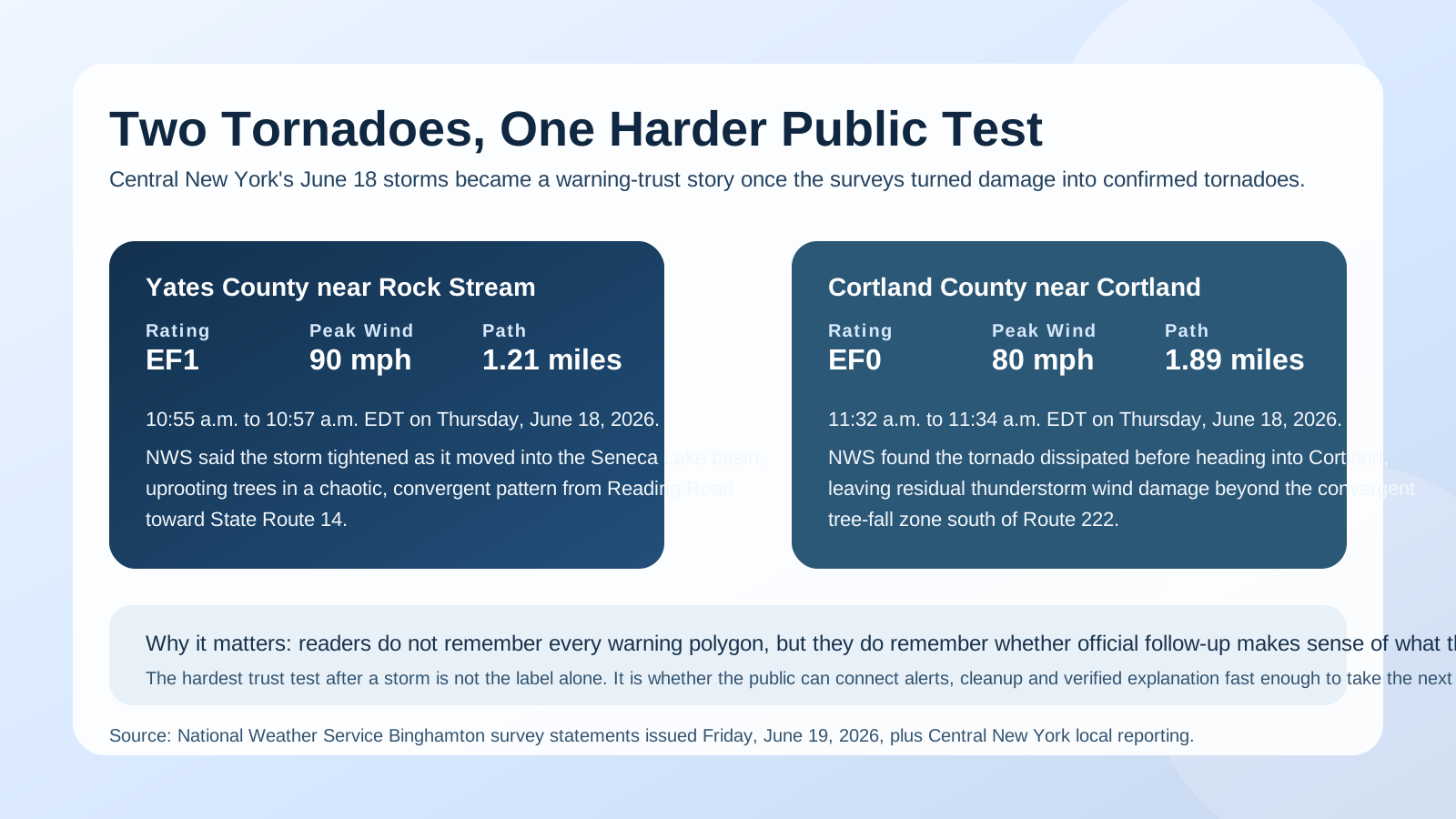
By the time central New York woke up on Friday, June 19, 2026, the visible work was already familiar: crews clearing trees, utilities restoring lines, neighbors comparing where the wind bent and where it snapped. What changed the story was the official label. In separate damage surveys, the National Weather Service office in Binghamton said an EF1 tornado struck near Rock Stream in Yates County at 10:55 a.m. EDT on Thursday, June 18, with peak winds of 90 mph, while a later corrected survey statement said an EF0 tornado touched down southwest of Cortland at 11:32 a.m. with peak winds of 80 mph. No fatalities or injuries were reported in either survey. But once storm damage turns into two confirmed tornadoes, the public standard changes with it.
NewsChannel 9 WSYR Syracuse — Severe weather rips through Central New York
NewsChannel 9 WSYR's local video report shows the broader storm damage that later split into two confirmed tornado survey paths. If the player does not load, use the direct YouTube link in the article.
That is the harder civic story here. People can absorb that thunderstorms knocked down trees. What they need after a day like Thursday is a clearer sense of whether the warning system, the surveys and the cleanup record all line up into something they can trust the next time their phones light up. Spectrum News reported Friday that storm cleanup continued across the region as National Grid and NYSEG worked to restore outages, while the weather service surveyed damage in Rock Stream, Cortland and Groton. CNY Central reported that damaging gusts reached up to 60 mph across parts of the Finger Lakes, with trees and utility poles down in Ontario and Yates counties and roads blocked in places. Those are cleanup facts. They are also trust facts, because they tell readers whether official confirmation feels anchored in the damage they actually saw.
What the surveys actually changed
The Yates County finding was the stronger of the two tornado confirmations. The Binghamton office said the tornado near Rock Stream tracked for 1.21 miles with a maximum width of 150 yards, and that the circulation intensified as the storm dropped from higher terrain toward the Seneca Lake basin. The Cortland survey described a shorter, weaker tornado that ran for 1.89 miles and dissipated before it pushed into town, leaving broader straight-line wind damage behind it. That distinction matters because it separates one public memory from another. A tornado near a lakeside community is one kind of warning story. A brief touchdown that gives way to residual wind damage near a city is another.
| Location | What NWS confirmed | Why readers should care |
|---|---|---|
| Rock Stream, Yates County | EF1 tornado, 90 mph peak wind, 1.21-mile path, 10:55 a.m. to 10:57 a.m. EDT on June 18. | This was the sharper tornado signal in the region, with convergent tree damage and a stronger circulation entering the Seneca Lake basin. |
| Southwest of Cortland | EF0 tornado, 80 mph peak wind, 1.89-mile path, 11:32 a.m. to 11:34 a.m. EDT on June 18. | The survey showed the tornado dissipated before heading into Cortland, helping explain why some residents saw major tree damage without a longer in-town tornado path. |
| Broader Central New York storm zone | Local outlets also documented damaging thunderstorm winds, downed trees, blocked roads and scattered utility damage. | Most people experienced the day as a cleanup event first, which is why survey precision matters if officials want public attention during the next warning cycle. |
Why this was always about more than the tornado label
Weather offices do not issue surveys to dramatize storms after the fact. They do it to sharpen the public record. That is especially important in a region where many residents have more experience with winter advisories, lake-effect bands and flood warnings than with confirmed tornado tracks. A tornado confirmation changes how readers interpret what they were told in real time, how local officials review their response, and how seriously families may treat the next severe-thunderstorm warning that sounds, at first glance, interchangeable with every other summer alert.
There is a practical discipline in that. The corrected Cortland statement did not exaggerate the event; it narrowed it. The Yates statement did not turn every snapped limb into tornadic proof; it described where the convergent pattern began and where the stronger circulation tightened. That kind of restraint is part of the trust equation. Overstatement weakens warnings. Precise understatement strengthens them.
- Restoration pace: utility recovery matters because it tells residents which counties took the most infrastructure stress, not just the most social-media video.
- Survey follow-through: if NWS final storm-data reporting matches the local damage record, public confidence in the warning chain gets stronger.
- Risk memory: communities around the Finger Lakes and Cortland corridor will decide whether Thursday felt like a one-off shock or a reminder to treat future warnings more literally.
- Communication quality: the best local weather systems do not only warn well; they explain well afterward.
The next warning will be the real verdict
Central New York was fortunate that Thursday's tornado confirmations did not become a casualty story. That should not make the event feel small. The more useful takeaway is that the region received a rare but legible test of how weather trust works in practice. First comes the alert. Then comes the damage. Then comes the survey that tells people whether the official story matches the one in their yards, on their roads and across their utility lines. If that chain holds, the next warning carries more weight. If it does not, people start treating every alert as noise until the trees are already down.
Source card: If the local video below does not load in your browser, use the direct NewsChannel 9 WSYR video report on severe weather in Central New York. Readers who want the official storm record should keep the Yates County survey statement and the corrected Cortland County survey statement close at hand.
Reader Sentiment & Impact Pulse
How do you evaluate the primary outcome of this development?
Select an option to cast your perspective. Responses are anonymous and aggregated in real time.
Key Context & Frequently Asked Questions
National Weather Service survey teams confirmed an EF1 tornado near Rock Stream and an EF0 tornado near Cortland after Thursday's storms in Central New York. The immediate damage mattered, but the harder public question now is whether official follow-through can make the next severe-weather warning feel precise instead of generic. This analysis from PanoramaDigest examines primary documentation, operational implications, and broader institutional impacts across news.
Read Next
Related Stories

Jury Convicts Driver of Negligent Homicide in Death of Reporter Covering Super Bowl
A Louisiana jury has found a driver guilty of negligent homicide in the fatal striking of a journalist covering Super Bowl events in New Orleans. The verdict brings legal accountability to a tragic case that underscored pedestrian safety challenges during major national entertainment spectacles.

Jensen Huang Reframed AI Doom Debate as National Opportunity in Discourse With Donald Trump
Nvidia CEO Jensen Huang addressed existential AI fears during conversations with Donald Trump, advocating for American leadership and innovation over restrictive regulatory caution.
Old Trails Fire Damage Estimate Reaches 640 Structures in Spokane
Spokane County's preliminary estimate says the Old Trails fire destroyed 640 structures, while evacuation zones remain active across northwest Spokane.