The June Bootids Are Active Now. The Real Story Is How Badly We Still Forecast Surprise Skies.
The June Bootids are not the kind of meteor shower that rewards hype. What makes this week's window interesting is that reputable skywatching calendars still disagree on whether the best viewing has already passed or may yet surprise observers later in the week.
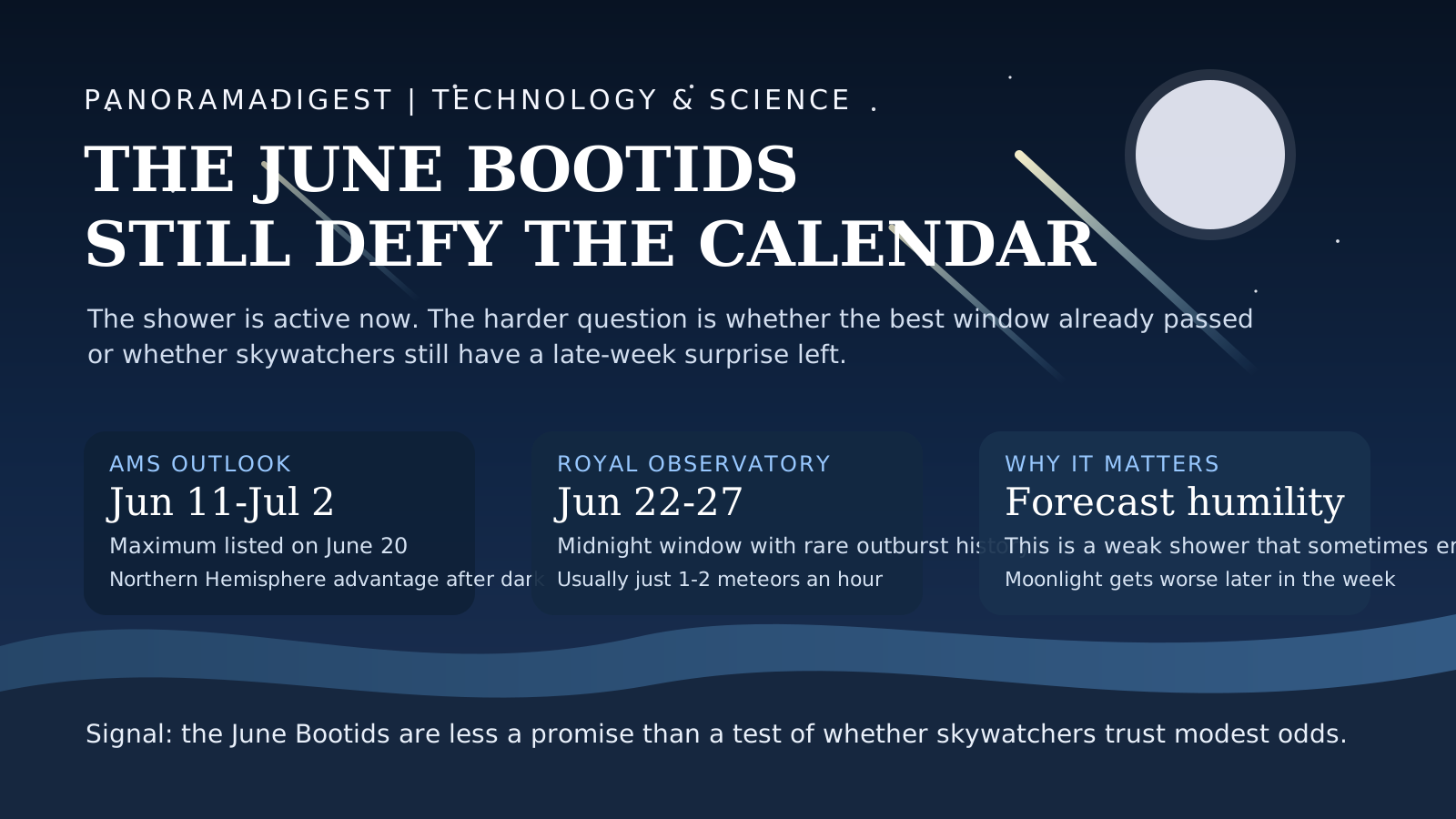
The easiest way to oversell the June Bootids is to promise a sky full of fireworks. The more honest way to read this week's meteor-shower chatter is to notice how quickly the forecasts stop sounding certain. One reputable calendar says the maximum already came on Friday, June 20. Another says the best window runs from Sunday, June 22, through Friday, June 27. That is not a trivial mismatch. It is the story.
Museum of Science / YouTube — Museum of Science guide to the June Bootids meteor shower
A short Museum of Science explainer on why the June Bootids can surprise observers. If the embed does not load, the direct YouTube link remains visible in the article body.
The American Meteor Society's June 20-26 outlook says the June Bootids are active from June 11 through July 2 and lists the maximum on June 20. The Royal Observatory Greenwich's June sky guide, meanwhile, says the shower peaks around June 22-27 at roughly midnight. Both descriptions can be defensible because the Bootids are not a tidy annual spectacle like the Perseids. They are a weak, erratic shower tied to debris from comet 7P/Pons-Winnecke, and their real reputation is not consistency. It is surprise.
That surprise has a history. Royal Observatory Greenwich notes that the Bootids usually produce only one or two meteors per hour, but that the shower has also broken character before: up to about 100 meteors per hour in 1998, then roughly 20 to 50 in 2004, before a much-hyped 2010 return largely failed to deliver. Space's June 22 explainer makes the same point from a consumer angle. The Bootids are compelling not because they promise abundance, but because they occasionally embarrass the calendar.
| Source | What it says | What readers should take from it |
|---|---|---|
| American Meteor Society | Active June 11-July 2, with maximum activity on June 20. | The formal observing window is broad, but the expected rate is modest and already may have crested. |
| Royal Observatory Greenwich | Peak around June 22-27 at about midnight, usually only one or two meteors an hour. | The practical watch window can still extend later in the week even without a guaranteed outburst. |
| Recent coverage and public explainers | Rare eruptions remain the reason people keep checking the Bootids anyway. | This is a meteor shower for patient observers, not for anyone demanding a scheduled spectacle. |
Why the disagreement is not a flaw so much as a warning label
Readers should not mistake the date mismatch for sloppy astronomy. The June Bootids are hard to game because the shower is not usually strong enough to let forecasters speak with the confidence they can bring to larger annual events. The AMS outlook itself frames the current week in modest terms, noting that moonlight becomes more intrusive as the week goes on. Royal Observatory Greenwich goes a step further and says there are no predictions of an outburst this year. That is useful because it resets the expectation. The right posture is not confidence. It is opportunism.
In practical terms, that means this is a dark-sky decision more than a date-purity decision. If you have clear weather, a decent northern-latitude view, and patience after dusk or around midnight, the shower is still worth a look. If you are waiting for a guaranteed headline number, this is the wrong shower. The Bootids reward people who understand that low probability and high intrigue are not the same thing.
The real attraction is what this shower says about modern skywatching
There is a broader reason this story travels well beyond amateur astronomy. We live in a period when event calendars, push alerts, and algorithmic explainers train people to expect certainty on command. The June Bootids are a small rebellion against that habit. They are a reminder that even in an age of exquisite sky maps and nonstop science coverage, some phenomena still arrive with a shrug attached. We know the parent comet. We know the general window. We know where to look. We do not know whether the sky will decide to perform for you.
That makes the June Bootids less a blockbuster sky event than a test of expectation management. The science here is real. The uncertainty is real too. And that combination may be why the shower keeps its niche prestige. It asks observers to accept a harder bargain than most modern feeds allow: step outside, let your eyes adjust, keep the Moon out of your line of sight, look toward Bootes in the west-southwest, and accept that the reward may be either a quiet hour or the kind of short-lived surprise that keeps people looking up again next year.
For PanoramaDigest readers, the sensible takeaway is plain. Treat the June Bootids as an active late-June opportunity, not as a promised show. If the sky overdelivers, that is the point. If it does not, the calendars were warning you all along.
Related context: PanoramaDigest's recent analysis of Caltech's Nevada radio array made a different version of the same argument: modern science is often most interesting where the data are still forcing humility.
Reader Sentiment & Impact Pulse
How do you evaluate the primary outcome of this development?
Select an option to cast your perspective. Responses are anonymous and aggregated in real time.
Key Context & Frequently Asked Questions
The June Bootids are not the kind of meteor shower that rewards hype. What makes this week's window interesting is that reputable skywatching calendars still disagree on whether the best viewing has already passed or may yet surprise observers later in the week. This analysis from PanoramaDigest examines primary documentation, operational implications, and broader institutional impacts across technology & science.
Read Next
Related Stories

Leaked Apple Silicon Benchmarks Point to Massive Graphics Performance Gains in M5 Ultra and M6 Chips
Leaked benchmark testing reported by MacRumors highlights significant graphics and computational advancements for Apple's upcoming M5 Ultra and M6 silicon, signaling a major leap for on-device AI and workstation performance.
Smart TV Data Tracking Prompts Heightened Privacy Concerns as Consumers Seek Mitigation Strategies
Modern smart televisions routinely monitor viewing habits and collect consumer data through Automatic Content Recognition technology. However, targeted network adjustments and privacy settings offer users practical avenues to limit telemetry and reclaim control over their living room data.

Apple Hardware Executive Details Engineering Strategy for Foldable iPhone Durability and Crease Elimination
In an interview highlighting material science breakthroughs, Apple's hardware leadership discussed the hinge design, display elasticity, and structural longevity engineered for foldable form factors.