EU Panel Recommends Restricted Social Media Access for Children Under 13
A European Commission expert panel recommended restricting social media and other digital services for children under 13 until providers can show that their products are safe by design. The recommendation is not yet an EU law.
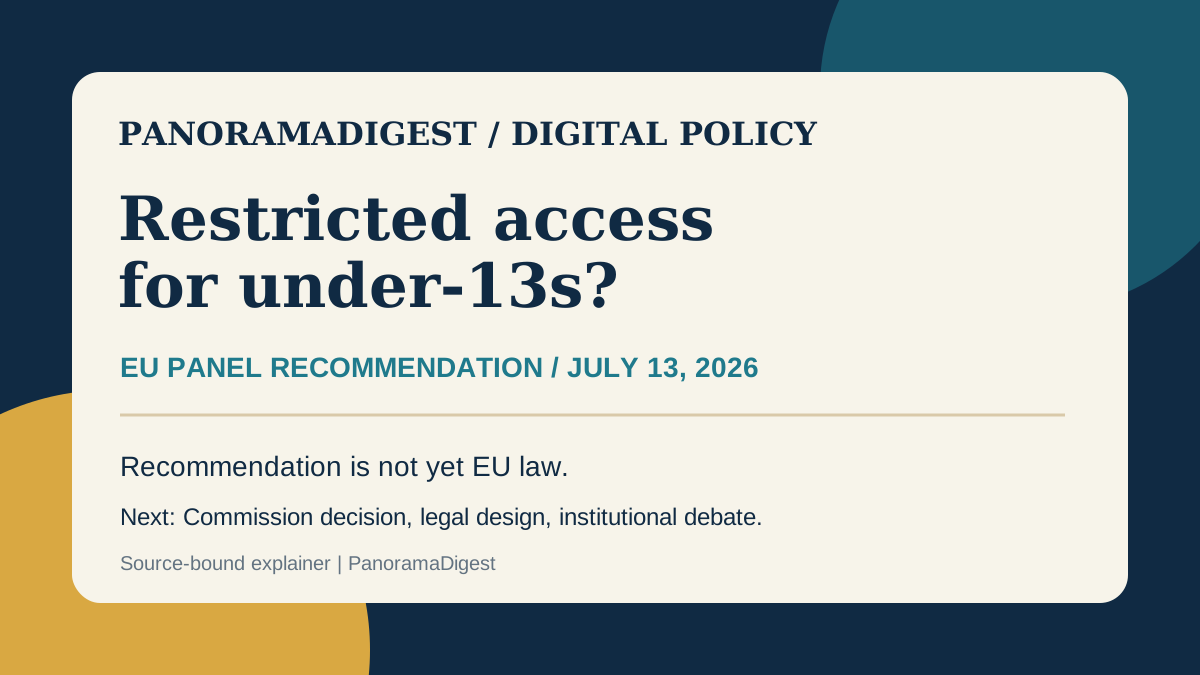
The immediate answer is clear: a European Commission expert panel recommended on July 13, 2026 that social media and other digital-service providers face restricted access for children under 13 until they can demonstrate that their products are safe by design. The recommendation is not an EU-wide ban or law yet. The European Commission panel page records the handover and the policy questions under review. The Commission has received the panel's report and says it will now consider the next steps.
European Commission — Social Media Must Protect Children: President von der Leyen on Child Safety Online
Official European Commission video explaining the policy case for stronger protections for children online; included as context for the panel recommendation discussed in this article.
The distinction matters because the proposal shifts responsibility. Instead of asking parents and children to prove that they can navigate harmful design, the panel says platforms should carry the burden of proving that their services are safe enough for children to use. That would put age assurance, product design and platform accountability at the centre of the next EU policy fight.
This is the latest development in a broader European debate over age limits, online safety and digital identity. PanoramaDigest previously examined how Britain's under-16 social-media policy turns child safety into a question of who must enforce the rule. The EU proposal is different in age and legal status, but it raises the same practical problem: how can a platform check age without creating a new privacy risk?
| What happened July 13 | What has not happened | Why the distinction matters |
|---|---|---|
| The Commission's special panel handed its report to President Ursula von der Leyen. | No EU-wide social-media law took effect. | A recommendation begins a policy process; it does not itself impose a binding duty. |
| The panel backed restricted access for under-13s until providers show their services are safe by design. | The final legal definition of restricted access is not settled. | Implementation could depend on age assurance, supervision, education and service design. |
| The panel called for the burden of proof to sit with providers. | The public record does not yet establish a single enforcement model. | The argument moves from parental control alone to platform accountability. |
What the panel recommended
The European Commission's public panel page says the group was created to help develop a European approach to keeping children safe online. Its work covered a possible common EU age limit for social media, the risks and benefits of social media, gaming, messaging apps and AI tools, and the responsibility of technology companies.
The panel's recommendation, as described in the reporting and the handover materials, is precautionary. Providers would need to demonstrate that their services are safe by design before children under 13 receive ordinary access. The panel also called for further precautionary age restrictions to be considered for children older than 13. That does not mean the EU has selected one final age threshold for every service.
European Commission President Ursula von der Leyen has argued for phased and gradual access for different age groups. In practical terms, that points toward a system in which a younger child might receive only limited access under the supervision of a parent, teacher or other caregiver, while older teenagers could receive broader access to services that meet age-appropriateness and safety requirements.
Why this is not an EU ban yet
The panel is advisory. The Commission's own timeline says the report is being handed to the president, after which the Commission will consider the recommendations and determine next steps. Any binding EU measure would still need a legal basis, a proposal or other formal instrument, and the relevant institutional process involving member states and the European Parliament where required.
That procedural gap is not a technical footnote. It will decide whether the final policy is a regulation, a directive, guidance under the Digital Services Act, a coordinated age-assurance framework, or a combination of measures. It will also determine who is responsible when a child reaches a restricted service, what evidence a provider must keep, and how families can challenge an incorrect age decision.
The EU already has a policy foundation for age assurance. A European Union recommendation on digital age verification calls for privacy-enhancing proof-of-age technology and a common approach that protects personal data. The challenge is connecting that technical framework to real platform enforcement without turning children's ordinary online activity into a system of continuous identity checks.
The enforcement question is bigger than the age number
Most major social platforms already state that users must be at least 13 to open an account. The recurring problem is that a self-declared birth date is easy to falsify, while stronger checks can require more personal data or biometric inference. An EU rule would therefore have to answer two questions at once: how to keep children out of services that are not safe for them, and how to avoid building an unnecessarily invasive age-verification layer.
The Commission has previously scrutinized Meta's handling of under-13 access on Instagram and Facebook under the Digital Services Act. PanoramaDigest's coverage of the Apple-OpenAI litigation provides a useful comparison for readers tracking the wider technology-policy landscape: the common thread is that product design and corporate governance are increasingly becoming public-law questions, not merely company choices.
That is also why the panel's burden-of-proof language matters. If providers must show that a service is safe by design, regulators may focus less on whether a parent successfully set a control and more on whether the product's default features create foreseeable risks for children. Infinite scrolling, recommendation systems, messaging, advertising and the handling of sensitive data could all become part of that assessment.
What to watch next
Three developments will show whether the July 13 recommendation becomes a concrete EU initiative. First, the Commission must explain whether it intends to propose binding legislation or use existing digital-services enforcement tools. Second, policymakers must define how age assurance can work while limiting data collection and false positives. Third, member states and the European Parliament will have to decide whether a common EU rule is preferable to a patchwork of national age limits.
The policy debate will also test the meaning of “safe by design.” A service may block under-13 accounts while still exposing an unverified visitor to public content, targeted advertising or contact from adults. A serious rule will need to address those pathways rather than treating account creation as the whole safety problem.
For now, the verified position is narrower than the loudest headlines: an EU expert panel has recommended restricted access for children under 13, the Commission has received the report, and the legal route is still open. The next story will not be whether Europe has already banned social media for children. It will be whether the Commission can turn a broad safety principle into a privacy-preserving, enforceable rule.
Readers following the institutional side of technology regulation can also use PanoramaDigest's child online safety coverage for related coverage as the Commission decides what comes next.
Read Next
Related Stories

Old Trails Fire Damage Estimate Reaches 640 Structures in Spokane
Spokane County's preliminary estimate says the Old Trails fire destroyed 640 structures, while evacuation zones remain active across northwest Spokane.

USCIS Can Now Refer Asylum Cases to Immigration Court Without an Interview
A DHS rule effective July 28 lets USCIS send some affirmative asylum applications directly to immigration court. Referral is not a denial, but the interview is no longer guaranteed.

Seattle Center Shooting Kills Three and Injures Four at Bite of Seattle Festival
Seattle police say a shooting at the Bite of Seattle festival killed three people and injured four others, including a 2-year-old boy. One suspect was arrested and police continued searching for another.