Heat Wave and Storms Leave 842,000 Homes Dark on America's 250th Birthday
America's 250th birthday opened with more than 842,000 homes dark across the Midwest and Northeast. The same heat that canceled parades from Washington to Philadelphia is stress-testing the power grid on exactly the days losing it hurts most.
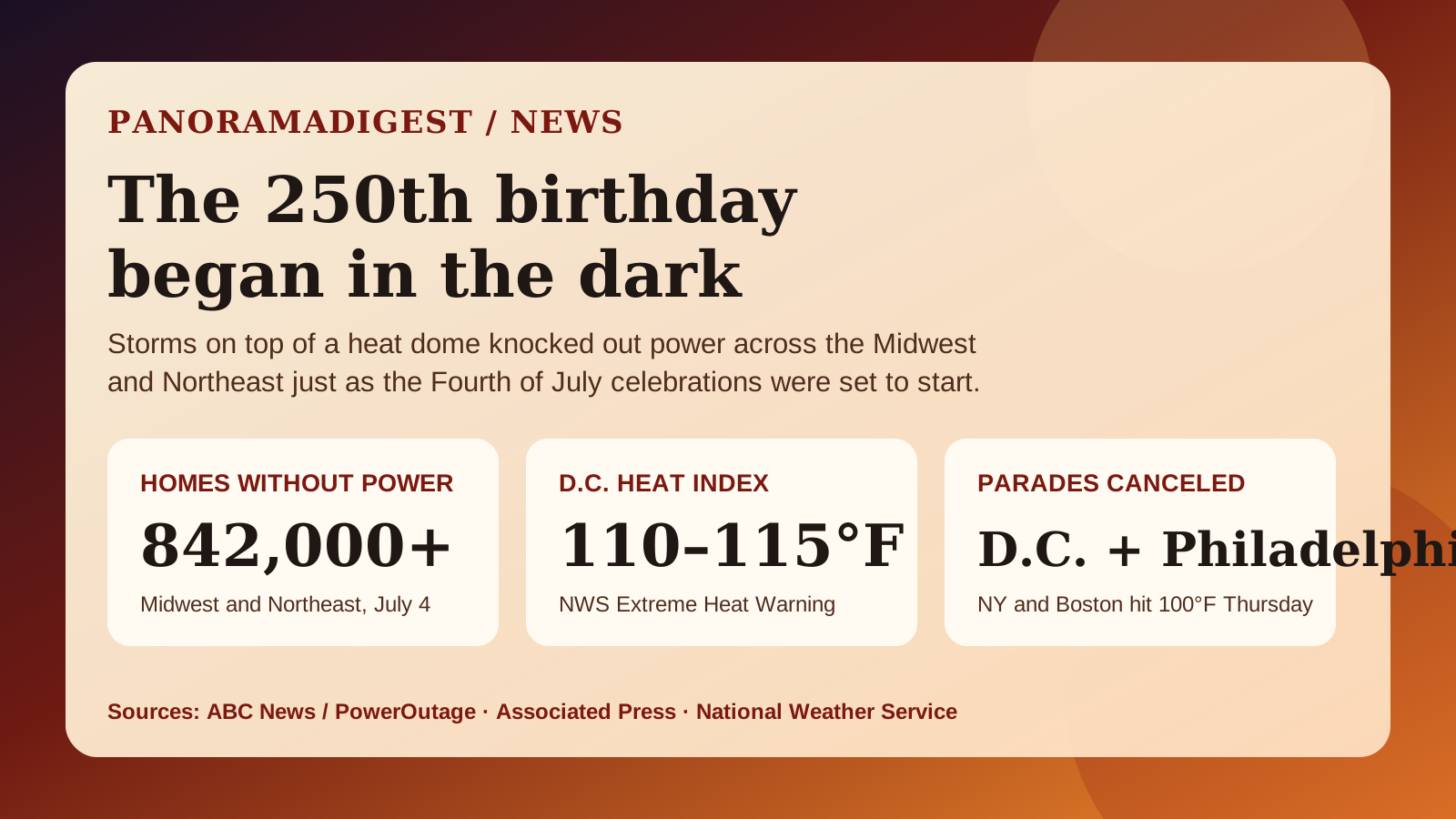
More than 842,000 homes across the Midwest and Northeast had no electricity on Saturday morning as the United States woke up to its 250th birthday, ABC News reported, citing the tracking site PowerOutage. Severe storms rolling through regions already pinned under days of extreme heat pushed the tally to nearly 1 million outages, and the number kept shifting through the morning as crews restored some lines while new storms took down others.
ABC News — Powerful storms and heat wave cause power outages in Midwest, Northeast
Video: ABC News on the storm-driven outages across the Midwest and Northeast during the July 2026 heat wave.
That count measures households, not people, so the number of Americans facing the holiday without air conditioning is far larger. It is a rough way to start a Semiquincentennial. It is also a preview of a problem that will outlast the weekend: the grid keeps getting asked to do its hardest work on the days when losing power is most dangerous.
The party the heat rewrote
Washington's marquee event fell first. Organizers of America's Independence Day Parade, set for 10:30 a.m. Saturday in the capital, called it off late Friday evening.
"The organizers of America's National Independence Day Parade, scheduled for July 4, 2026, at 10:30 AM, have regretfully canceled the parade due to extreme heat in the Washington, DC, region. The National Weather Service has an Extreme Heat Warning for the District of Columbia, with heat index values expected to reach between 110°F and 115°F."
Parade organizers, in a statement on the event's website
The call came after what organizers described as extensive consultation
with the National Park Service, the District of Columbia city government and Freedom 250, with participant and spectator safety cited as the deciding factor.
Philadelphia had already lost its Salute to Independence Semiquincentennial Parade on Friday to the same heat, according to ABC station WPVI. And the disruptions have been piling up since Thursday, when the Associated Press documented a wave of cancellations and schedule changes across the Northeast.
| Event | What changed |
|---|---|
| America's Independence Day Parade, Washington | Canceled late Friday evening |
| Salute to Independence parade, Philadelphia | Canceled Friday |
| Boston Pops Fireworks Spectacular | Entrance pushed from noon to 4 p.m. |
| Great American State Fair and FIFA Fan Zone, National Mall | Opening at noon, two hours late |
| Independence Day parade, Norristown, Pa. | Canceled; evening fireworks still on |
| Gettysburg National Military Park programs | Moved indoors |
| Amtrak trains 88, 106, 107, 142, 159, 163, 666, 667, 694, 695 | Canceled entirely |
Amtrak, which had already scrapped Acela service between Boston and Washington on Thursday and warned of reduced speeds through Saturday, announced the latest round of cancellations on X: Due to temperature-related conditions, Trains 88, 106, 107, 142, 159, 163, 666, 667, 694, and 695 are canceled in their entirety. We apologize for any inconvenience this may cause.
Storms stacked on a heat dome
The engine behind all of this is a heat dome, a high-pressure system parked over a region that traps heat and humidity beneath it. This one has been smothering the country from the Midwest to the East Coast since midweek. The National Weather Service said Thursday that dangerous, record-breaking heat would persist across the central and eastern United States through Friday and hold along the East Coast through the weekend. New York and Boston both hit 100 degrees on Thursday.
Anywhere you go in southern New England, you will be dealing with dangerous heat today, tomorrow and Saturday,
National Weather Service meteorologist Bryce Williams said Thursday, per the AP.
The storms are the second half of a nasty equation. Thunderstorms feeding on heat and humidity knock out power lines, and every downed line converts a heat advisory into a health emergency for the households behind it. A house without power in triple-digit heat index conditions has no air conditioning, no fans and a warming refrigerator. That is why officials across the affected states have been opening cooling centers, and why the National Weather Service's heat safety guidance treats power loss as a trigger to relocate, not to wait it out.
The pattern is becoming familiar. PanoramaDigest covered a version of it in June, when storms tore through Iowa and left outage risk trailing behind the winds, and again when Europe's late-June heat wave exposed how far adaptation lags behind the new baseline. The American version of that gap showed up this weekend as a birthday guest.
Norristown, Pennsylvania, offers the small consolation of the weekend. The borough canceled its Saturday parade over safety concerns but kept its evening celebration on the calendar. The parade is one of our community's most beloved traditions, and we share in the disappointment of its cancellation, especially as we celebrate America's 250th birthday,
interim municipal administrator Jayne Musonye said. The fireworks survive, in Norristown and in most of the country, because they wait for sunset, when the heat index finally lets go. America's 250th will be celebrated after dark this year, in more ways than one.
Read Next
Related Stories
Old Trails Fire Damage Estimate Reaches 640 Structures in Spokane
Spokane County's preliminary estimate says the Old Trails fire destroyed 640 structures, while evacuation zones remain active across northwest Spokane.

USCIS Can Now Refer Asylum Cases to Immigration Court Without an Interview
A DHS rule effective July 28 lets USCIS send some affirmative asylum applications directly to immigration court. Referral is not a denial, but the interview is no longer guaranteed.

Seattle Center Shooting Kills Three and Injures Four at Bite of Seattle Festival
Seattle police say a shooting at the Bite of Seattle festival killed three people and injured four others, including a 2-year-old boy. One suspect was arrested and police continued searching for another.