Apple Sues OpenAI Over Trade Secrets as the AI Hardware Race Moves Into Court
Apple's July 10 lawsuit accuses OpenAI, io and former Apple executives of using confidential Apple knowledge to speed up AI hardware development. The larger technology story is that the next device fight is now about suppliers, recruiting discipline and what courts will let labs build from insider know-how.
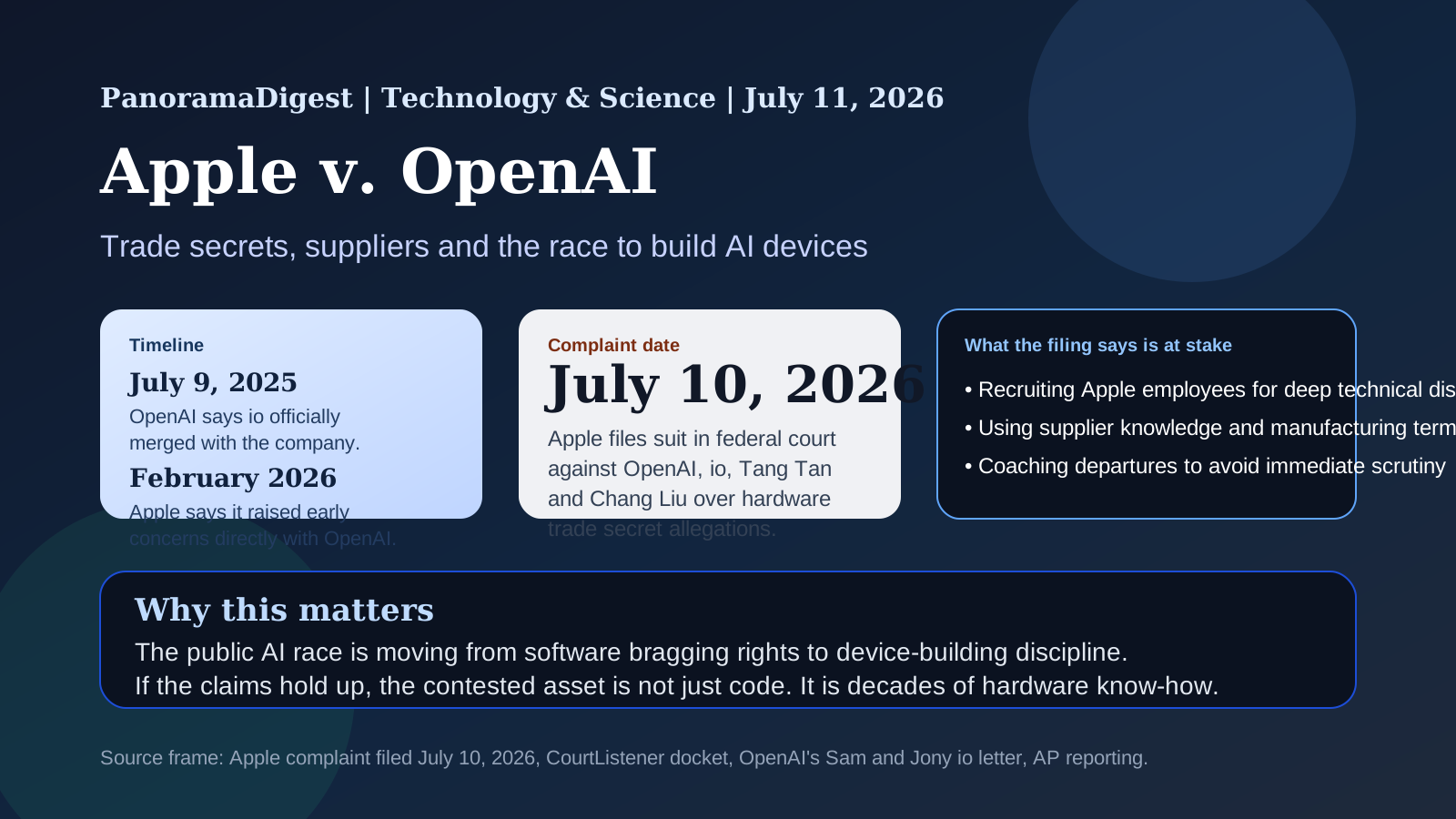
Apple filed a federal lawsuit on Friday, July 10, 2026, accusing OpenAI and several current or former insiders of misappropriating trade secrets to build consumer AI hardware. For readers searching the headline question, the answer is straightforward: yes, Apple is suing OpenAI over alleged trade secret theft tied to hardware ambitions. The more durable story is not only who sued whom. It is that the AI device race has now moved into the courtroom, where the contested assets are not model benchmarks but supplier knowledge, recruiting practices, manufacturing methods and the invisible operational habits that turn sketches into mass-market products.
NBC News — Apple sues OpenAI and two former employees over alleged trade secret theft
NBC News' report is the clearest directly relevant video summary of the July 10 lawsuit. If the player does not load, use the direct YouTube link in the story.
The complaint, filed in the Northern District of California and reflected on CourtListener's docket for Apple Inc. v. Liu, names Chang Liu, Tang Tan, OpenAI entities and io. Apple's filing argues that OpenAI's hardware effort did not merely hire experienced people away from Cupertino. It alleges that OpenAI used those departures to extract confidential information about unannounced products, engineering methods, supplier relationships and even offboarding procedures designed to stop exactly that kind of leakage. None of those allegations has been proven in court, and AP reported that OpenAI denied any interest in competitors' trade secrets. But as a public filing, the complaint already tells readers what Apple believes the next phase of AI hardware competition looks like.
What Apple says happened
The complaint itself is unusually specific. In one section, Apple alleges that OpenAI interviewers used internal Apple project code names to probe candidates about unreleased products and asked some candidates to bring "actual parts," CAD artifacts and prototypes into interviews. In another, Apple says OpenAI and io used confidential Apple knowledge to approach trusted suppliers, including around a proprietary metal-finishing process that Apple says took years to develop. The filing also alleges that OpenAI coached Apple employees on how to leave without triggering the most immediate scrutiny, including by previewing an internal Apple offboarding document marked "Need to Know" and advising recruits not to reveal their next employer too early.
| Apple allegation | What the filing points to | Why readers should care |
|---|---|---|
| Interview extraction | Apple says OpenAI used internal code names and asked candidates for detailed slides, parts and prototypes tied to Apple work. | If true, the fight is not about hiring talent. It is about whether interviews became intelligence-gathering sessions. |
| Supplier targeting | Apple says OpenAI and io approached trusted partners using insider terminology and know-how. | That would mean the competitive advantage at issue includes manufacturing relationships, not just product ideas. |
| Exit coaching | Apple says OpenAI circulated offboarding guidance and advised recruits how to avoid early detection. | The case could hinge on whether departure behavior looks like ordinary turnover or coordinated concealment. |
| Hardware commercialization | Apple argues the alleged conduct was aimed at helping OpenAI build products for sale to consumers. | This ties the lawsuit directly to the still-forming AI device market rather than to an isolated HR dispute. |
Readers should be careful with the verbs here. Apple alleges these actions. The court has not validated them, and discovery may narrow, expand or undermine parts of the complaint. Still, the public filing is valuable because it shows what Apple thinks was vulnerable: hardware samples, design artifacts, partner communication patterns, internal terminology and the security choreography surrounding employee departures. That is a far more industrial picture than the usual Silicon Valley story about one engineer taking a better offer.
Why io makes the lawsuit bigger than a one-company grudge
The io angle is what turns this from a bitter former-employer case into a clearer signal about OpenAI's device ambitions. On its own "A letter from Sam & Jony" page, OpenAI says the io Products team officially merged with OpenAI on July 9, 2025 and explains that Jony Ive founded io with Scott Cannon, Evans Hankey and Tang Tan to build a new company around hardware. That page matters because it provides OpenAI's own public framing: this was not a side experiment. It was a deliberate attempt to create new products at the intersection of AI, hardware and design.
Once that is the goal, Apple's complaint starts to read less like an emotional reaction to a former partner and more like a warning about the cost of entering the device business quickly. Consumer hardware is slower, more physical and more supplier-dependent than shipping a new model API. That is why PanoramaDigest's June 16 analysis of SpaceX's bid for Cursor mattered as a workflow-distribution story, and why our June 14 look at the OpenAI multistate probe mattered as a disclosure-and-governance story. This new lawsuit sits at the point where those lines meet: scale pressure, legal scrutiny and a company trying to turn AI momentum into a consumer-hardware business before its operational discipline is fully trusted by rivals or regulators.
This case is really about what counts as defensible know-how
That is the technology question worth keeping. Apple is not only saying that specific files or parts were mishandled. It is arguing that decades of manufacturing knowledge, supplier trust and product-development discipline cannot be treated like generic executive experience that walks out the door with a departing employee. That claim matters far beyond Apple and OpenAI. Frontier labs, device startups and big incumbents are all converging on the same problem: AI assistants may be software, but the next wave of AI products increasingly depends on batteries, enclosures, thermal systems, radio components, materials finishes and factories that can actually make the thing repeatedly.
Seen that way, the complaint also fits alongside PanoramaDigest's June 21 piece on Anthropic's scientific-prestige fight. The AI market is stretching beyond chat interfaces into harder forms of credibility. For Anthropic, that credibility question was scientific seriousness. For OpenAI, after this filing, it may increasingly be operational trust: can the company persuade courts, partners and customers that its hardware push was built legitimately rather than stitched together from insider shortcuts?
- July 9, 2025: OpenAI says the io Products team officially merged with OpenAI, making the hardware ambition explicit.
- February 2026: Apple says it wrote to OpenAI early in its investigation asking what precautions were being taken to keep Apple information out of OpenAI's business.
- July 10, 2026: Apple filed its complaint in federal court after saying OpenAI never responded.
- Next phase: the important questions move to discovery, evidence preservation and whether the court sees a basis for injunctive relief.
What Apple wants, and what to watch next
The complaint asks for more than damages. Apple is seeking preservation of evidence, return of confidential material and injunctions aimed at further acquisition, use or disclosure of Apple trade secrets. In plain terms, Apple is trying to stop what it says is an ongoing hardware-knowledge transfer, not merely punish conduct that already happened. That makes the next procedural steps more important than the rhetorical heat of complaint-day coverage. If the court quickly pushes the parties into evidence fights or targeted restraints, the case could affect OpenAI's device timeline and recruiting behavior long before any trial.
Three follow-ups matter most. First, does OpenAI file a narrow denial-and-dismissal response, or does it more directly contest the factual backbone of Apple's account? Second, do supplier and device-development allegations survive long enough in court to create real pressure on OpenAI's hardware roadmap? Third, does the lawsuit alter how other AI companies recruit from incumbents with deep hardware operations? Those are the stakes beneath the headline. Apple's lawsuit may or may not prove systemic theft. But it already shows that the AI hardware era will be judged by a stricter standard than the software era ever was.
Watch the current video coverage: NBC News' Apple sues OpenAI and two former employees over alleged trade secret theft is the cleanest directly relevant video summary surfaced in this run. If the embedded player below does not load in your browser or region, use that direct YouTube link instead.
Read Next
Related Stories

Kilauea Episode 55: End Time, Alert Downgrade and Remaining Hazards
Episode 55 stopped at 9:03 a.m. HST on October 17. A checked timeline separates the fountains, the later alert downgrade and hazards that remain.

MMX Launch Date and Time: Japan's Phobos Sample-Return Timeline
Japan's MMX mission targets October 20 in Japan, October 19 in Europe and America. A time-zone guide and mission timeline explain the Phobos sample-return plan.
NASA's Commercial Space Station RFP: December 8 Deadline and the ISS Transition
NASA has opened its final competition for commercial space stations. A dated milestone guide separates the bidding deadline from contract awards, crew certification and the ISS retirement decision.