Georgia's QR-Code Ballot Deadline Is About to Arrive. The Real Risk Is Administrative Confusion.
Georgia lawmakers are returning to Atlanta with less than three weeks before a July 1 legal deadline bars the state's official ballot count from relying on QR codes. The immediate danger is not ideological theater. It is forcing county election offices into a last-minute workflow change before a July special election and before early voting begins on July 6.
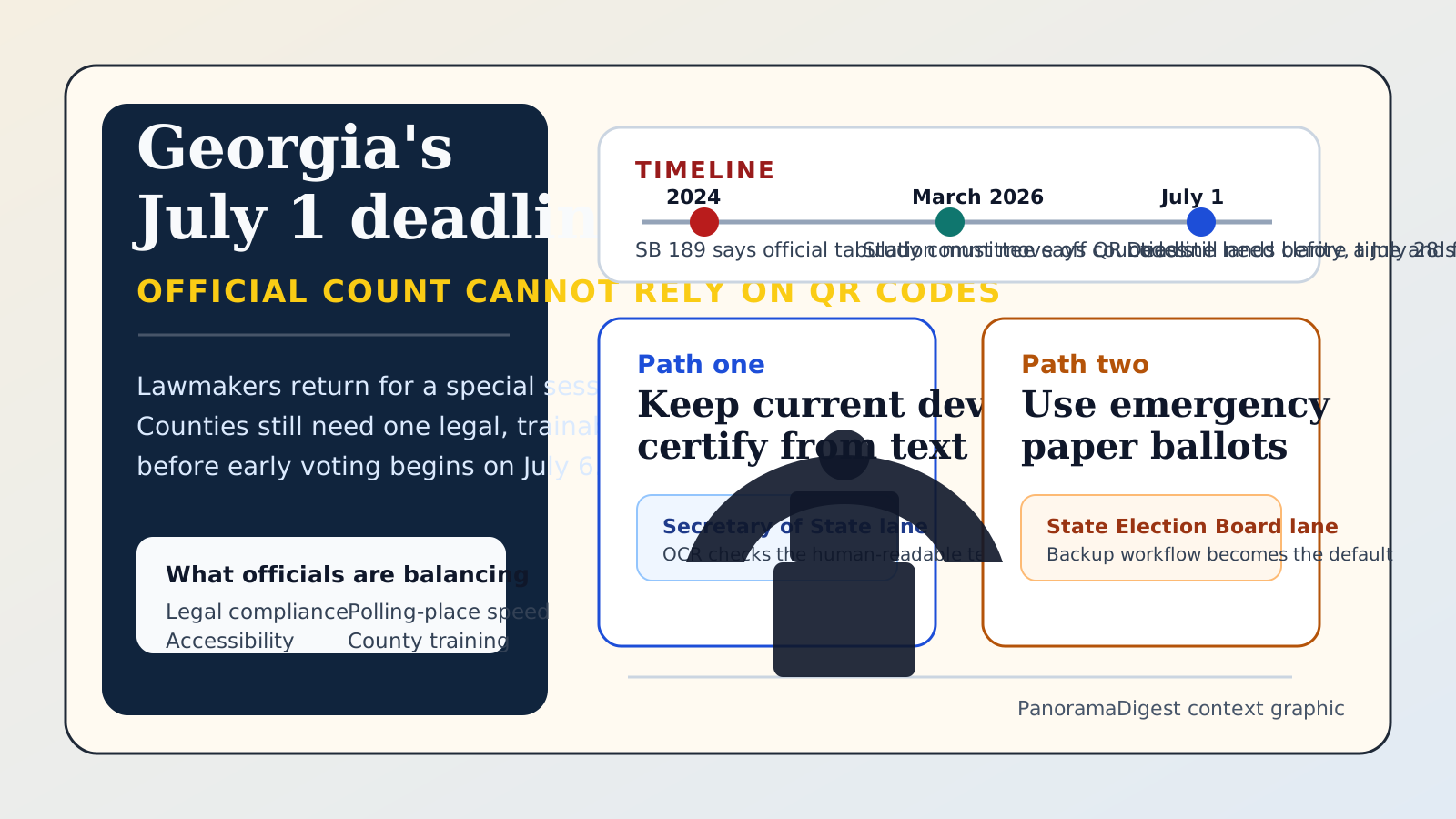
Georgia's election problem on Sunday, June 14, 2026, is not that officials suddenly discovered a flaw in the state's voting system. It is that the state wrote itself a deadline, never fully built the replacement workflow, and is now trying to clean up the result under the clock. When lawmakers return to the Capitol this week for a special session, they are not just revisiting an abstract fight about election technology. They are deciding whether county election offices will enter July with one count method, two conflicting instructions, or a legal vacuum that invites litigation.
YouTube / 11Alive — Georgia election system facing major change under new state law
A local television explainer shows how Georgia's July 1 rule change could force a new county workflow. If the video does not render, open the direct YouTube link.
The latest Associated Press report from Atlanta lays out the immediate bind. Georgia law says that after July 1, 2026, the state's official tabulation count can no longer rely on QR codes printed on ballots. Yet Georgia's current rules still describe in-person voting through electronic ballot markers whose printed ballots are scanned at the precinct, with emergency hand-marked paper ballots reserved for failures or impracticable conditions, as shown in the Georgia Secretary of State's election rules. The result is not a grand constitutional mystery. It is a management problem with real dates attached to it: early voting for the July 28 special election to succeed the late U.S. Rep. David Scott begins on July 6.
If the video card below fails to render in your browser, use the direct 11Alive report on Georgia's coming election-system change.
What the law changed, and what the state never fully settled
The core political decision is older than this week. Georgia's 2024 Senate Bill 189 required the official count to rely on the text portion or machine mark of a ballot rather than a QR code. That mandate became law before the state had finished choosing the exact operational path that counties would use to comply. A Georgia House study committee said in its March 2026 report that local election officials and the Georgia Association of Voter Registration and Election Officials had already warned lawmakers they still needed statutory clarity, implementation time and additional funding. The same report said the Secretary of State's office had tested an optical-character-recognition approach and found scanner tabulations matched the human-readable ballot text with 100% accuracy in the pilot audits.
That detail matters because it shows the current fight is not simply machine versus paper. Georgia has at least two plausible routes. One is to keep the existing ballot-marking devices in place and treat the human-readable text as the official count through an OCR-backed certification workflow. The other is to treat emergency hand-marked paper ballots as the practical fallback if lawmakers do not move fast enough. The blue-ribbon committee's warning was essentially bureaucratic, not theatrical: absent a clear statewide choice, counties could be pushed into expensive backup procedures just to remain legally compliant.
- May 2024: Georgia passes SB 189 and sets a July 1, 2026, cutoff for official counts that rely on QR codes.
- March 2026: The House blue-ribbon study committee says counties still need clarity, time and money to comply cleanly.
- June 2026: State officials issue conflicting guidance over whether existing machines can remain in the workflow or whether backup paper ballots should take over.
- July 6, 2026: Early voting begins in the special election scheduled for July 28.
Why the state is now sending counties mixed signals
AP's latest reporting says the Secretary of State's office told the six counties involved in the July special election that they could still use the current devices to generate election-night results, then use uploaded ballot images and OCR software to certify the official tabulation from the human-readable text. Two days later, the State Election Board pointed counties in the opposite direction, saying that if lawmakers do not extend the deadline, local officials should use the emergency backup path: hand-marked paper ballots scanned in the ordinary way.
That is the part of the story voters should focus on. The most serious election risk here is not that ballots will suddenly become unknowable. It is that county offices may have to train poll workers, prepare ballots and explain procedures while two state authorities are describing different landing zones. The Georgia rules already require accessible voting devices at polling places and reserve emergency paper ballots for circumstances when using ballot-marking devices is impossible or impracticable. Turning the backup plan into the default plan is possible in an operational sense. It is simply not the same thing as telling counties, months in advance, that this will be the state's settled system.
| Decision path | What it would do | Main advantage | Main risk |
|---|---|---|---|
| Extend the deadline and keep the current devices in place for now | Preserve today's polling-place workflow while giving lawmakers more time to codify the official count method. | Least disruptive for counties with a July election already on the calendar. | Looks like the state is conceding it missed its own deadline. |
| Use OCR-backed tabulation from the human-readable text | Keep existing ballot production but shift official certification to the readable text rather than the QR code. | Matches the blue-ribbon committee's discussion of the secretary's pilot results. | Needs clear legal cover and uniform instructions fast. |
| Force counties onto emergency hand-marked paper ballots | Use the backup path as the default if the deadline hits without a legislative fix. | Most directly satisfies critics who want QR-code dependence gone immediately. | Creates the biggest training, accessibility and logistics burden at the worst possible moment. |
Why this is an administration story, not a conspiracy story
Georgia has spent years carrying two arguments about its voting system at once. One comes from Trump-era distrust of machine counting. The other comes from administrators who keep warning that changing the workflow too late can itself become the thing that undermines confidence. A separate AP report from March captured that collision well: lawmakers had already promised to get rid of QR-code dependence, but the state still had not funded or finalized the full transition.
That is why the smarter question this week is not whether Georgia can eventually move to another count method. It plainly can. The better question is whether lawmakers are willing to prioritize a short-term legal and operational patch over another round of symbolic escalation. If they extend the deadline or bless an OCR-based certification path, critics will say they blinked. If they do nothing and counties are pushed toward emergency paper workflows just before early voting, the practical cost will fall on election staff, poll workers and voters who did not create the timetable.
What readers should watch before July 6
Three things now matter more than rhetoric. First, lawmakers need to say plainly whether they are changing the July 1 deadline or clarifying how counties can comply without tearing up the current polling-place setup. Second, county election directors need one statewide training message, not a duel between agencies. Third, any fix has to preserve accessibility obligations, because Georgia still must provide voters with a usable system at the polls, not just a legally satisfying one on paper.
Georgia is close enough to the deadline that a messy outcome would not need fraud, sabotage or machine failure to damage trust. Confusion would be enough. That is why this week's session deserves attention outside election-law circles. The state is not merely deciding how ballots should be read. It is deciding whether its own institutions can still sequence a rule change in a way that ordinary voters experience as orderly, legible and boring. In election administration, boring is usually the mark of competence.
Read Next
Related Stories

Old Trails Fire Damage Estimate Reaches 640 Structures in Spokane
Spokane County's preliminary estimate says the Old Trails fire destroyed 640 structures, while evacuation zones remain active across northwest Spokane.

USCIS Can Now Refer Asylum Cases to Immigration Court Without an Interview
A DHS rule effective July 28 lets USCIS send some affirmative asylum applications directly to immigration court. Referral is not a denial, but the interview is no longer guaranteed.

Seattle Center Shooting Kills Three and Injures Four at Bite of Seattle Festival
Seattle police say a shooting at the Bite of Seattle festival killed three people and injured four others, including a 2-year-old boy. One suspect was arrested and police continued searching for another.