Romania's New Prime Minister Pick Is Really a Test of Whether the Center Can Still Govern
President Nicusor Dan's decision on Sunday, June 14, to replace Eugen Tomac with Adrian Vestea does more than restart Romania's government talks. It abandons the technocratic workaround and forces the country's pro-European parties to prove they can still assemble a political majority while deficits, inflation and far-right pressure keep rising.
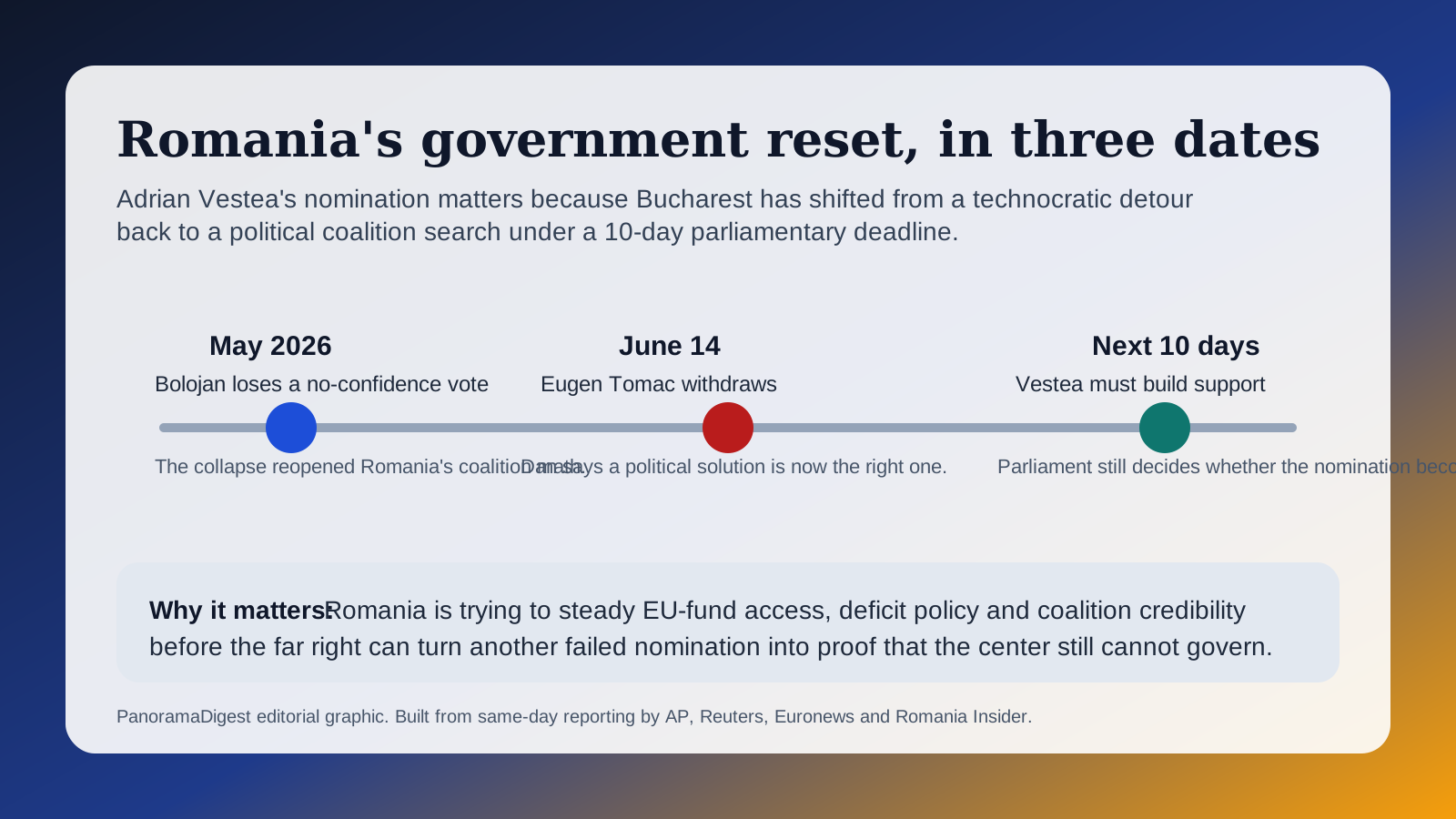
Romania's surprise on Sunday, June 14, 2026, was not simply that President Nicusor Dan named Adrian Vestea to try to become prime minister. It was that Dan used the moment to admit something larger about the country's political crisis: the technocratic escape hatch had run out of road. After Eugen Tomac withdrew his mandate, Dan said a political solution was now the right one. That phrase matters more than the personnel switch, because it tells readers where the next ten days will be decided: not in presidential improvisation, but in Parliament's willingness to let the battered center govern like a coalition again.
YouTube / Euronews — Romanian president nominates Adrian Vestea as prime minister
A short Euronews video summarizes the nomination and the pressure on Romania's next round of coalition talks. If the player does not render, use the direct YouTube link in the story.
The Associated Press report from Bucharest says Dan praised Vestea's administrative record and described him as a categorically pro-Western figure with budget experience. Reuters' same-day report adds the harder political fact: parliamentary parties had already been signaling that a minority political cabinet, however fragile, would be preferable to a government of technocrats with no durable base. Euronews tied Dan's decision directly to his public statement that consultations with the parties had made the choice clear. Romania Insider supplied the local framing: Vestea is not being sold as a national savior, but as a political operator acceptable enough to reopen a parliamentary route that had just collapsed under Tomac.
If the video card below does not render in your browser, use the direct Euronews video report on Adrian Vestea's nomination.
Why Dan changed course so quickly
Presidents do not usually advertise that their first plan failed unless they want the second plan to carry a different message. Dan's first nomination this month leaned toward a nonparty stabilizing formula at a moment when Romania's establishment parties still seemed tempted to postpone the argument over who would actually own painful fiscal and governing choices. Tomac's withdrawal ended that option. Reuters reported that he had lacked the parliamentary support needed to advance a technocratic cabinet. Dan's response was not to hunt for another neutral face. It was to shift the premise altogether and nominate a Liberal with an institutional track record who could negotiate directly with the pro-European democratic parties.
That change is more revealing than dramatic. Romania does not merely have a vacancy problem. It has an accountability problem. Somebody now has to own spending restraint, coalition discipline and the public explanation for why a country with one of the European Union's largest deficits still cannot afford another season of procedural drift. A technocrat can temporarily absorb blame. A political nominee has to bargain for votes and then live with the consequences.
- Early May: Prime Minister Ilie Bolojan falls in a no-confidence vote, reopening government formation.
- Early June: Dan taps Eugen Tomac, signaling interest in a technocratic or cross-party stopgap.
- Sunday, June 14: Tomac withdraws after failing to secure support, and Dan designates Adrian Vestea instead.
- Next 10 days: Vestea must negotiate a cabinet and win a parliamentary confidence vote.
Why Vestea is being asked to solve a coalition problem, not a branding problem
AP's reporting and Dan's own remarks point to the same reason Vestea was chosen: he has moved through the levels of Romanian administration that matter when coalition partners are deciding whether a nominee can manage budgets, ministries and local power centers without constantly re-litigating basic competence. That does not make him inevitable. It makes him legible. In a political system under strain, legibility can be worth more than charisma.
Romania Insider noted that Vestea comes into the role from the National Liberal Party and from Brașov County's political machinery, not from the kind of outsider lane that can excite a protest cycle but struggle once the parliamentary arithmetic begins. Euronews added that Dan cast him as a man of dialogue with strong values and experience handling budgets. Taken together, those descriptions suggest the presidency is no longer trying to float above party politics. It is trying to reassemble enough of it to govern.
| Option after Tomac's withdrawal | What it offered | Why it looked weaker by Sunday |
|---|---|---|
| Try another technocratic nominee | A short-term image of neutrality and distance from party feuds. | Parties had already signaled they preferred a political cabinet to another support-free experiment. |
| Nominate Adrian Vestea | A recognizable Liberal operator with administrative and budget credentials. | He still has to prove the center can vote like a governing bloc rather than an anxious alliance. |
| Let talks collapse further | More time for parties to avoid ownership of painful compromises. | That would deepen the credibility damage and hand more ammunition to the far right. |
What the numbers and the timing do to the politics
This is where the story stops being a palace maneuver and becomes a European governance test. Reuters said the crisis has already endangered access to EU funds and pushed the leu to record lows. Euronews reported Romania's government deficit stood at 9.3% of gross domestic product in 2024 and eased to 7.9% in 2025, still among the bloc's highest levels. AP added the broader mood music: high inflation, a technical recession and a political class that has not yet shown it can deliver stability for even a full year. In other words, Vestea is not being asked to inherit a normal premiership. He is being asked to turn a nomination into a proof of capacity before economic stress starts making every coalition compromise look like weakness.
That is also why the next 10 days matter beyond Bucharest. Romania has repeatedly been treated in Brussels and NATO capitals as a strategically important state whose internal politics may be noisy but ultimately manageable. Dan's second nomination is a reminder that manageability now has to be demonstrated, not presumed. If Vestea can win a confidence vote, the center buys time to argue over policy from inside government. If he cannot, then the crisis stops looking procedural and starts looking structural.
What to watch before Parliament votes
Three signals matter now. First, watch which pro-European parties publicly commit to negotiations rather than merely praising stability in the abstract. Second, watch whether Vestea talks more about ministries and personalities or about an agreed fiscal and reform sequence; one approach builds a cabinet, the other builds a government. Third, watch whether Dan stays in the lane he chose on Sunday. By declaring that a political solution is the right one, he narrowed the room for another improvisational reset.
Romania's center is no longer being tested on whether it can denounce chaos. It is being tested on whether it can count. Vestea's nomination matters because it forces the country's mainstream parties to answer that question in public, under time pressure, with markets, Brussels and their own voters watching.
Read Next
Related Stories
Denmark's 11-Month Military Service Starts With 1,600 Volunteers Across 14 Bases
Denmark's first full 11-month military-service cohort includes about 1,600 volunteers at 14 sites. Equal conscription applies if volunteers fall short.

Lula Wins PT Nomination for Brazil's 2026 Election With Alckmin as Running Mate
Brazil's Workers' Party formally selected Lula and Geraldo Alckmin for the 2026 presidential election. Candidate registration is due August 15.

Ceuta Migrant Crossing Death Toll Reaches 67 as Spain Adds a 500-Meter Barrier
Spain says 67 people died during the mass crossing into Ceuta and is adding a 500-meter sea-border barrier after most entrants returned to Morocco.