Utah's Iron Fire Forced Eureka Out Fast. The Harder Test Is Keeping the Warning Ahead of the Wind.
A fast-growing Utah wildfire near Eureka turned into more than an acreage story: it became a real-time test of whether evacuation orders, road access and public updates can move faster than the terrain.
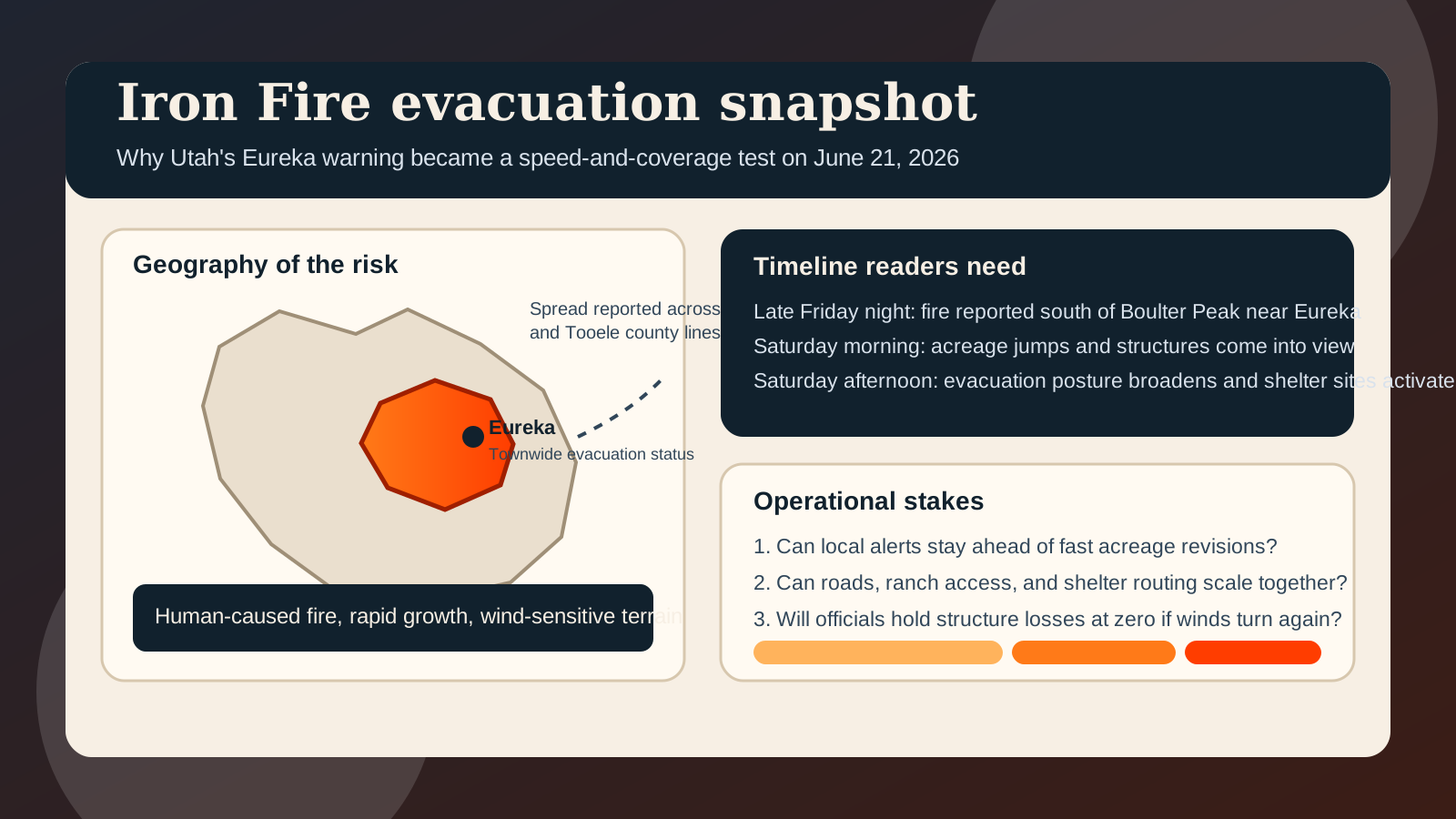
The most important fact about Utah's Iron Fire on Saturday was not just how quickly the acreage moved. It was how quickly officials had to decide whether Eureka's warning posture still matched the fire's pace. By the time townwide evacuation orders were in place, the question was no longer whether the blaze was large. It was whether the public message, the road network and the shelter plan could stay a step ahead of a wind-driven fire spreading across county lines.
FOX 13 News Utah — Town of Eureka evacuated as Iron Fire grows to 13,000 acres
FOX 13's same-day report shows how the Eureka evacuation moved from acreage update to public-safety order. If the player does not load, use the direct YouTube fallback link below.
That distinction matters because wildfire coverage can get trapped in a false simplicity: acres, containment, dramatic smoke, then a waiting game. The public-risk story is different. In Utah Fire Info's statewide wildfire system and in contemporaneous local reporting from FOX 13 News Utah and Deseret News, the Iron Fire emerged as a moving logistics problem: a human-caused start near Eureka, rapid expansion across parts of Juab, Utah and Tooele counties, threatened structures, and an evacuation picture that kept changing as the fire built momentum.
That is why this story deserves to be read as a warning-system test, not just a wildfire update. Rural fire response is always partly about flame behavior. It is also about whether official alerts remain credible when acreage estimates jump, whether residents know which "ready" status has become a leave-now order, and whether evacuation routes can absorb people before smoke, darkness or rumor start making the decisions for them.
What changed from a fire start to a townwide evacuation
According to local reporting that cited Utah Fire Info updates, the Iron Fire was reported late Friday night south of Boulter Peak near Eureka. By Saturday, the acreage estimate had climbed sharply, officials were describing a human-caused origin under investigation, and evacuation language had expanded from ranch areas north of town to a broader order affecting Eureka itself.
| Operational moment | Why it mattered |
|---|---|
| Fire reported overnight near Eureka | Residents still had a narrow window in which official warnings could stay ahead of rumor and traffic. |
| Acreage expanded rapidly by Saturday | The public had to recalibrate from a new start to a potentially community-shaping event. |
| Structures were described as threatened | The fire moved from land-management story to home-and-access story. |
| Evacuation sites in Elberta were activated | Response shifted from warning people to physically receiving them. |
The practical test in fires like this is less cinematic than the smoke column. It is administrative speed. Are county alerts, sheriff messaging, state fire updates and local TV reports reinforcing one another, or forcing residents to compare conflicting versions of the same risk? When a blaze crosses county boundaries, even small timing gaps begin to matter because people do not evacuate by acreage number alone. They evacuate when they trust that the next alert is newer, clearer and more specific than the last one.
Why Eureka's geography raises the stakes
Eureka is the kind of place where wildfire warnings are never only about the flame front. Access roads, ranch properties, county boundaries and shifting smoke conditions all change the usefulness of a warning. A city neighborhood can shelter in place block by block; a fast-moving fire near a small town often demands earlier judgment, because the penalty for waiting is higher when the route network is thinner and the fire can outrun assumptions.
That helps explain why the Iron Fire matters beyond Utah's daily incident board. It arrived before the deepest stretch of summer and exposed the pressure point many Western communities now face: preparedness campaigns can reduce human-caused starts, but once a blaze is moving, readiness becomes a communication exercise as much as a suppression exercise. Every update has to do at least three jobs at once. It must describe the fire, direct the public and preserve confidence that officials still have the clearest picture.
In that respect, the official and local reporting lines were complementary rather than redundant. Utah Fire Info and associated public alerts supplied the operational backbone. Local reporters added the kind of detail residents actually use: where shelters were set up, which areas were already under evacuation, and how fast the risk picture had changed. Readers need both. An official dashboard tells you what is authorized; ground-level reporting tells you what the order feels like on the road.
What officials know, and what they still do not
By Saturday, some points were clear in the public record: the fire had grown quickly, it had crossed into a multi-county concern, it was considered human-caused, and evacuations were active. But the hardest questions were still unresolved. How durable would the current evacuation footprint be if winds shifted again? How accurate was the latest acreage relative to real-time spread? And how long could officials protect threatened structures without exhausting the warning advantage that early evacuation had created?
Those are not signs of a weak response. They are the normal uncertainties of an active wildfire. The problem for public trust is that uncertainty can look like inconsistency when information arrives through scattered posts, rolling TV chyrons and partial screenshots. That is why the response standard should not be perfection. It should be disciplined clarity: say what changed, say what did not, and say what residents should do next.
The choice of video evidence matters for the same reason. PanoramaDigest selected a same-day local television report showing the evacuation context because it is directly tied to the event and easier to verify than stray social clips or smoke images detached from time and place. A dramatic plume without sourcing is emotionally vivid but operationally weak. A verified report tied to a known newsroom and a specific update window is far more useful to readers trying to understand risk.
What to watch next
The next meaningful checkpoints are simple. Watch whether evacuation boundaries stabilize or widen, whether officials keep reporting zero home losses, and whether updates continue to move in a consistent sequence from fire agencies to local authorities to public shelter information. If that chain holds, the Iron Fire will stand as a case study in how a rural community can use time well against a fast-moving threat.
If it does not, the lesson will be harsher. Western wildfire coverage often celebrates the heroics of suppression, and that work deserves it. But communities are judged earlier than the containment line. They are judged at the moment a resident has to decide whether "be ready" still means wait, or already means go. Saturday's Iron Fire made that decision the real story.
Reader Sentiment & Impact Pulse
How do you evaluate the primary outcome of this development?
Select an option to cast your perspective. Responses are anonymous and aggregated in real time.
Key Context & Frequently Asked Questions
A fast-growing Utah wildfire near Eureka turned into more than an acreage story: it became a real-time test of whether evacuation orders, road access and public updates can move faster than the terrain. This analysis from PanoramaDigest examines primary documentation, operational implications, and broader institutional impacts across news.
Read Next
Related Stories

Jury Convicts Driver of Negligent Homicide in Death of Reporter Covering Super Bowl
A Louisiana jury has found a driver guilty of negligent homicide in the fatal striking of a journalist covering Super Bowl events in New Orleans. The verdict brings legal accountability to a tragic case that underscored pedestrian safety challenges during major national entertainment spectacles.

Jensen Huang Reframed AI Doom Debate as National Opportunity in Discourse With Donald Trump
Nvidia CEO Jensen Huang addressed existential AI fears during conversations with Donald Trump, advocating for American leadership and innovation over restrictive regulatory caution.
Old Trails Fire Damage Estimate Reaches 640 Structures in Spokane
Spokane County's preliminary estimate says the Old Trails fire destroyed 640 structures, while evacuation zones remain active across northwest Spokane.