Maine's Governor Primaries Just Picked Two Nominees. November Will Test a Different Kind of Math.
Maine's ranked-choice tabulation on June 19, 2026 sent Democrat Hannah Pingree and Republican Bobby Charles to the fall governor's race. The sharper political lesson is that June rewarded coalition-building, while November's three-way race will be decided by simple plurality.
Maine finished the long tail of its June 9 primary in the early hours of Friday, June 19, 2026, when the state's ranked-choice tabulation made Democrat Hannah Pingree and Republican Bobby Charles their parties' nominees for governor. The basic news is straightforward. The more revealing part is what the counting showed about each coalition, and how quickly those lessons stop applying once the race moves into November.
YouTube — June 2026 Primary Election Ranked Choice Voting Tabulation - Day 5
Maine's official Day 5 tabulation stream is the cleanest primary-source record of how the final rounds were announced. Use the direct YouTube link in the article if the player does not load.
The Maine Secretary of State's June 19 tabulation notice confirmed Pingree as the Democratic winner after Angus King III, Shenna Bellows and Troy Jackson were eliminated in sequence, while Charles survived a seven-way Republican field and outlasted Jonathan Bush, Garrett Mason and the rest of his party's bench. AP's same-day report captured the big political frame: Gov. Janet Mills is term-limited, so Maine is heading into a genuinely open gubernatorial race. But the official vote files add the more interesting layer. Pingree did not win because she dominated first-choice voting. She won because she built the better second- and third-choice coalition. Charles, by contrast, won because a fragmented Republican field never found a stronger anti-Charles consolidation before the rounds ran out.
What the ranked-choice count actually revealed
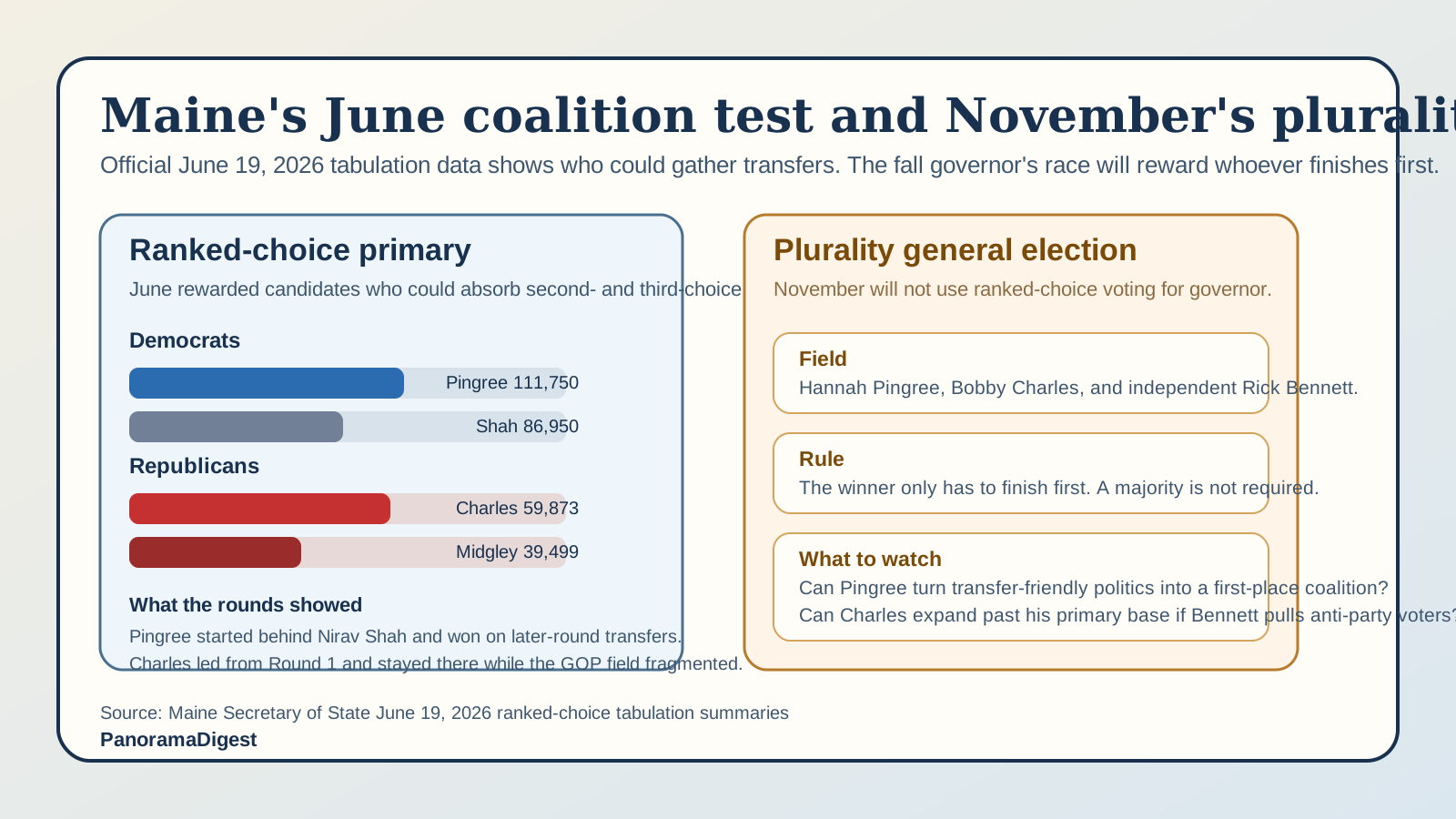
The Democratic side produced the clearest lesson. In the official Secretary of State summary, Pingree started behind Nirav Shah on first-round votes, 50,552 to 58,606. By Round 3 she had moved ahead, 75,671 to 72,681, and in the final round she beat Shah 111,750 to 86,950. That is not a trivial accounting quirk. It means Pingree's path was less about commanding the field on election night than about becoming the acceptable home for supporters of other Democrats once their first choices were gone.
Maine Public's reporting underscored the same point, noting that Pingree picked up significant second- and third-place support from the Jackson and Bellows camps. That matters because it tells readers something more useful than a simple winner's headline. Pingree leaves the primary with evidence that she can pull together an intra-party coalition even when she is not every voter's first instinct.
The Republican picture was different. Charles led from Round 1 with 49,129 votes, while Ben Midgley sat at 25,880 and Bush at 25,449. The eventual final round ended 59,873 to 39,499 for Charles over Midgley. In other words, the Republican field stayed divided long enough for the front-runner to keep the pole position. That does not mean Charles built the broader coalition. It means his lead survived the winnowing process before a rival could gather enough transfers to overtake him.
| Primary result | What the official rounds showed | Why it matters for fall |
|---|---|---|
| Democrats: Hannah Pingree defeated Nirav Shah | Pingree trailed on Round 1, then won 111,750 to 86,950 in the final round after lower-ranked candidates were eliminated. | She enters November with proof that her coalition widened as voters made backup choices. |
| Republicans: Bobby Charles defeated Ben Midgley | Charles led from the first round and finished 59,873 to 39,499 in Round 7. | He showed first-choice strength, but not necessarily the same breadth of crossover acceptability. |
| System effect | Exhausted ballots climbed to 23,705 in the Democratic race and 38,609 in the Republican race by the final round. | The counting process rewarded durable support, but it also thinned the electorate by the end. |
Why November will be a different election entirely
The next stage is where the story gets sharper. Maine Public reported earlier this month that state Sen. Rick Bennett qualified for the ballot as an independent, setting up a three-way general election. It also noted the constitutional rule that matters most here: ranked-choice voting is used in Maine primaries and congressional general elections, but not in the general election for governor. That means November will not ask who can gather the best second-choice network. It will ask who can finish first in a split field.
That distinction is the real June 19 takeaway. Pingree's primary result suggests she can unify Democrats after a crowded contest. Charles' result suggests he can stay upright while his opponents divide the anti-front-runner vote. Bennett's presence means neither party nominee can assume the fall race will reward the same behavior that worked in June. Coalition-building still matters politically, of course. But legally and mechanically, the November contest is harsher. A candidate can win without majority support if the opposition fractures in the right way.
What the nominees are bringing into that three-way map
Each nominee also arrives with a clear public persona. Pingree's campaign biography describes her as a former Maine House speaker who later ran the Governor's Office of Policy Innovation and the Future, with a platform shaped around housing, health care and climate-linked economic issues. Charles' own campaign site presents him as a former U.S. assistant secretary of state and a law-and-order conservative focused on crime, taxes and what he calls government corruption. That contrast was already visible before Friday. The tabulation results simply formalized which versions of those messages proved durable enough to survive the elimination rounds.
There is also a temperamental difference buried inside the official and campaign records. Pingree's road to victory depended on being acceptable to voters who began somewhere else. Charles' path depended on holding a committed core while a crowded field failed to cohere around an alternative. Those are not interchangeable strengths. In a three-way fall race, one model tests whether a candidate can hold together a broad center-left or anti-Trump coalition. The other tests whether a disciplined ideological base can win because the rest of the vote splinters.
What readers should watch next
The next useful questions are not ceremonial. Watch whether Pingree can convert her ranked-choice coalition into a durable general-election argument once backup preferences no longer count. Watch whether Charles expands beyond the hard-edged message that carried him through a fractured Republican primary. And watch Bennett's vote share closely, because in a plurality race he does not have to win to change the outcome.
Maine did not just pick two nominees on June 19. It exposed the shape of the strategic problem each one now faces. Pingree emerged as the better coalition collector. Charles emerged as the stronger first-choice survivor. November will decide which skill matters more when the rules stop asking for consensus and start rewarding the cleanest path to first place.
If the official tabulation player below does not render in your browser, use the direct link to the Maine Secretary of State's Day 5 ranked-choice tabulation stream.
Reader Sentiment & Impact Pulse
How do you evaluate the primary outcome of this development?
Select an option to cast your perspective. Responses are anonymous and aggregated in real time.
Key Context & Frequently Asked Questions
Maine's ranked-choice tabulation on June 19, 2026 sent Democrat Hannah Pingree and Republican Bobby Charles to the fall governor's race. The sharper political lesson is that June rewarded coalition-building, while November's three-way race will be decided by simple plurality. This analysis from PanoramaDigest examines primary documentation, operational implications, and broader institutional impacts across news.
Read Next
Related Stories

Jensen Huang Reframed AI Doom Debate as National Opportunity in Discourse With Donald Trump
Nvidia CEO Jensen Huang addressed existential AI fears during conversations with Donald Trump, advocating for American leadership and innovation over restrictive regulatory caution.

Old Trails Fire Damage Estimate Reaches 640 Structures in Spokane
Spokane County's preliminary estimate says the Old Trails fire destroyed 640 structures, while evacuation zones remain active across northwest Spokane.

USCIS Can Now Refer Asylum Cases to Immigration Court Without an Interview
A DHS rule effective July 28 lets USCIS send some affirmative asylum applications directly to immigration court. Referral is not a denial, but the interview is no longer guaranteed.