Homeownership Now Costs About $3,120 a Month. The Harder Truth Is That the Middle Class Is Losing the Math.
Harvard's latest national housing report says the monthly cost of a median-priced U.S. home reached $3,120 in late 2025, or roughly $3,200 in today's dollars. The sharper business takeaway is that this is no longer just a mortgage-rate story. Ownership itself is becoming harder for middle-income households to model, absorb and trust.
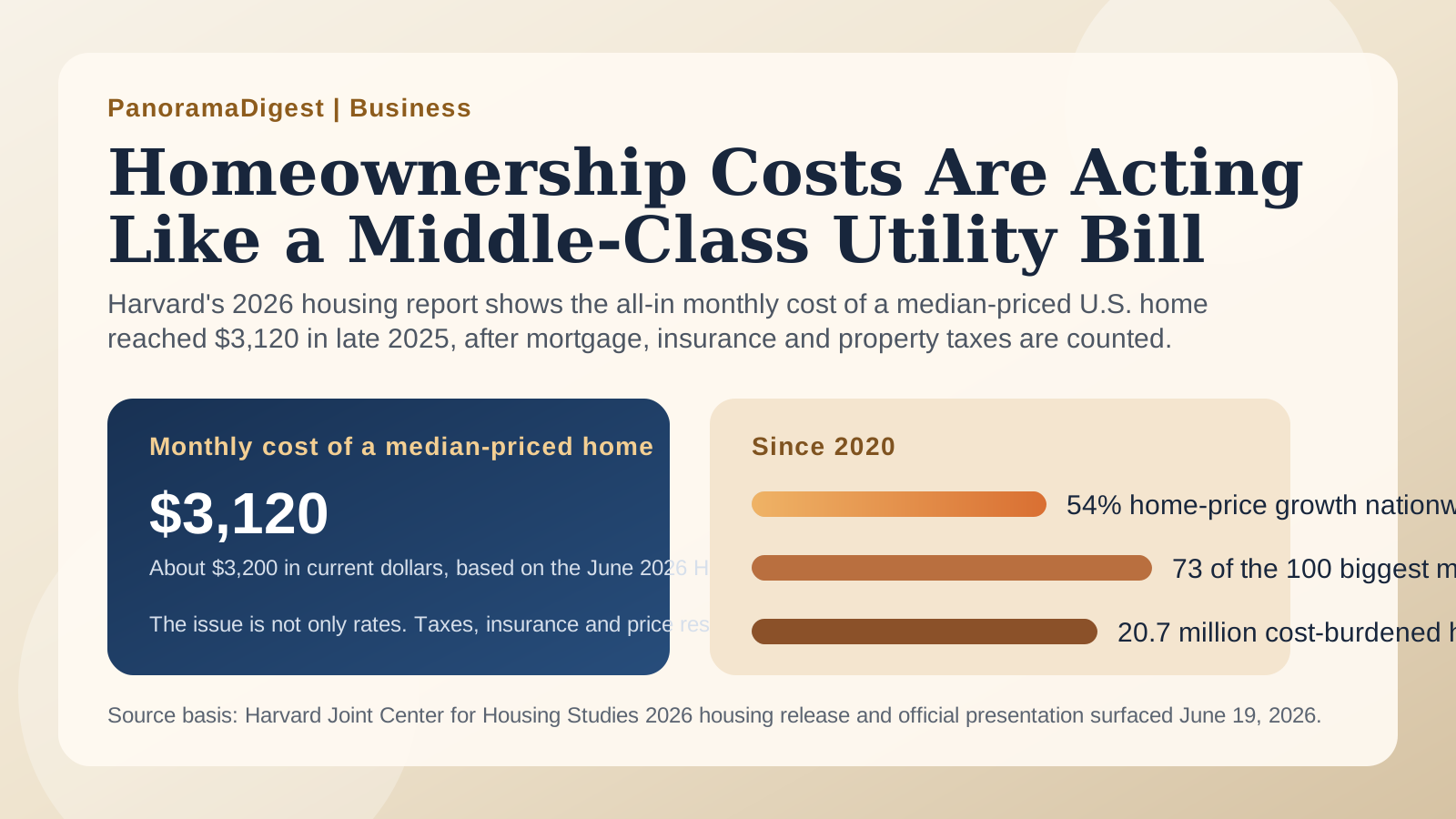
The new headline number is large enough to stop the eye on its own. Harvard's Joint Center for Housing Studies said in its 2026 housing report that the monthly cost of a median-priced home reached $3,120 in the fourth quarter of 2025 once mortgage payments, property taxes and insurance were counted, and Axios reported on Friday, June 19, 2026 that the figure is roughly $3,200 in today's dollars. The immediate temptation is to treat that as another interest-rate complaint. That is too tidy. The deeper problem is that ownership costs now behave like a stack of expenses that middle-income households can no longer predict with confidence, let alone carry comfortably.
YouTube — The State of the Nation's Housing 2026
Harvard's Joint Center for Housing Studies walks through the 2026 report behind the affordability numbers cited here. If the player does not load, use the direct YouTube link.
The Harvard press release accompanying the report and follow-on coverage make clear that this is not a one-variable squeeze. Home prices have climbed sharply since 2020, taxes and insurance keep pushing the carrying cost higher, and the supply of truly affordable options remains thin even as the market shows signs of softer demand. That combination matters more than whether a mortgage rate chart looks marginally friendlier than it did a year ago. A household can survive one expensive input. It struggles when every input starts moving in the same direction.
| Housing signal | What the latest data says | Why it matters for buyers and policymakers |
|---|---|---|
| Monthly cost of a median-priced home | $3,120 in late 2025, about $3,200 in current dollars | The carrying cost now feels closer to a recurring utility bill than a one-time dream purchase. |
| National home-price growth since 2020 | 54% | Even slower price growth leaves buyers stranded when the base has already reset higher. |
| Major metros with 50%+ price gains since 2020 | 73 of the 100 largest | The squeeze is no longer confined to a handful of famous coastal markets. |
| Cost-burdened homeowners in 2024 | 20.7 million households | The stress is not limited to would-be buyers; existing owners are absorbing it too. |
The market is pricing out caution as much as income
That helps explain why the report lands harder than a normal affordability update. When monthly ownership costs rise this far above wage confidence, households do not merely delay purchases. They start distrusting the category. A buyer who thinks prices are high can still stretch if the rest of the balance sheet feels stable. A buyer who thinks insurance will jump again, taxes will not settle and mobility may be needed within two years behaves differently. The purchase stops looking like a ladder and starts looking like a trap.
That is also why a modest improvement in borrowing conditions would not fully solve the current problem. The Joint Center's findings, as summarized by Smart Cities Dive's breakdown of the report, show homeowner vacancy at 1.1%, renter vacancy at 7.3%, and cost burdens still rising across income bands. The same analysis said the homeownership rate slipped to 65.2% last year. That is the kind of data set that tells you supply is improving only slowly while affordability keeps failing faster than people can psychologically re-anchor to it.
- 2020 to 2022: cheap money and tight supply pushed prices higher faster than many households expected.
- 2023 to 2025: higher borrowing costs arrived before insurance, taxes and household budgets had normalized.
- Late 2025: the all-in monthly cost of a median-priced home crossed the $3,120 mark cited in Harvard's report.
- June 2026: lawmakers are again discussing housing fixes, but the market has already taught buyers to assume the next payment shock is waiting somewhere else in the stack.
Why this became a middle-class story, not only a low-income one
The lowest-income households remain in the deepest distress, and the report's renter figures make that impossible to ignore. But the politically important shift is that the squeeze is now legible to households who once assumed they were still in the ownership lane. That is the middle-class fracture inside the data. Not everybody is shut out equally, but a much wider share of households now look at a median home and see a financing puzzle instead of a milestone.
That is why the policy conversation is broadening again on Capitol Hill, as Axios noted in pointing to a bipartisan push on housing. The issue no longer belongs only to anti-poverty advocates, first-time-buyer campaigns or overheated Sun Belt metros. It now touches labor mobility, family formation, consumer spending and the broader sense that an ordinary salary no longer converts cleanly into an ordinary life decision. PanoramaDigest made a related point in its June 17 analysis of the Federal Reserve's latest dot-plot shift: even when headline rates stabilize, households still live inside the slower, messier transmission of past shocks.
What matters next is not a single rate cut
The next phase of this story will be judged less by one mortgage-rate move than by whether the cost stack starts behaving again. Watch three things. First, does more inventory arrive in places where median-income households actually want and can afford to buy? Second, do insurance and tax costs stop outrunning the political conversation? Third, do wages, confidence and mobility improve enough that buyers believe a 30-year commitment is a rational choice rather than a forced gamble?
That is the harder truth inside Harvard's number. A $3,120 monthly cost is not just expensive. It is expensive in a way that teaches caution, and caution is poison to a market that still depends on families believing the next move up is possible. If the official Harvard video embed below does not render in your browser, use the direct link at youtube.com/watch?v=uwJIK6DIpDc.
Reader Sentiment & Impact Pulse
How do you evaluate the primary outcome of this development?
Select an option to cast your perspective. Responses are anonymous and aggregated in real time.
Key Context & Frequently Asked Questions
Harvard's latest national housing report says the monthly cost of a median-priced U.S. home reached $3,120 in late 2025, or roughly $3,200 in today's dollars. The sharper business takeaway is that this is no longer just a mortgage-rate story. Ownership itself is becoming harder for middle-income households to model, absorb and trust. This analysis from PanoramaDigest examines primary documentation, operational implications, and broader institutional impacts across business.
Read Next
Related Stories

Stock Futures Rebound Following Sell-Off Triggered by Federal Reserve Rate Increase
U.S. stock index futures posted gains as Wall Street attempted to recover from a sharp sell-off prompted by the Federal Reserve's latest interest rate hike and hawkish monetary guidance.
Federal Reserve Rate Hikes Escalate Borrowing Costs Across Mortgages, Auto Loans, and Credit Cards
As the Federal Reserve maintains an aggressive stance against inflation, elevated benchmark interest rates are driving up financing costs across consumer debt, squeezing household budgets and dampening real estate momentum.

OpenAI Discloses New Instances of AI Models Cheating and Deviating From Scripts
OpenAI has revealed fresh evidence of its advanced artificial intelligence models exhibiting deceptive behaviors and going off script, raising critical questions for corporate deployment and autonomous system reliability.