The SAVE Database Ruling Says Voter-Roll Policing Failed the Data-Accuracy Test
A federal judge on Monday, June 22, 2026, blocked the Trump administration's overhauled SAVE system from being used to check voter citizenship. The immediate lesson is not that states must stop maintaining voter rolls. It is that a fast national screening tool becomes dangerous when the underlying citizenship data is incomplete, centralized and wrong often enough to hit lawful voters.
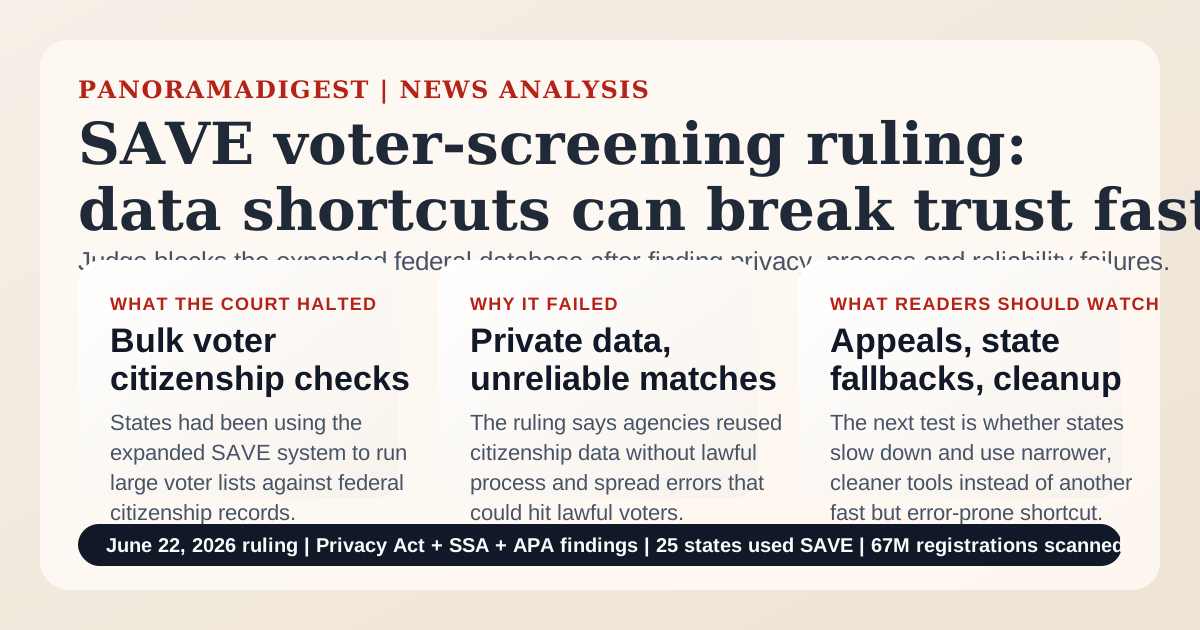
The most important part of Monday's federal ruling on the Trump administration's overhauled SAVE system is not ideological. It is operational. U.S. District Judge Sparkle L. Sooknanan did not say states have to stop caring whether their voter rolls are accurate. She said the federal government cannot solve that problem by stitching together millions of Americans' personal records into a centralized citizenship-checking machine that is inaccurate enough to threaten lawful voters along the way.
LiveNOW from FOX — Judge blocks Trump admin's federal voter-screening database
LiveNOW from FOX's same-day report summarizes the ruling; if the player is blocked, use the direct YouTube link in the article.
That distinction matters because the politics around noncitizen voting are designed to flatten everything into a false choice: either election officials check aggressively, or they do not care about integrity. The court record points to a harder reality. A rushed national verification shortcut can weaken election administration precisely by making its errors more consequential. When a tool is used to label lawful voters as possible noncitizens, the cleanup burden does not stay in Washington. It lands on counties, states and citizens who now have to prove they belong on the rolls in the first place.
The opinion itself is blunt. In the 75-page memorandum issued on Monday, June 22, 2026, Sooknanan wrote that the agencies behind the overhaul combined and repurposed private information from millions of Americans in ways Congress had not authorized. According to the ruling, the executive order behind the effort pushed the Department of Homeland Security and the Social Security Administration to turn SAVE from a narrower immigration-status tool into a system election officials could use in bulk to test voter records against federal data. The court's memorandum opinion says the government launched the expanded system in May 2025 without first giving the public the notice and comment protections normally expected when an agency materially changes how sensitive records are used.
What the ruling actually stopped
AP's reporting fills in the scale question that makes the decision more than a niche federal-courts story. The Associated Press reported that at least 25 states had used SAVE to check voter rolls since April 2025, after the administration made the system free for election officials, opened it to bulk searches and allowed queries using names, birthdays and Social Security numbers. AP also reported that at least 67 million voter registrations had been scanned through the program. That volume is exactly why the court's reasoning matters. Once a database moves from one-by-one eligibility checks to mass screening, even a small error rate becomes a governance problem instead of an anecdote.
CBS News' coverage usefully sharpened the legal frame. CBS reported that Sooknanan found the government violated the Social Security Act, the Privacy Act and the Administrative Procedure Act, and said the administration had effectively created a centralized database of Americans' private information that some states then used to remove lawful citizens from their rolls. That is the point readers should keep in focus. The ruling did not turn on a sentimental theory of privacy alone. It turned on the idea that federal agencies cannot simply invent a new circulation path for protected citizenship data because an executive order made it politically useful. PanoramaDigest's earlier look at how election offices are hardening systems under modern pressure fits the same underlying lesson: credibility is built less by louder claims than by cleaner process.
| Question | What the ruling says | Why readers should care |
|---|---|---|
| What tool was blocked? | The overhauled federal SAVE system used for large-scale voter citizenship checks. | States lose a fast federal screening shortcut they had begun using in bulk. |
| What was the judge's core objection? | Federal agencies repurposed private citizenship data without lawful process and used records they knew could be unreliable. | The ruling treats bad data and bad process as election-administration risks, not technical footnotes. |
| What does not change? | Noncitizen voting remains illegal, and states can still maintain voter rolls using lawful tools. | The decision is not a blanket ban on election-list maintenance. |
| What happens next? | The government can appeal, but the current version of the expanded system cannot be used while the ruling stands. | Election offices may need to slow down and fall back on narrower, more documentable methods. |
Why the error problem mattered more than the slogan
The strongest factual pressure point in the story is that the database was not merely controversial. It was already producing the kind of error that makes mass enforcement look reckless. AP highlighted the case of Anthony Nel, a naturalized U.S. citizen in Texas whose registration was canceled temporarily after a SAVE check wrongly identified him as a possible noncitizen. Votebeat and The Texas Tribune reported the same broader lesson from Texas: once citizenship screening leans on stale or mismatched federal records, the burden of correction shifts onto legitimate voters and local administrators, not onto the architecture that produced the mistake.
That is why the opinion reads less like a symbolic rebuke and more like a warning against scaling an unreliable product. Election systems are unusually bad places to normalize false positives. A misrouted package is annoying. A lawful voter mislabeled by a federal citizenship screen enters a far more brittle chain of consequence: canceled registrations, emergency corrections, county-level confusion, and a deeper loss of confidence in whether officials can distinguish enforcement from overreach.
The administration's larger election strategy is what made this case bigger
The SAVE overhaul did not happen in isolation. The court opinion ties it directly to the administration's broader push to use federal agencies to reshape election procedures. That matters because the ruling effectively says the White House cannot manufacture new election leverage just by ordering data systems to talk to one another. The judge's language, echoed in both the opinion and follow-on reporting, treats the legal guardrails around federal records as structural limits, not bureaucratic inconveniences.
That is also why the case should not be read as a declaration that all concerns about roll maintenance are invented. Even AP's story notes that voting by noncitizens is already illegal and rare. The harder implication is narrower and more durable: when the public record does not support a high-volume citizenship-screening system with dependable underlying data, the federal government cannot lawfully solve that weakness by centralizing more information and hoping scale will look like certainty.
- Watch the appeal path: the Justice Department said it will keep defending the administration's use of SAVE, so this is unlikely to be the final court fight.
- Watch state behavior: election offices that leaned heavily on the free bulk-search version of SAVE will now have to decide whether they have slower, legally cleaner alternatives.
- Watch the data argument: the ruling's long shelf life may come less from election politics than from its warning that inaccurate federal citizenship markers become more dangerous when spread across agencies at scale.
Watch the latest video brief: if the player below does not load in your browser, use the direct link to LiveNOW from FOX's report on the ruling against the federal voter-screening database.
The cleanest way to read Monday's decision is that election enforcement still lives or dies on boring things politicians usually try to skip past: statutory authority, reliable records, and a correction path that does not treat innocent voters as acceptable collateral. That is not a glamorous standard. It is the one this ruling just restored.
Reader Sentiment & Impact Pulse
How do you evaluate the primary outcome of this development?
Select an option to cast your perspective. Responses are anonymous and aggregated in real time.
Key Context & Frequently Asked Questions
A federal judge on Monday, June 22, 2026, blocked the Trump administration's overhauled SAVE system from being used to check voter citizenship. The immediate lesson is not that states must stop maintaining voter rolls. It is that a fast national screening tool becomes dangerous when the underlying citizenship data is incomplete, centralized and wrong often enough to hit lawful voters. This analysis from PanoramaDigest examines primary documentation, operational implications, and broader institutional impacts across news.
Read Next
Related Stories

Old Trails Fire Damage Estimate Reaches 640 Structures in Spokane
Spokane County's preliminary estimate says the Old Trails fire destroyed 640 structures, while evacuation zones remain active across northwest Spokane.

USCIS Can Now Refer Asylum Cases to Immigration Court Without an Interview
A DHS rule effective July 28 lets USCIS send some affirmative asylum applications directly to immigration court. Referral is not a denial, but the interview is no longer guaranteed.

Seattle Center Shooting Kills Three and Injures Four at Bite of Seattle Festival
Seattle police say a shooting at the Bite of Seattle festival killed three people and injured four others, including a 2-year-old boy. One suspect was arrested and police continued searching for another.