Obama's Presidential Center Opened on Juneteenth. Chicago's Harder Test Starts After the Applause.
The Obama Presidential Center opened to the public on June 19, 2026, after a dedication ceremony the night before. The ceremony mattered, but the sharper civic question is whether the South Side campus becomes a daily public institution rather than a polished legacy monument.
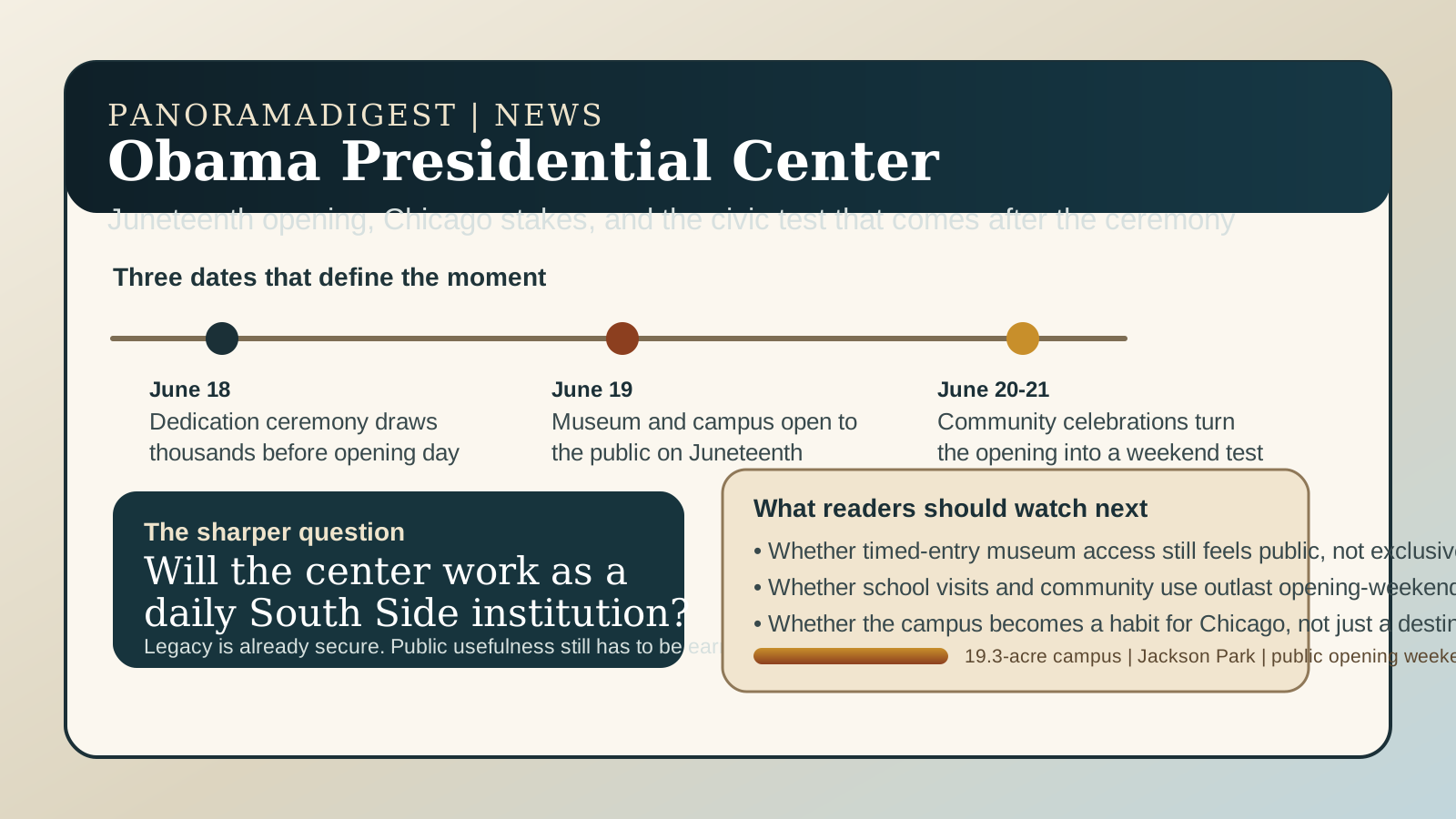
On Friday, June 19, 2026, the Obama Presidential Center opened to the public in Chicago's Jackson Park, deliberately landing on Juneteenth rather than on a neutral ribbon-cutting date. AP's national Juneteenth report treated the opening as part of the day's wider civic meaning, while the Obama Foundation's own opening page framed the weekend as a free, open-house-style public milestone. ABC7 Chicago reported that thousands had already turned out for Thursday night's dedication ceremony before the museum doors opened Friday. The easy version of this story is that a long-awaited presidential center is finally here. The harder, more useful version is that Chicago now has to decide whether this campus will function as a daily civic institution on the South Side or settle into life as a beautifully managed monument to a presidency that no longer needs help protecting its memory.
Obama Foundation — Grand Opening Ceremony at the Obama Presidential Center
The Obama Foundation's official opening ceremony stream shows how the center framed its public debut. Use the direct YouTube link in the article if the embedded player does not load.
Why the Juneteenth timing matters, and why symbolism alone is not enough
Juneteenth gives the opening a political and historical frame that no ordinary museum launch could borrow. AP noted that the public debut coincided with a federal holiday built around delayed freedom, national memory and the unfinished work of democratic inclusion. That is not decorative scheduling. It is the center's opening argument about what the institution wants to be.
But symbolism can do only part of the job. The Obama Foundation's materials make clear that this is not just a ceremonial library stop. The campus is pitched as a broad public environment with a museum, gathering spaces and a long calendar of community activity, and the foundation says the museum and campus opened to the public on June 19 while larger community celebrations continue through the weekend. The challenge is that American political monuments often sound more democratic on opening day than they feel a year later. Chicago's real stake is whether this place keeps acting public after the opening script has ended.
| When | What happened | Why it matters |
|---|---|---|
| Thursday, June 18 | The dedication ceremony formally unveiled the center before a large crowd in Jackson Park. | The opening arrived first as a national spectacle, not a quiet local soft launch. |
| Friday, June 19 | The campus and museum opened to the public on Juneteenth. | The center tied its public identity to a date about freedom, memory and unfinished democratic work. |
| Friday-Sunday, June 19-21 | The foundation scheduled community celebrations across the opening weekend. | The institution is presenting itself as a living public campus rather than a one-room legacy vault. |
| Fall 2026 | School visits are slated to begin after spring reservations, according to the opening FAQ. | That is an early clue about whether the center becomes part of civic habit instead of tourist ritual. |
The center's bigger promise is not archival. It is civic.
That distinction matters because the center is opening in Chicago, not in a neutral museum district built to absorb occasional bus traffic and commemorative speeches. The foundation's museum page emphasizes the story of Barack and Michelle Obama, while the broader campus materials describe a 19.3-acre site meant for movement, gathering and repeated public use. In plain terms, the project is asking to be judged as more than a container for presidential memorabilia.
That is why the center's strongest argument may turn out to be practical rather than sentimental. If families use the campus without feeling priced out or over-managed, if museum entry feels accessible rather than ceremonially scarce, if school groups and neighborhood visitors treat it as a place to return to instead of a place they once visited, then the opening will have meant something larger than prestige. If not, the center risks becoming another institution that speaks the language of democratic access while operating mostly as a carefully curated symbol.
Chicago's harder question starts after the grand opening
ABC7's live coverage captured the obvious opening-weekend energy: crowds, speeches, star power and a city eager to attach itself to a long-delayed milestone. That part is real, and it should not be minimized. But celebrity attendance is not the interesting metric from here. The more serious question is whether the center behaves like a democratic public space once the famous guests leave and the first rush of curiosity fades.
The official FAQ offers one revealing hint. The campus itself is free, but museum visits run on timed entry, and school programming will not begin until the fall. None of that is suspicious on its own. Major cultural institutions need flow control. Still, those details are where lofty civic language either becomes concrete or starts to narrow. A center that genuinely wants to be woven into Chicago life has to prove that access, repetition and neighborhood usefulness are not secondary to branding.
- After the opening weekend: do Chicago residents keep showing up once the ceremony glow fades?
- Through the summer: does timed museum entry still feel manageable and welcoming rather than scarce and performative?
- By fall: do school visits and community use make the campus part of civic routine?
- By next year: is the center talked about as a working public place or mainly as a prestige landmark?
What readers should watch next
The best next indicator is not another tribute to the Obamas' place in American history. That legacy is already secure. The sharper question is whether this institution can turn symbolic timing into daily trust. A presidential center on Juneteenth is an elegant statement. A public campus that still feels open, useful and locally claimed in six months would be a more difficult and more meaningful achievement.
Source card: If the official ceremony player below does not load in your browser, use the direct link to the Obama Foundation's grand-opening livestream. Readers who want the public-facing logistics can also keep the opening FAQ and the weekend event page handy.
Reader Sentiment & Impact Pulse
How do you evaluate the primary outcome of this development?
Select an option to cast your perspective. Responses are anonymous and aggregated in real time.
Key Context & Frequently Asked Questions
The Obama Presidential Center opened to the public on June 19, 2026, after a dedication ceremony the night before. The ceremony mattered, but the sharper civic question is whether the South Side campus becomes a daily public institution rather than a polished legacy monument. This analysis from PanoramaDigest examines primary documentation, operational implications, and broader institutional impacts across news.
Read Next
Related Stories

Jensen Huang Reframed AI Doom Debate as National Opportunity in Discourse With Donald Trump
Nvidia CEO Jensen Huang addressed existential AI fears during conversations with Donald Trump, advocating for American leadership and innovation over restrictive regulatory caution.
Old Trails Fire Damage Estimate Reaches 640 Structures in Spokane
Spokane County's preliminary estimate says the Old Trails fire destroyed 640 structures, while evacuation zones remain active across northwest Spokane.

USCIS Can Now Refer Asylum Cases to Immigration Court Without an Interview
A DHS rule effective July 28 lets USCIS send some affirmative asylum applications directly to immigration court. Referral is not a denial, but the interview is no longer guaranteed.