The WEF's 2026 Tech List Says the AI Race Is Leaving the Chat Window
The World Economic Forum's Top 10 Emerging Technologies of 2026 argues that the most consequential innovation race is moving out of consumer software and into grids, factories, medicines and materials. The sharper question is whether governments and companies are prepared for a tech cycle that now lives inside physical systems.
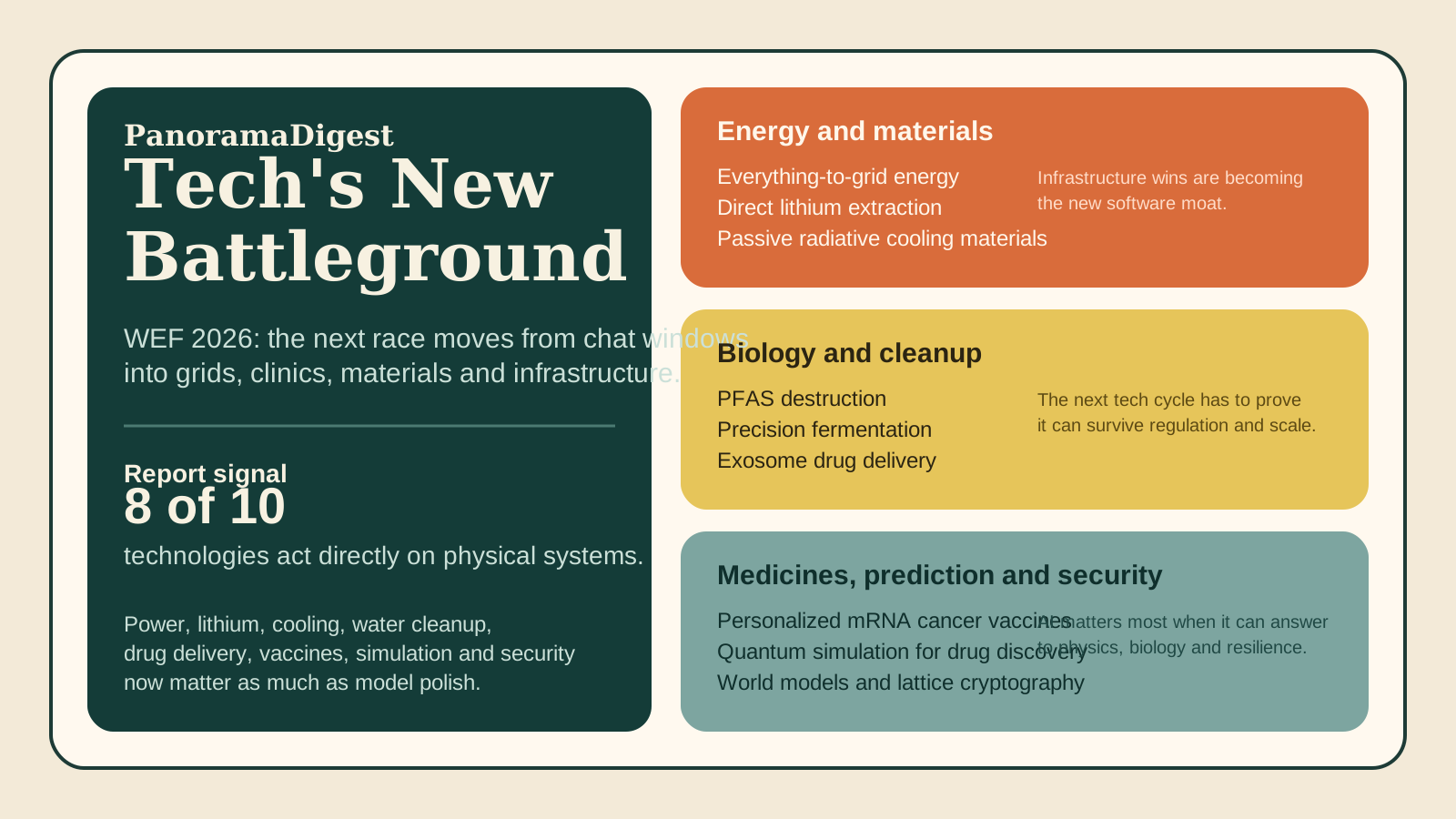
The easiest way to misread the World Economic Forum's Top 10 Emerging Technologies of 2026 is to treat it as another future-of-innovation slideshow. The more useful reading is harsher. This year's list says the center of gravity is shifting away from software that mostly lives on screens and toward technologies that act on grids, buildings, minerals, water, tumors and supply chains. On Tuesday, June 23, 2026, the Forum and Frontiers framed that shift in unusually direct terms: after years of software-first AI, the technologies with the greatest impact are moving into the physical systems that underpin energy, medicine, food and materials.
World Economic Forum — Top 10 Emerging Technologies 2026
The official World Economic Forum video expands on the June 23 list; use the direct YouTube link in the article if the player is blocked.
That is why this report matters more than a ranking exercise. The list itself is broad, spanning everything-to-grid energy, direct lithium extraction, passive radiative cooling materials, PFAS destruction, precision fermentation, exosome drug delivery, personalized mRNA cancer vaccines, quantum simulation for drug discovery, world models and lattice-based cryptography. But the real signal is the pattern underneath it. Frontiers' co-publisher summary says eight of the 10 technologies act directly on physical systems and that competitive advantage is moving toward control of infrastructure, materials, biological processes and industrial data. That is a much bigger claim than saying AI is still important. It says AI is becoming a means, not the whole destination.
Why the list feels different from a normal emerging-tech roundup
The 2026 package is not simply betting on more artificial intelligence. It is betting on where AI becomes operational. World models are the only openly AI-native item in the top 10, yet even that entry is about predicting how real systems behave under stress, including scenarios such as superstorms. The broader field is more grounded: cleaner cooling, better water treatment, faster lithium recovery, more targeted medicine and security tools built for a quantum era. That makes the report feel less like a catalogue of digital novelty and more like a map of which sectors are about to become harder to separate from frontier computing.
That shift lines up with pressures we have already been tracking at PanoramaDigest. Our June 18 analysis of the fight over who pays for AI-era power infrastructure showed that compute growth is already colliding with grid politics. Our June 21 piece on John Jumper's move to Anthropic argued that scientific credibility is becoming the scarcer AI asset. The WEF list pushes both threads further. It suggests the next prestige race will not be won by a chatbot that sounds slightly smoother. It will be won by whoever can move technology from impressive demos into stubborn physical systems without blowing up cost, trust or time.
| Technology lane | Examples from the report | What the shift means |
|---|---|---|
| Energy and materials | Everything-to-grid energy, direct lithium extraction, passive radiative cooling materials | The race is moving into the infrastructure that has to hold up under real demand, not just investor enthusiasm. |
| Water and industrial cleanup | PFAS destruction | Breakthrough claims increasingly have to prove they can solve slow, expensive public problems at scale. |
| Biology and medicine | Precision fermentation, exosome drug delivery, personalized mRNA cancer vaccines, quantum simulation for drug discovery | AI's value case strengthens when it compresses lab timelines or delivery precision instead of merely generating text. |
| Computation and security | World models, lattice-based cryptography | The software story is not disappearing. It is being redirected toward prediction, resilience and long-horizon security. |
The hidden argument is about where scarcity moves next
Software booms create one kind of scarcity: top researchers, chips, distribution and attention. Physical-system booms create another: transmission capacity, permitting, specialized manufacturing, trusted clinical pathways, water access, mine chemistry, field maintenance and regulatory patience. That is why the Forum's framing matters. A company can move fast in code and still hit a wall in a grid queue, a hospital workflow or a water-treatment plant. Once technology leaves the browser tab, friction stops being abstract.
Frontiers said this year's report used an AI-based nomination workflow that screened more than 1,200 candidate technologies across academic publications and industry sources before expert review narrowed the list. That methodology is worth noticing because it mirrors the article's deeper thesis. AI is already becoming part of the technology-selection machinery itself, but the technologies chosen are overwhelmingly about changing the physical world. In other words, the software layer is helping choose which hard-world bets now matter most.
Where the report is strongest, and where readers should stay skeptical
The report is strongest as a direction-of-travel document. It captures a change that is already visible across capital spending, industrial policy and research prestige: technology's next big arguments are becoming more material. It is less useful as a timetable. Emerging-tech lists are good at spotting where energy is moving and weaker at predicting which breakthroughs will survive cost overruns, weak incentives, public opposition or messy deployment.
That is especially true for medicine and energy. Personalized cancer vaccines can look inevitable in a research narrative and still face scale, reimbursement and manufacturing constraints. Everything-to-grid energy can sound straightforward until local rules, utility incentives and hardware standards collide. Direct lithium extraction has been a tantalizing promise for years; the question is never whether the chemistry sounds elegant on paper. The question is whether it performs consistently enough, cheaply enough and cleanly enough to matter beyond pilots.
- Consumer-AI phase: the market rewarded tools that could capture attention quickly through chat, search, coding and image generation.
- Infrastructure phase: the pressure shifted toward power, chips, network capacity and the industrial cost of running large models.
- Physical-systems phase: the WEF's June 23, 2026 list argues the harder frontier now sits in grids, medicines, materials and climate-facing hardware.
- Next test: which organizations can turn technical promise into deployed systems that regulators, operators and the public will keep using.
What to watch after the headlines fade
Three follow-up questions matter more than which item readers personally find coolest. First, which of these technologies gets paired with durable policy support instead of one conference cycle of applause. Second, which ones can survive first contact with real operating environments such as hospitals, utilities and industrial plants. Third, whether companies that built their reputations on software can adapt to a phase where field deployment and physical reliability matter more.
Source card: If the player below does not load in your browser, use the direct World Economic Forum video on the 2026 Top 10 Emerging Technologies. Readers who want the clearest written summary should keep both the WEF explainer and the Frontiers co-publication note open.
The most important sentence in this year's list is not the name of any one technology. It is the implied warning behind the whole package. The next innovation cycle may be less forgiving, less purely digital and much more expensive to get wrong. If the first AI boom trained the market to ask what software can do, this new phase is asking a harder question: what systems can still function once software has to answer to physics, biology and the public realm.
Reader Sentiment & Impact Pulse
How do you evaluate the primary outcome of this development?
Select an option to cast your perspective. Responses are anonymous and aggregated in real time.
Key Context & Frequently Asked Questions
The World Economic Forum's Top 10 Emerging Technologies of 2026 argues that the most consequential innovation race is moving out of consumer software and into grids, factories, medicines and materials. The sharper question is whether governments and companies are prepared for a tech cycle that now lives inside physical systems. This analysis from PanoramaDigest examines primary documentation, operational implications, and broader institutional impacts across technology & science.
Read Next
Related Stories

Leaked Apple Silicon Benchmarks Point to Massive Graphics Performance Gains in M5 Ultra and M6 Chips
Leaked benchmark testing reported by MacRumors highlights significant graphics and computational advancements for Apple's upcoming M5 Ultra and M6 silicon, signaling a major leap for on-device AI and workstation performance.
Smart TV Data Tracking Prompts Heightened Privacy Concerns as Consumers Seek Mitigation Strategies
Modern smart televisions routinely monitor viewing habits and collect consumer data through Automatic Content Recognition technology. However, targeted network adjustments and privacy settings offer users practical avenues to limit telemetry and reclaim control over their living room data.

Apple Hardware Executive Details Engineering Strategy for Foldable iPhone Durability and Crease Elimination
In an interview highlighting material science breakthroughs, Apple's hardware leadership discussed the hinge design, display elasticity, and structural longevity engineered for foldable form factors.