France's Red Alert Heat Wave Is Really a National Endurance Test
France's June 22 heat emergency is no longer just a weather story. Red alerts, school disruptions and record overnight heat are testing whether a country built for temperate summers can operate through a hotter normal.
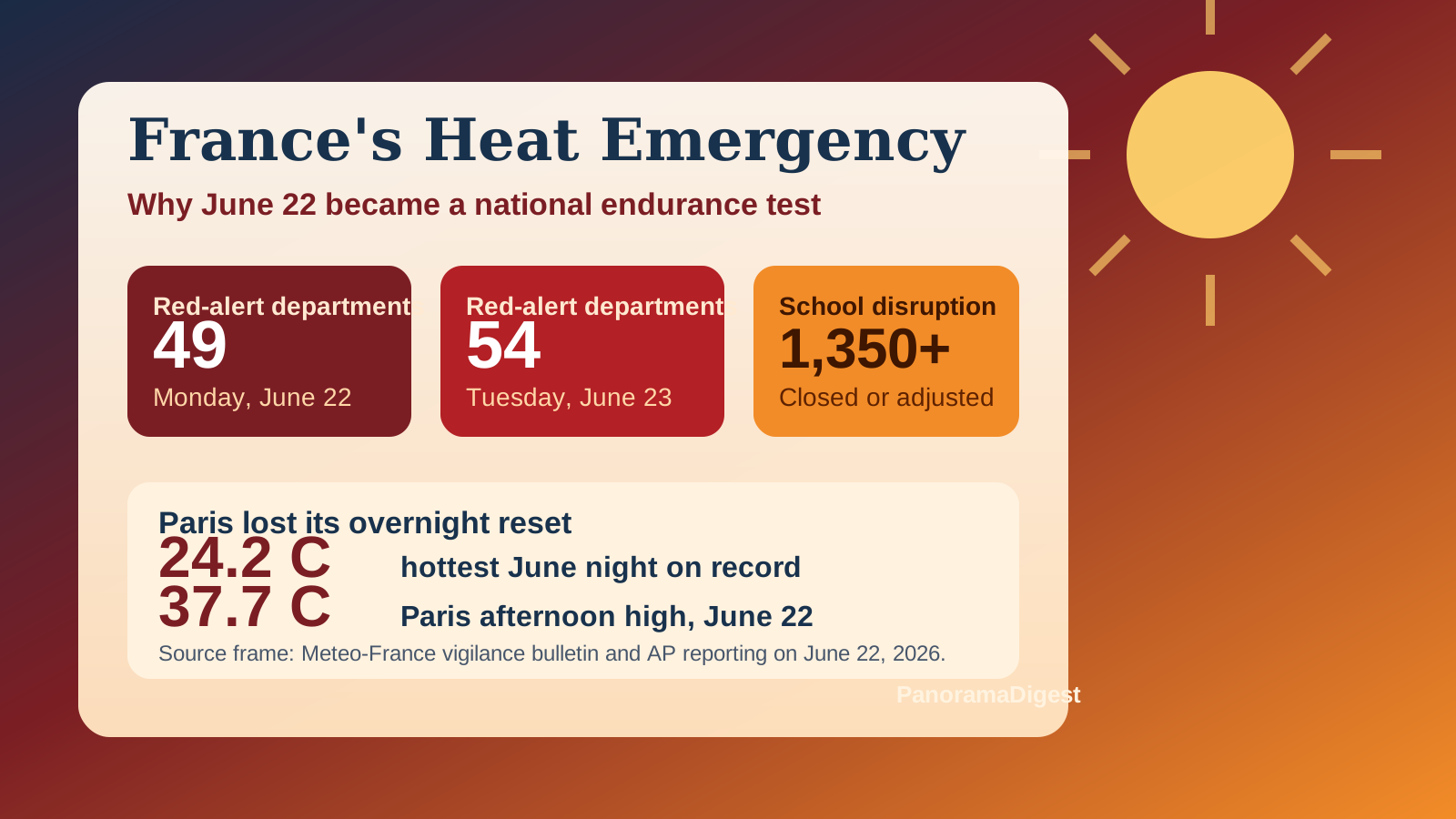
France's heat emergency stopped looking like a weather sidebar on Monday, June 22, 2026. It started to look like a governance test. In the official Meteo-France vigilance bulletin, forecasters said 49 departments were under red heat alert for Monday and 54 for Tuesday. AP reported that daytime highs were pushing above 40 degrees Celsius, Paris logged its hottest June night on record at 24.2 C, and the national weather service did not expect broad relief before Friday. That combination matters because it changes the public question. This is no longer only about how hot France gets. It is about how long modern French life can keep moving when the heat does not release overnight.
That is the deeper world story. AP reported that more than 1,350 schools were closed or shifted their schedules, transport systems were warning commuters to hydrate, and officials were clamping down on public drinking because alcohol and extreme heat are a dangerous mix. Reuters and other current European coverage also describe a mounting death toll tied to drownings and other heat-related incidents. Those details matter, but they are best read as signals of institutional strain. A red-alert heat wave tests not just bodies but routines: schools, rail systems, hospitals, apartment blocks, labor schedules and the political promise that summer disruption can still be treated as an exception rather than an operating condition.
Why the red-alert map matters more than a single temperature record
Heat waves become politically important when they stop being local. Meteo-France's red-alert expansion matters because it shows a large country moving into a synchronized stress event instead of a patchwork inconvenience. The agency's own guidance says red vigilance is reserved for exceptionally dangerous conditions that require absolute caution. In practice, that means local officials are no longer managing only comfort. They are managing continuity.
| June 22 signal | What the source record shows | Why the wider world story matters |
|---|---|---|
| Red-alert expansion | Meteo-France said 49 departments were under red alert on Monday and 54 would be under red alert on Tuesday. | The heat event is broad enough to become a national capacity test, not only a regional one. |
| Record overnight heat in Paris | AP reported the capital did not fall below 24.2 C overnight and later reached 37.7 C on Monday afternoon. | Nighttime heat is what turns a hard day into a cumulative public-health problem. |
| School disruption | AP reported more than 1,350 schools closed or adjusted hours because of the heat. | Education systems become an early indicator of whether ordinary routines are still workable. |
| Limited cooling culture | AP noted France remains a country with comparatively little air-conditioning. | The practical risk is not only meteorological. It is infrastructural and social. |
The older French heat memory is back, but the present problem is different
French officials do not need a lecture on why extreme heat can become deadly. The 2003 heat disaster remains the country's defining warning, and AP noted that Meteo-France itself explicitly compared the current event to that earlier benchmark while saying the duration is still uncertain. But the sharper lesson in 2026 is not simply that heat can kill. It is that the institutional fixes built after 2003 are now being tested by an earlier, broader and more frequent pattern.
That is why this event reads as more than a tragic seasonal spike. France can issue alerts, open cooling spaces and push health advice. The harder question is whether housing, schools, transport and work culture are adapting at the same pace as the weather signal. PanoramaDigest touched a related public-risk problem in its recent analysis of how extreme heat turns ordinary movement into a misread risk boundary. France's version is more urban and more systemic, but the logic is similar: institutions still have to persuade people that heat is not background weather once it begins changing the rules of ordinary life.
Why this is now a Europe story, not just a France story
France is the clearest pressure point in Monday's coverage, but it is not the only one. AP and other current European reporting show the heat building across borders, with Britain issuing rare top-tier heat warnings and other countries bracing for similar spikes. France matters here because it provides one of the best early tests of whether a large European state can convert climate awareness into operational resilience quickly enough to matter during the event itself.
The public temptation is to treat that as a climate debate. It is also an administrative one. How many schools can shift schedules without parents losing work time? How many apartments stay dangerous after sunset? How much rail, hospital and municipal planning still assumes that severe June heat is unusual enough to be improvised around? Those are not abstract environmental questions. They are workload questions for governments and cost questions for households.
- Early June: French health authorities were already warning that the country's first heat episodes of 2026 were driving more emergency-care demand.
- Monday, June 22: Meteo-France placed 49 departments under red heat alert and reported an exceptionally dangerous national pattern.
- Monday, June 22: AP reported Paris posted its hottest June night on record and more than 1,350 schools were disrupted.
- Tuesday, June 23: Meteo-France said the red-alert footprint would rise to 54 departments, showing the stress event was still widening rather than easing.
What to watch before the heat breaks
The cleanest question for readers over the next several days is not whether France posts another headline number. It is where the system shows fatigue first. If overnight temperatures stay elevated, hospitals and caregivers will matter as much as meteorologists. If school disruption spreads further, the heat story becomes a household-economics story as much as a public-health one. And if rail, power or water stresses begin to stack, the event will start to look less like a temporary shock and more like a preview of how Europe will have to function in hotter summers.
The hardest truth in this story is also the simplest one. A society does not adapt to heat when it learns the forecast vocabulary. It adapts when ordinary infrastructure behaves as if the forecast is real. France's June 22 emergency is a test of whether that shift is finally happening at the speed the weather now demands.
Primary sources and reporting used here: Meteo-France's June 22 vigilance bulletin, AP's same-day report from France, and France's ecology ministry guidance on heat-wave protective measures.
Reader Sentiment & Impact Pulse
How do you evaluate the primary outcome of this development?
Select an option to cast your perspective. Responses are anonymous and aggregated in real time.
Key Context & Frequently Asked Questions
France's June 22 heat emergency is no longer just a weather story. Red alerts, school disruptions and record overnight heat are testing whether a country built for temperate summers can operate through a hotter normal. This analysis from PanoramaDigest examines primary documentation, operational implications, and broader institutional impacts across world.
Read Next
Related Stories

Global Oil Prices Surge Following Houthi Drone and Missile Strike on Saudi Capital
Crude futures jumped following a sophisticated attack by Yemen's Houthi movement against targets in Riyadh, injecting fresh geopolitical risk into global energy markets.

Merz Reaffirms Commitment to Economic Reforms Following Defeat in German State Elections
Despite a historic setback for the Christian Democratic Union in regional elections, leader Friedrich Merz pledged to push forward with sweeping fiscal and economic modernization policies across Germany.
Saudi Arabia Intercepts Targeted Houthi Attack on Riyadh Amid Escalating Regional Tensions
Saudi air defense forces neutralized an attempted strike targeting the capital city of Riyadh by Yemen's Houthi rebels, threatening fragile regional peace initiatives and raising security concerns for Gulf energy infrastructure.