The White House Delayed a Voting-Machine Study. The Real Risk Is What That Does to Midterm Trust.
Reuters reported on June 19, 2026, that White House officials delayed the release of a U.S. voting-machine study for months ahead of the November midterms. The technical findings matter, but the sharper political danger is turning election security into a secrecy fight that voters encounter before they see any clear public fix.
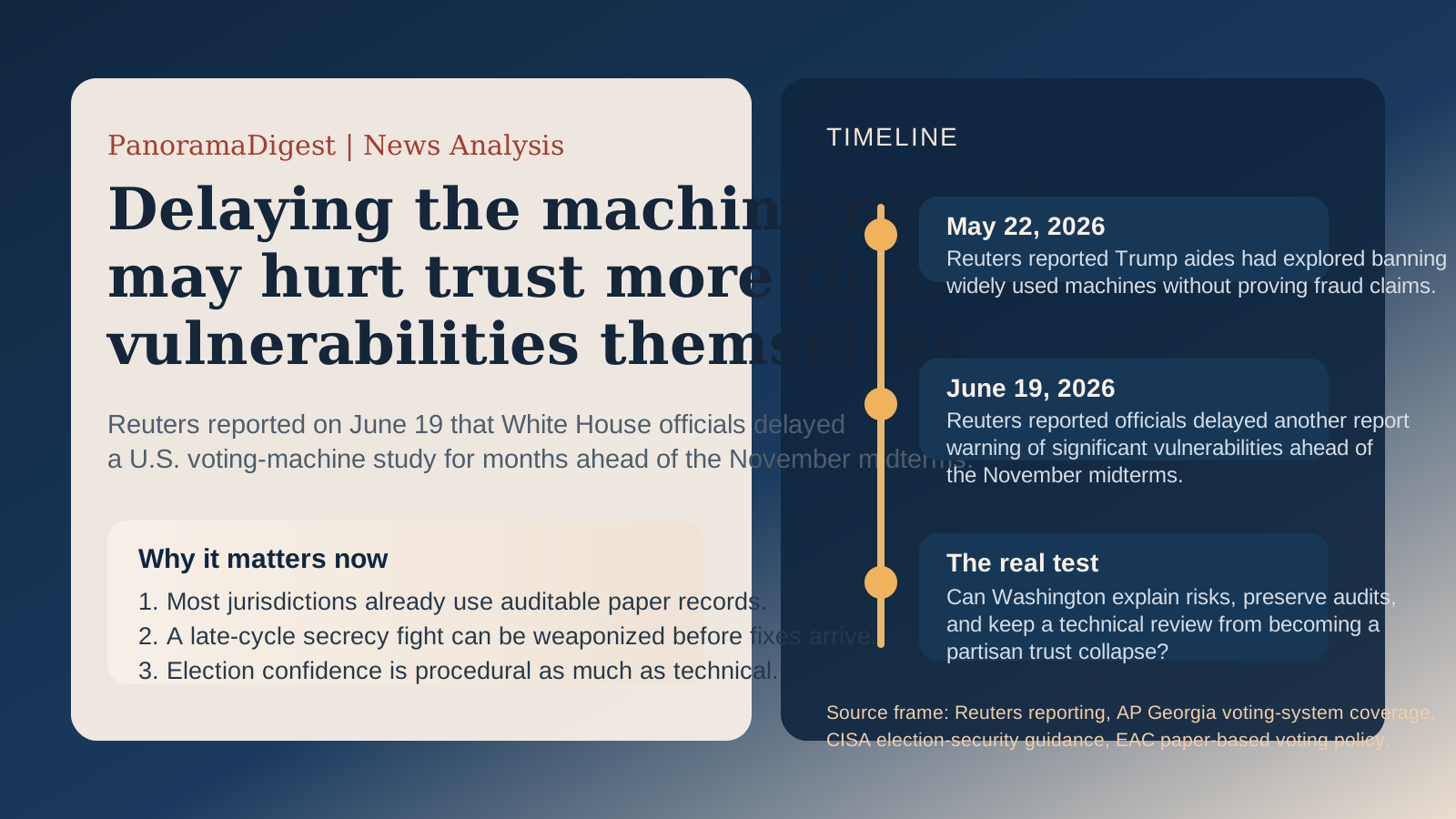
Election administration is built on an unglamorous bargain: machines can fail, software can be tested, procedures can be tightened, and the public can still accept the result if the process is legible and auditable. Reuters reported on Friday, June 19, 2026, that White House officials delayed the release of a U.S. government study describing significant vulnerabilities in voting machines for months ahead of the November midterms, according to three sources familiar with the matter. If that reporting holds, the deepest problem is not merely that a report was delayed. It is that the administration may have moved a technical security question into the far more combustible territory of late-cycle trust management.
That distinction matters because the United States does not run elections on a single national machine network waiting for one federal switch to be flipped. CISA describes election security as both a physical-security and cybersecurity task across the systems and assets that support voting. The U.S. Election Assistance Commission said on May 28, 2025 that more than 98% of jurisdictions already use systems with a paper record of every vote, and it formally backed paper-based, auditable systems. Verified Voting likewise argues that the most resilient systems rely on paper ballots or a voter-verifiable paper record that can be checked in audits. In other words, election security is not a fairy tale about flawless hardware. It is a chain of audits, records, procedures and public explanation.
Why the delay lands in a political system already primed for chaos
This is not the first Reuters report to put voting-machine policy inside the Trump White House's political orbit. On May 22, Reuters reported that Trump officials had previously explored whether the federal government could push aside widely used voting machines, with the effort collapsing after aides failed to produce evidence to justify the move. That background matters because the June 19 delay story does not arrive in a neutral climate. It arrives after months of election-system suspicion, federal pressure on state processes, and public rhetoric that treats voting technology as both a security object and a partisan symbol.
That is exactly why timing matters more than many officials admit. A vulnerability review released with time for explanation, mitigation and public testing can strengthen confidence. A vulnerability review held back until the political season is fully lit can do the opposite, even if the underlying technical advice is sound. Readers do not experience this as a software lifecycle. They experience it as a question of whether the people in charge are being candid about risk before asking them to trust the same system in November.
The Georgia story is a useful warning here. In March, AP reported that Georgia's effort to move away from the voting machines Trump has long attacked ran into a practical problem: late-stage system changes can create their own operational chaos. PanoramaDigest has already followed that theme in its earlier look at Georgia's QR-code ballot deadline. The broader lesson is consistent. Technical flaws are serious, but rushed political handling of election systems can become a second-order risk all by itself.
| What the public can reasonably accept | What starts to corrode trust |
|---|---|
| Officials identify vulnerabilities, explain them clearly and show how audits or paper records limit the danger. | Officials hide or delay the findings until voters assume disclosure is being managed for political convenience. |
| States and counties keep the emphasis on auditable paper trails, testing and post-election review. | National actors talk as if one federal maneuver can rewrite how state-run elections work overnight. |
| Technical reviews are treated as routine maintenance. | Technical reviews become ammunition in a pre-existing campaign over legitimacy. |
The procedural question is now bigger than the hardware question
There is a temptation in stories like this to ask whether the machines are safe, as if the answer can only be yes or no. That is too simple for the real system the country uses. Machines can have vulnerabilities and elections can still be run credibly when there are paper records, chain-of-custody controls, pre-election testing and post-election audits. Machines can also be comparatively well protected and still become vehicles for distrust if officials behave as though disclosure itself is optional.
That is why the strongest public-interest question after the Reuters report is not whether every machine in America is suddenly suspect. It is whether the administration can now explain four things in plain English: what kind of vulnerabilities the report reportedly identified, whether those issues affect tabulation, ballot-marking, ballot-display or adjacent systems, what mitigations states already use, and why release was delayed for months if the findings were serious enough to matter before the midterms. Without that sequence, the political vacuum fills itself.
Readers should also be careful about the opposite mistake: turning every voting-machine flaw into proof that paper-only hand counts are automatically cleaner. The EAC's policy support for paper-based systems is really support for auditable systems, not for procedural chaos. In its Georgia reporting, AP showed why last-minute transitions can be destabilizing. The practical standard is not romance about one method or another. It is whether the system leaves a checkable record and whether officials have enough time to explain and practice the workflow before voters are asked to rely on it.
What to watch before November
Three things now matter more than the headline alone. First, watch for any public release, summary or congressional briefing that clarifies what the delayed study actually found. Second, watch whether federal and state election officials return to the most concrete public confidence language: paper records, testing, audits and chain-of-custody controls. Third, watch whether this episode becomes an excuse for theatrical federal interventions into state-run election machinery rather than a push for transparent remediation.
If the report is eventually published with a clear explanation of what is already being done to limit the risk, the damage from the delay may still be containable. If the study remains vague, becomes a leak war, or is used mainly to keep voters suspicious of every coming result, then the most important vulnerability will no longer sit inside the machines. It will sit inside the public's willingness to believe that election security is still being handled as administration instead of performance.
The United States can survive discovering that election technology needs maintenance. It is far less well equipped to survive leaders treating maintenance as a narrative weapon. That is the real June 19 warning in this story, and it is why the next public explanation matters almost as much as the report itself.
Reader Sentiment & Impact Pulse
How do you evaluate the primary outcome of this development?
Select an option to cast your perspective. Responses are anonymous and aggregated in real time.
Key Context & Frequently Asked Questions
Reuters reported on June 19, 2026, that White House officials delayed the release of a U.S. voting-machine study for months ahead of the November midterms. The technical findings matter, but the sharper political danger is turning election security into a secrecy fight that voters encounter before they see any clear public fix. This analysis from PanoramaDigest examines primary documentation, operational implications, and broader institutional impacts across news.
Read Next
Related Stories

Jensen Huang Reframed AI Doom Debate as National Opportunity in Discourse With Donald Trump
Nvidia CEO Jensen Huang addressed existential AI fears during conversations with Donald Trump, advocating for American leadership and innovation over restrictive regulatory caution.

Old Trails Fire Damage Estimate Reaches 640 Structures in Spokane
Spokane County's preliminary estimate says the Old Trails fire destroyed 640 structures, while evacuation zones remain active across northwest Spokane.

USCIS Can Now Refer Asylum Cases to Immigration Court Without an Interview
A DHS rule effective July 28 lets USCIS send some affirmative asylum applications directly to immigration court. Referral is not a denial, but the interview is no longer guaranteed.