New York's 2042 Winter Olympics Push Is Really a Test of Whether Two Hosts Can Share One Games
Governor Kathy Hochul's new exploratory committee is selling a 2042 Winter Olympics concept built on Lake Placid's venues and New York City's scale. The real question is whether climate advantage, cost discipline and public consent can survive the romance of the pitch.
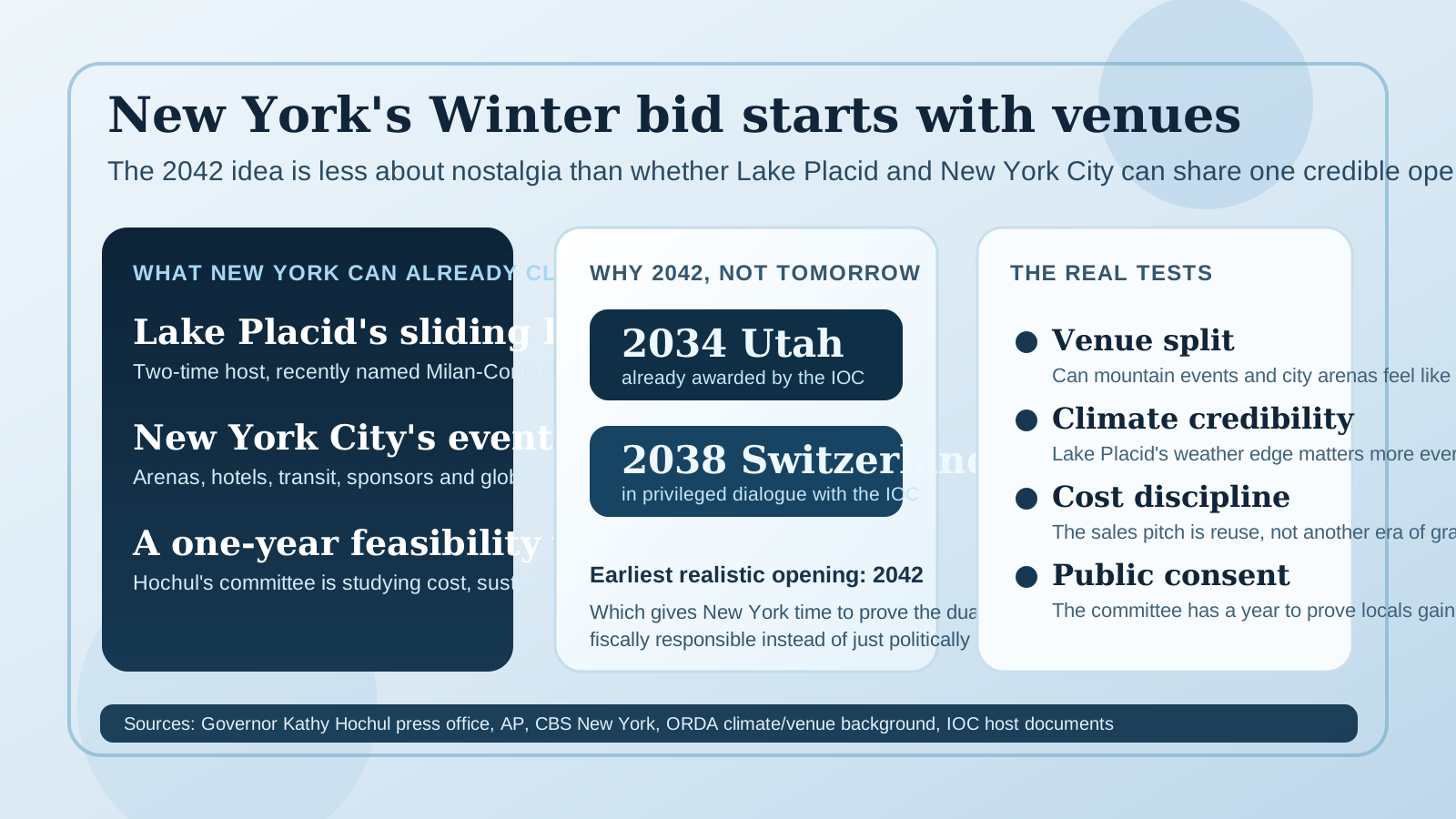
New York's latest Olympic idea becomes interesting only when you strip away the easy nostalgia. Governor Kathy Hochul's June 22 announcement did not launch a formal Winter Games bid. It launched a one-year test of whether Lake Placid's mountain infrastructure and New York City's event economy can be made to look like one coherent operation instead of two places sharing a slogan.
That distinction matters. Lake Placid still carries real Olympic weight: it hosted the Winter Games in 1932 and 1980, and New York State says more than $750 million has gone into modernizing the North Country venues that now anchor the Olympic Regional Development Authority system. New York City, meanwhile, brings the part Lake Placid cannot fake at scale: hotel capacity, international media gravity, sponsor appeal, and arenas that already understand major-event logistics. The committee Hochul announced is effectively being asked to determine whether those strengths add up to a modern Winter Olympics model or merely a compelling press release.
The timing is not accidental, and neither is the caution.
According to Hochul's office, the committee will spend about a year evaluating feasibility, sustainability, fiscal responsibility and community engagement before any state leadership decides whether to move closer to a formal bid. That restraint is more important than the headline. The Olympic movement has spent years trying to persuade governments that future Games can be smaller, more distributed and less financially reckless. New York is clearly trying to present itself as a case study in that model: reuse the mountain assets, borrow the city-stage advantages, and avoid pretending this has to look like a blank-sheet megaproject.
The calendar also forces realism. The IOC has already awarded 2034 to Utah, and Switzerland remains in privileged dialogue for 2038, as the Swiss bid team says in its public FAQ. That makes 2042 the first plausible opening if New York ever decides to move beyond exploration. In practice, that long runway is helpful. It gives the state time to test whether the dual-host story can withstand cost scrutiny, venue mapping, athlete-transport questions and local political patience.
What New York has is real. What it still lacks is a proven operating story.
AP's initial report captured the most seductive version of the pitch: Lake Placid's legacy, the Milan-Cortina example, and the possibility that climate change could make Adirondack winter reliability more valuable over time. That last point is not throwaway context. ORDA's own climate and venue briefing leans on research suggesting Lake Placid is among the former Winter Olympic hosts expected to remain comparatively reliable deeper into mid-century. In an era when Winter Games hosts are quietly being sorted by snow certainty as much as by politics, that is not branding. It is leverage.
But climate advantage does not solve the hardest Olympic question, which is operational identity. If alpine, sliding and Nordic events belong in Lake Placid while indoor spectacles, ceremonies and sponsor hospitality tilt toward New York City, the state still has to prove those pieces feel integrated rather than improvised. Readers should think less about the miracle-on-ice mythology and more about the connective tissue: athlete movement, housing logic, security loads, television flow, venue sequencing, and whether the public can understand why this arrangement is better than simply handing another Games to a compact mountain region.
| Pressure point | Why New York can make the case | Why the committee still matters |
|---|---|---|
| Venue readiness | Lake Placid already has rare winter-sport infrastructure, and New York City has existing arenas and hospitality scale. | The state still has to show how the split would work event by event. |
| Climate reliability | Lake Placid is one of the few legacy hosts still treated as comparatively resilient for future winter sport. | Reliability helps only if it comes with sustainable snowmaking, transport and cost discipline. |
| Political sales pitch | The project can be framed as reuse and regional development, not just spectacle. | New Yorkers and Adirondack communities will still want to know who pays and who benefits. |
| Olympic timing | 2042 is far enough away to build methodically. | Long timelines also give opposition plenty of time to grow if the numbers wobble. |
CBS New York's local coverage usefully framed the committee for what it is: not a triumphal bid launch, but a feasibility exercise. That is the correct posture. The strength of this idea is that New York does not need to argue from scratch that it can host big events. The vulnerability is that the Olympics are not just a stack of separate events. They are an ecosystem of timing, movement, labor and public legitimacy. Milan-Cortina offered one successful dual-host precedent. It did not prove that every politically attractive two-region concept automatically works.
The smart read is that New York is testing a climate-era Olympic theory.
If the Winter Games are drifting toward a future in which reliable snow, existing venues and political flexibility matter more than host-city vanity, then New York has a serious argument. Lake Placid brings the weather and the winter-sport credibility. New York City brings the revenue logic and the broadcast-friendly scale. What the state does not yet have is proof that those assets can be fused without bloating the operation or exhausting local trust.
That is why Hochul's committee matters more than the headline itself. If it produces a disciplined map of costs, venues, public benefits and environmental tradeoffs, New York could become a credible model for how the Winter Olympics survive a harsher climate and a more skeptical public. If it cannot, then this will look like what so many Olympic ideas become in the end: a flattering vision that worked better as symbolism than as planning.
Readers can track the state's public rationale directly through the governor's announcement and the committee background it lays out. For now, the important fact is not that New York wants the Olympic flame back. It is that the state has finally acknowledged the modern requirement: before romance comes operations.
Reader Sentiment & Impact Pulse
How do you evaluate the primary outcome of this development?
Select an option to cast your perspective. Responses are anonymous and aggregated in real time.
Key Context & Frequently Asked Questions
Governor Kathy Hochul's new exploratory committee is selling a 2042 Winter Olympics concept built on Lake Placid's venues and New York City's scale. The real question is whether climate advantage, cost discipline and public consent can survive the romance of the pitch. This analysis from PanoramaDigest examines primary documentation, operational implications, and broader institutional impacts across sports.
Read Next
Related Stories

Mississippi Governor Clarifies National Guard Role Ahead of Ole Miss-LSU Game Amid 'Hurricane Kiffin' Comments
Mississippi Governor Tate Reeves clarified the state's security preparations for the SEC matchup between Ole Miss and LSU, dismissing military crowd control rumors while highlighting coach Lane Kiffin's high-powered football environment.
FIFA Drops $20 Billion World Cup Equity Plan as UEFA Withdraws Confidence in Infantino
FIFA withdrew its $20 billion World Cup equity plan after opposition across three confederations. UEFA's no-confidence statement now shifts the dispute to Infantino's 2027 election.
Nirmal Purja Dies in Broad Peak Avalanche: His Verified Climbing Records
Elite Exped has confirmed that Nirmal Purja died after the Broad Peak avalanche. Here is the verified rescue timeline and the record evidence behind his climbing legacy.