Three Grand Canyon Heat Deaths Show How the Rim Can Hide the Real Risk Below
Three apparent heat-related deaths and a new extreme heat watch are turning Grand Canyon safety into a public-warning test: the rim's milder feel can badly mislead hikers about the furnace waiting below.
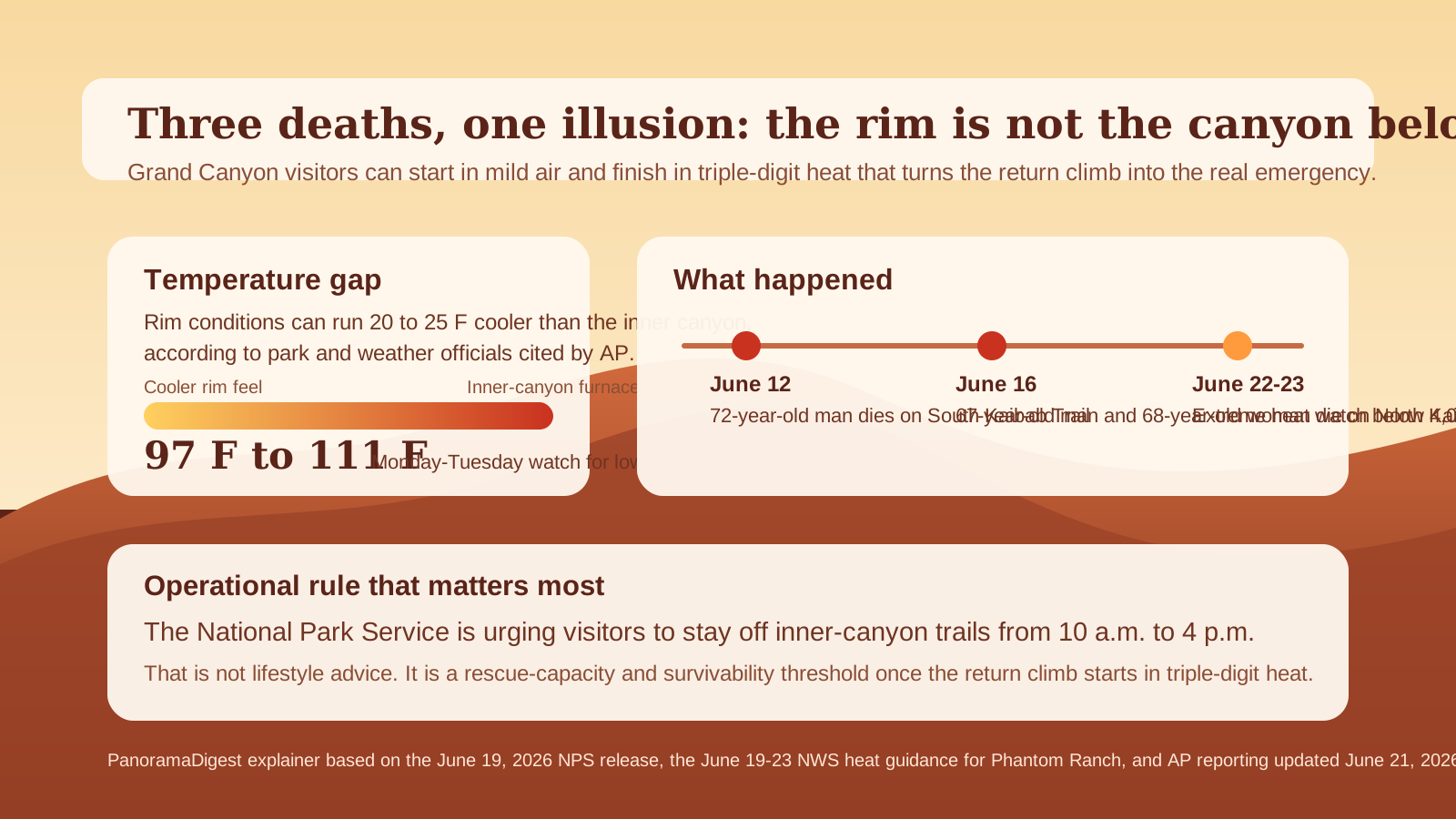
Grand Canyon National Park's June 19 death notice did more than report a tragedy. It clarified a public-safety problem that park visitors keep rediscovering the hard way: the weather people feel at the rim is not the weather that can kill them below.
Grand Canyon National Park — Grand Canyon National Park extreme heat watch post
Grand Canyon National Park's official Instagram post warns that an extreme heat watch will be in effect below 4,000 feet on June 22 and June 23.
According to the National Park Service release dated Friday, June 19, 2026, a 72-year-old man died on June 12 along the South Kaibab Trail, and a 67-year-old man and a 68-year-old woman died on June 16 on the North Kaibab Trail. The park said all three appeared to succumb to heat-related illness. AP's June 21 follow-up added the next layer of urgency: the National Weather Service issued an extreme heat watch for the lower elevations of the canyon from Monday morning through Tuesday evening, with temperatures projected to run from 97 degrees Fahrenheit at Havasupai Gardens to 111 at Phantom Ranch.
If the official Instagram card below does not render in your browser, use the direct Grand Canyon National Park heat-watch post.
The canyon's hardest problem starts with perception
The National Park Service and weather officials are not describing a routine hot-weather inconvenience. They are describing a terrain-and-heat mismatch. AP reported that rim temperatures often run 20 to 25 degrees cooler than what hikers will face at the bottom. That gap matters because it distorts judgment at the moment people are deciding how far to descend, how much water is enough and whether a round trip still feels realistic.
The National Weather Service watch for Phantom Ranch is unusually blunt. It warns that most people will be at risk for heat-related illness without effective cooling or adequate hydration, and it tells day hikers on Bright Angel Trail not to descend farther than 1 1/2 miles from the upper trailhead. That kind of guidance is less about individual toughness than operational reality. Once people are deep enough into the canyon, the return climb becomes a long exposure problem, not a motivational one.
That is why this story is more useful as a warning-design story than as a simple tragedy count. Hikers do not make decisions in a sterile lab. They make them after driving to a scenic overlook, taking photos in relatively cooler air and seeing a trail that starts with gravity on their side. The first half of the experience can feel manageable enough to disguise what the second half will demand.
Why three deaths in four days should change how readers interpret summer hiking advice
The park's June 19 release says inner-canyon temperatures can exceed 109 degrees Fahrenheit in the shade during midday hours. The danger is not abstract. On June 16, the North Kaibab Trail victims were on what the NPS describes, via AP, as the most difficult of the major inner-canyon trails. On June 12, the South Kaibab death came before rescuers could reach the hiker. In all three cases, responders arrived too late.
That sequence matters because it strips away the usual comforting fiction that help will close the gap if something goes wrong. The Grand Canyon is not an urban trail system with easy vehicle access and fast extraction. It is a place where distress can start after the body is already paying for an earlier decision, and where vertical distance can make rescue a race that patients are already losing.
| Heat signal | What the official sources show | Why it changes the reader's decision |
|---|---|---|
| Three deaths on June 12 and June 16 | NPS says all three hikers appeared to succumb to heat-related illness in the inner canyon. | This is not a hypothetical seasonal warning. The risk is active and already producing fatal outcomes. |
| 97 F to 111 F watch below 4,000 feet | NWS says lower elevations from Havasupai Gardens to Phantom Ranch face dangerously hot conditions Monday and Tuesday. | A rim forecast cannot be treated as a full-canyon forecast. |
| 10 a.m. to 4 p.m. stay-off-trails advice | NPS says visitors should avoid inner-canyon trails during the hottest part of the day. | The safest plan is not to push through the warning window; it is to structure the hike so you are not in it. |
| Return climb after descent | AP's reporting, citing park and weather officials, explains that the climb back out compounds strain as temperatures rise. | The most dangerous moment may arrive after the hike seemed manageable at the start. |
The broader test is whether warning language can beat canyon psychology
Public agencies often struggle with a familiar problem: the better they understand a hazard, the more ordinary their warning language can start to sound. "Avoid strenuous hiking" is technically clear, but it can still be read as advice meant for other people. PanoramaDigest made a related point in its recent look at how warning credibility changes behavior during fast-moving storm alerts. The Grand Canyon version is different in terrain but similar in logic. Visitors do not simply underestimate heat. They underestimate how much the canyon's shape lets them postpone the feeling of danger until they are already committed.
That is why the lower-canyon heat watch matters more than the usual seasonal reminder. It supplies a concrete threshold, a time window and named locations. It tells readers that this is not just Arizona being hot again. It is a specific stretch of days when a descent that feels scenic at first can turn into a rescue problem later.
Readers planning a trip this week should probably take the park's guidance more literally than they are used to taking travel advice. If the itinerary depends on being below the rim between late morning and late afternoon, the safer decision is not to pack more grit. It is to change the plan.
The deepest lesson from the last several days is not that the Grand Canyon is unforgiving. Visitors already know that in the abstract. The harder lesson is that the canyon can look forgiving right up to the point where it stops being recoverable. That is exactly why the next heat watch deserves to be treated as a decision boundary, not as background noise.
Reader Sentiment & Impact Pulse
How do you evaluate the primary outcome of this development?
Select an option to cast your perspective. Responses are anonymous and aggregated in real time.
Key Context & Frequently Asked Questions
Three apparent heat-related deaths and a new extreme heat watch are turning Grand Canyon safety into a public-warning test: the rim's milder feel can badly mislead hikers about the furnace waiting below. This analysis from PanoramaDigest examines primary documentation, operational implications, and broader institutional impacts across news.
Read Next
Related Stories

Jury Convicts Driver of Negligent Homicide in Death of Reporter Covering Super Bowl
A Louisiana jury has found a driver guilty of negligent homicide in the fatal striking of a journalist covering Super Bowl events in New Orleans. The verdict brings legal accountability to a tragic case that underscored pedestrian safety challenges during major national entertainment spectacles.

Jensen Huang Reframed AI Doom Debate as National Opportunity in Discourse With Donald Trump
Nvidia CEO Jensen Huang addressed existential AI fears during conversations with Donald Trump, advocating for American leadership and innovation over restrictive regulatory caution.
Old Trails Fire Damage Estimate Reaches 640 Structures in Spokane
Spokane County's preliminary estimate says the Old Trails fire destroyed 640 structures, while evacuation zones remain active across northwest Spokane.